A room full of people and one stack of coloring pages can go two ways. Either everyone settles in and the noise drops to a happy hum, or you run out of pages by the second table and spend the hour hunting for a blue crayon. The difference is planning, and it takes less than you think.
This guide is for teachers, librarians, youth leaders, activity coordinators and anyone running a party or event. You will find out where free printable coloring pages for groups come from (and what the small print allows), how many to print, how to set up the room, and simple activities that work for preschoolers, adults and seniors alike.
Quick picks: coloring sets that allow group printing
| Product | Best for | Price | Link |
|---|---|---|---|
| Snug Hours Cozy Coloring Book | Adult wellness groups and care homes | $5.99 | View |
| Hop to Ten Color by Number | Preschool and kindergarten classes | $4.49 | View |
| Letter Parade Alphabet Coloring Book | Letter-of-the-week in class | $3.99 | View |
| Porchlight Memories Large Print Book | Senior centers and memory care | $8.99 | View |
Read the license before you print 30 copies
This is the part most people skip, and it matters more for groups than for anyone else. Most coloring pages, free or paid, come with a personal use license. That usually means you can print as many as you like for yourself and your household. It does not always cover a class of 25 or a library event for 40.
Before you print, look for words like “classroom”, “teacher”, “group” or “care setting” in the terms. Some sets say a single teacher may print for their own class. Others cover one care home. A few free pages are shared openly for any group. If the terms say nothing, assume home use only and pick something else.
Good places to look for free group-friendly pages:
- Your library. Many libraries print and share activity sheets for their own story times, and staff are often happy to point you to sources.
- Museum and park education pages. These are usually made to be printed for school visits.
- Teacher resource sites. Free samples often include a classroom use line.
- Draw your own. A simple outline traced from a photo you took yourself belongs to you.
One more thing to check: whether you may hand finished pages out to take home. With most licenses that is fine, because the printed page is being used, not shared as a file. What usually is not allowed is emailing the PDF to parents or uploading it to a class website. Print it, hand it over, and keep the file on your own computer.
Free pages shine for a single session. When you run a weekly group, a set with a clear group or classroom license saves you the worry each week.
How many pages to print: a worked example
Running out feels awful. Printing triple wastes paper. Here is a simple rule that works for most groups: plan 1.5 pages per person, plus 10% spare.
Say you have a first-grade class of 28 children and a 40-minute session.
- 28 children x 1.5 pages = 42 pages
- Plus 10% for spills, rips and “I want to start again” = 46 pages
- Offer 3 designs so children have a choice: about 15 to 16 of each
Fast finishers take a second page. Slow, careful colorers stay on one. Nobody is left empty-handed. For a two-hour drop-in event, raise it to 2 pages per expected guest, since people come and go and many take a page home.
Paper count matters too. A ream holds 500 sheets, so 46 pages barely dents it. Ink is the bigger cost. Pages with lots of solid black areas drain a cartridge quickly, so pick outline-only designs for big runs, or ask your school office whether the copier is cheaper per page than the classroom printer. It usually is.
Setting up the room so it runs itself
A group session works best when nobody has to ask for anything. Put the effort in before people arrive and the hour looks after itself.
Supply caddies
Give each table its own cup or tray of supplies: about 12 crayons or pencils for every 4 people, one sharpener, and a few markers if the paper is thick enough. Shared supplies spread across a big table cause more arguments than anything else in the room.
The page station
Lay the designs out on one side table, one pile per design, with a sample colored page on top of each pile. People choose faster when they can see what a finished page might look like.
A simple timeline for a 45-minute session
- Minutes 0 to 5: welcome, write names on pages, choose a design.
- Minutes 5 to 35: coloring. Soft music helps. So does a quiet “ten minutes left” at the 25-minute mark.
- Minutes 35 to 42: a short share. Hold up pages, or lay them on a table and walk past them like a gallery.
- Minutes 42 to 45: tidy up. Pencils back in caddies, pages in folders or bags.
That last gallery walk is often the best moment. Seeing 20 different versions of the same page, each one colored its own way, makes people smile. Even shy colorers feel quietly proud.
Preschool and kindergarten groups
Little ones do best with big spaces, thick lines and a clear task. Color-by-number pages are perfect for a group of 4- and 5-year-olds because every child knows exactly what to do next. Find the number, find the crayon, fill the space. The room goes quiet in a way that every early-years teacher will recognize.
Keep sessions short, around 15 to 20 minutes for this age, and sit the children four to a table with one shared caddy in the middle.
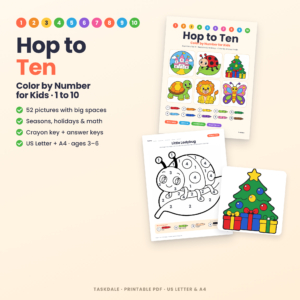
Hop to Ten Color by Number
Price: $4.49 | Best for: pre-K and kindergarten teachers
Hop to Ten has 52 pictures that use only the numbers 1 to 10, with big spaces, big numbers and a crayon key with simple color names. It moves from 1 to 5, to 6 to 10, to mixed numbers and simple sums, with seasonal and holiday pages and full-color answer keys. A one-teacher classroom licence is included, so you can print copies for your own class. Start the whole group on a 1 to 5 page so everyone finishes.
For more screen-free ideas with this age group, our post on printable coloring books for kids has a few that suit busy classrooms too.
A letter-of-the-week routine for small groups
Coloring is also a gentle way into early reading. One letter a week, one page each, and by the end of the school year a class has colored and traced the whole alphabet. Children love seeing their stack of letters grow, and parents love the folder that comes home in June.
The routine is simple. Monday, introduce the letter and its sound. Wednesday, color the page together. Friday, trace the letter and add something else that starts with that sound.
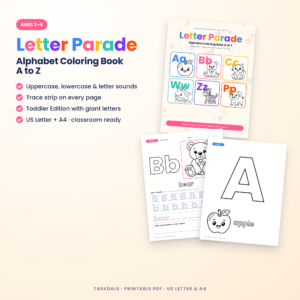
Letter Parade Alphabet Coloring Book
Price: $3.99 | Best for: preschool letter-of-the-week classes
Each page has a big uppercase and lowercase letter to color, a picture that starts with that sound (apple, bear, cat and so on), the word, and three trace rows on handwriting lines. A separate Toddler Edition gives each letter its own extra-large page for ages 2 to 4. It prints on US Letter or A4, has name lines, and includes a one-teacher classroom licence. Print the letter A page for everyone on your first Monday.
Calm coloring sessions for adult groups
Adults in a group often feel a little silly for the first five minutes. Then the pencils start moving and the room gets quiet in the nicest way. Workplace wellness hours, therapy groups, book clubs and church circles all use coloring this way.
Choose designs that can be finished in 30 to 45 minutes. Bold, cozy scenes work far better than fine-detail mandalas for a group, because nobody wants to leave with a page that is 10% done. Pair the session with a simple prompt, like the breathing and focus ideas in our mindfulness coloring pages for adults guide.
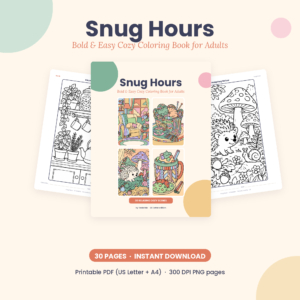
Snug Hours Cozy Coloring Book
Price: $5.99 | Best for: wellness groups and calm adult sessions
Snug Hours has 30 cozy scenes with thick outlines and large shapes, from a reading nook and a little bakery to a rainy window seat and a snowy cabin. You get US Letter and A4 PDFs plus 300 DPI PNG pages. The license lets teachers, care homes and therapists print free copies for their own groups. Lay out three scenes at the page station and let each person choose.
A small touch that adults enjoy: a pot of tea or coffee on a side table and a “Colored by” line signed at the end. It turns a coloring sheet into something they made.
Senior centers and memory care groups
For older adults, the page itself is often less important than the talk it sparks. A picture of a 1950s diner or a pie cooling on a windowsill can start a story that fills the whole session. Activity coordinators in assisted living know this well: the best groups are the ones where nobody notices the time.
Pace the session gently. Many coordinators find that 8 to 10 residents around one long table is about right, with a staff member or volunteer sitting in the middle to keep the talk going. Hand out pencils with chunky barrels or foam grips for anyone with stiff fingers, and keep the room bright. Thirty minutes of coloring and twenty of chat is a perfectly good hour.
Look for large shapes, thick black outlines and big print. Many residents have low vision, arthritis or less steady hands, so bold lines are kinder than detail.
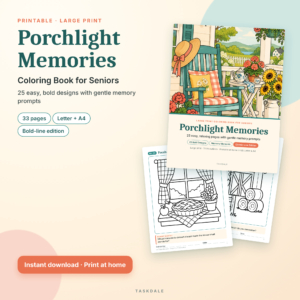
Porchlight Memories Large Print Book
Price: $8.99 | Best for: activity coordinators and family visits
Porchlight Memories has 25 nostalgic pages, each with a large-print Memory Moment question under the picture, such as which song takes you back in time. Every picture comes in Classic-Line and Bold-Line editions, with a Family and Caregiver Guide full of group activity ideas. The license covers printing for yourself, your family, or one care setting. Start the group with the front porch page and its question.
Group activity ideas that go beyond one page each
Once a group is comfortable, try something shared. These work for kids, adults and mixed ages:
- The collaborative mural. Print one design across four or nine sheets, give each person one piece, then tape them together on the wall at the end.
- Pass the page. Everyone colors for five minutes, then passes their page to the left. After four rounds each page has four colorists. Lots of laughs.
- Same page, different palettes. Everyone colors the same design with a different set of three colors. Lay them side by side for the gallery walk.
- Color and caption. Each person writes one line under their finished page: a name for the character, a title, a memory.
- Party table cards. At a birthday or wedding, color the page, then fold it into a card for the guest of honor.
A library story hour for 15 kids can use the mural idea in 30 minutes and leave a big, bright poster on the wall for the next week. The kids will drag their parents over to find their square.
Mistakes that slow a group down
- One design for everyone. Offer at least three. Choice gets people started faster.
- Too much detail. A page that cannot be finished in the session leaves people deflated.
- No names on pages. Write names first, before a single crayon touches paper.
- Markers on thin paper. Bleed-through marks the table and the next sheet. Stick to crayons and pencils on plain copy paper.
- Forgetting the early finisher. Every group has one person done in eight minutes. Keep a small pile of blank paper for free drawing, or a second, harder page, so they stay busy instead of drifting.
- Skipping the tidy-up time. Five minutes at the end saves twenty minutes of picking crayons off the floor after everyone leaves.
- Printing at “Fit to page”. It shrinks lines and can cut edges. Use 100% or “Actual size”.
Frequently asked questions
Can teachers print free coloring pages for the whole class?
Only if the terms allow it. Look for “classroom use” or “one teacher” in the license. If the page says personal use only, it is meant for home.
How many coloring pages should I print for a group?
About 1.5 pages per person plus 10% spare for a single session. For a drop-in event, plan 2 per expected guest.
What coloring pages work for mixed-age groups?
Bold, simple scenes with a few small details. Younger kids color the big shapes, older kids and adults add the detail.
How long should a group coloring session last?
15 to 20 minutes for preschoolers, 30 to 45 minutes for older kids and adults, and up to an hour for relaxed adult or senior groups.
Are there coloring activities for seniors in groups?
Yes. Large-print pages with thick outlines and a conversation prompt work well in senior centers and memory care.
Your next step
Count the people in your next session, multiply by 1.5, and add 10%. Then choose three designs and set up one supply caddy per table. If you run a calm adult or wellness group, start with the Snug Hours cozy coloring book, since its license covers your own group.