Some children learn the alphabet from apples and balls. Others learn it from Ankylosaurus and Brachiosaurus, and they will correct you loudly if you mix them up. If you live with the second kind, a dinosaur coloring book that runs from A to Z is one of the best tools you can put on the kitchen table.
This guide is for parents, grandparents and teachers of dinosaur-mad kids aged about 3 to 10. You will find out what makes an alphabet dinosaur book worth printing, how to say the big names without stumbling, a 26-day plan that turns one letter a day into a small adventure, and ways to stretch coloring into real paleontology play.
Along the way you will see a printable A to Z dinosaur book on Taskdale, plus two other sets that fill rainy afternoons between letters.
Quick picks for young paleontologists
| Product | Best for | Price | Link |
|---|---|---|---|
| Roar to Z Dinosaur Coloring Book A to Z with Names and Facts | A real dinosaur for every letter, with facts | $4.49 | View |
| Pretend Play Coloring Book | Kids who act out jobs and adventures | $2.99 | View |
| Indoor Activities Coloring Book Adventure | Rainy days between dinosaur letters | $2.99 | View |
What makes an A to Z dinosaur book worth printing
Plenty of dinosaur pages online show the same three animals over and over: a T. rex, a long-neck and something with spikes. Fine for an afternoon. Not enough for a child who already knows the difference between a Stegosaurus and an Ankylosaurus.
A good alphabet book does three things a pile of random pages cannot.
- Real names for every letter. Not “X is for Xylophone Dinosaur”. A real animal that lived.
- Help with the hard words. A say-it guide stops grown-ups mumbling through Parasaurolophus and hoping nobody notices.
- Facts that are checked. Kids repeat what they learn. If the book says T. rex lived in Africa, that error gets shared at school.
Add pages for different ages and you get a book that lasts a whole year rather than a weekend.
Inside an A to Z dinosaur book, letter by letter
The Taskdale book built around this idea is Roar to Z. Each letter has its own dinosaur or prehistoric reptile, its name in big outline letters to color, a say-it guide, what the name means and three short facts. A few of the 26 give a feel for the range: Ankylosaurus, Diplodocus, Iguanodon, Maiasaura, Stegosaurus, Tyrannosaurus rex, Velociraptor and Zuniceratops.
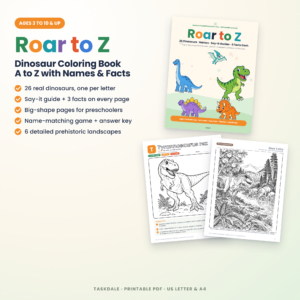
Roar to Z Dinosaur Coloring Book
Price: $4.49 | Best for: Dinosaur fans aged 3 to 10
A 58-page printable PDF in US Letter and A4 with 26 A to Z dinosaur pages, each with a say-it guide, name meaning and three facts, plus 8 big-shape pages for preschoolers, a name-matching game, word search, maze, 6 detailed prehistoric landscapes, 26 cut-out fact cards, a Dino Passport and a Junior Paleontologist certificate. Open the clickable ABC chart first and let your child pick the letter of their own name.
That last tip matters more than it sounds. A child called Maya who starts with Maiasaura, the “good mother lizard”, owns the book from page one.
The tricky letters, and why they are fun
Every alphabet has awkward corners. Dinosaurs are no exception, and the odd letters are often where kids learn the most.
Q is for a flying reptile
Quetzalcoatlus was a giant flying reptile, a pterosaur, not a dinosaur. A good book labels this clearly. It is a perfect moment to teach that “prehistoric” and “dinosaur” are not the same word.
X is for Xenoceratops
A horned dinosaur whose name means something like “alien horned face”. Children love that a dinosaur has “alien” in its name.
U is for Utahraptor
Named after Utah, where it was found. A neat way to show that many dinosaur names come from places.
F is for Fruitadens
A very small dinosaur, around the size of a cat. Kids are often surprised that not every dinosaur was huge, and that surprise sticks.
How to say the big names
Long dinosaur names look scary, but most are built from a few repeating Greek and Latin chunks. Learn the chunks and the names unlock.
| Chunk | Means | Example |
|---|---|---|
| saurus or saura | lizard | Stegosaurus, “roof lizard” |
| ceratops | horned face | Triceratops, “three-horned face” |
| raptor | thief or plunderer | Velociraptor, “swift thief” |
| tyranno | tyrant | Tyrannosaurus rex, “tyrant lizard king” |
| brachio | arm | Brachiosaurus, “arm lizard” |
Then clap the syllables. Steg-o-saur-us is four claps. Par-a-saur-ol-o-phus is six. Once a child can clap a name, they can say it, and the pride on a five-year-old’s face when they nail Pachycephalosaurus is worth the whole book.
A 26-day dinosaur alphabet plan
One letter a day, five days a week, takes just over five weeks. That pace keeps it fresh. Here is a simple layout.
| Week | Letters | Extra activity |
|---|---|---|
| 1 | A to E | Make a dinosaur name wall and add each colored page |
| 2 | F to J | Sort dinosaurs into plant eaters and meat eaters |
| 3 | K to O | Measure out a dinosaur’s length in the garden with string |
| 4 | P to T | Play the name-matching game and the word search |
| 5 | U to Z | Color a prehistoric landscape together |
| 6 | Review | Award the Junior Paleontologist certificate |
Each day follows the same short rhythm: read the name together, clap it out, read the three facts, then color. Fifteen to twenty minutes in total. Homeschool families can slot this into a morning block; our homeschool schedule examples show where a short themed activity fits in a real day.
Teachers planning a dinosaur week rather than a full alphabet can pick five letters and build around them. The preschool lesson plan template guide walks through planning a themed week step by step.
What week one looks like in a real house
Plans look neat on paper. Here is how the first five days tend to go with a six-year-old and a younger sibling tagging along.
- Monday, A for Ankylosaurus. Read the name, clap it (five claps), read the facts. The six-year-old colors the armor plates in three shades of green. The three-year-old colors a big-shape T. rex instead, because he refuses anything else. Both pages go on the wall.
- Tuesday, B for Brachiosaurus. Talk about why a long neck helps reach tall trees. Stand on tiptoe and stretch. Color.
- Wednesday, C for Carnotaurus. The horns above its eyes get a lot of attention. Someone draws extra horns. Allowed.
- Thursday, D for Diplodocus. Lay a ball of string down the hall to show how long a tail can be. The string runs out. Gasps.
- Friday, E for Edmontosaurus. Quick review of the week’s five names. Each correct answer earns a sticker on the Dino Passport.
Nothing fancy. By Friday the name wall has five colored pages, the six-year-old can say all five names, and the three-year-old has roared at every single one. That is a good week.
Turning coloring into paleontology play
Young paleontologists want to dig, not just color. A few cheap additions turn the book into a full role-play kit.
- A dig box. A plastic tub of sand or dry rice with small toy bones or pasta “fossils” hidden inside. Add a paintbrush and a spoon.
- A field notebook. Staple a few blank pages together. After each dig, the child draws what they found and labels it.
- A magnifying glass. Any cheap one. It turns a leaf on a walk into a specimen.
- A museum shelf. One shelf where colored pages and “finds” go on display with handwritten labels.
Some kids love playing the scientist as much as the subject. If your child is forever acting out jobs, from vet to chef to astronaut, a book of role-play scenes gives them more characters to step into between dinosaur letters.
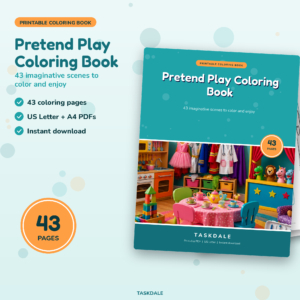
Pretend Play Coloring Book
Price: $2.99 | Best for: Kids who love role play
43 detailed scenes built around jobs and adventures, such as a chef in a toy kitchen, a firefighter beside a red truck, an astronaut at a control panel and a vet with a puppy. Each page is packed with props, which gives plenty to color and plenty to talk about. Print one job scene, ask your child who the character is and what happens next, then let them act it out.
Matching pages to your child’s age
Ages 3 to 5
Big shapes, thick outlines, one dinosaur per page. Start with the famous ones: T. rex, Triceratops, Stegosaurus. Read the facts aloud and keep it short. A 3-year-old will scribble, roar and move on, which counts as success.
Ages 5 to 8
The sweet spot for an A to Z book. Children can read short names, count facts and start to compare animals. “Which one was bigger?” becomes a favorite question.
Ages 9 and up
Older kids want detail and real science. Detailed prehistoric landscapes, with rivers, ferns and several animals in one scene, suit them well. So do fact cards they can quiz you with.
What color were dinosaurs, really?
This question always comes up. For most dinosaurs, nobody knows. Skin color rarely survives in fossils. For a few small feathered dinosaurs, scientists have found traces of pigment structures and made careful guesses about their patterns, but those are the exceptions.
That is good news for coloring. It means a purple Stegosaurus with orange plates is not wrong. Tell your child that real scientists are still working it out, and their guess counts as much as anyone’s. That freedom takes the pressure off a child who worries about getting it “right”.
A dinosaur alphabet birthday table
The A to Z idea works brilliantly at a party. Print one dinosaur page per guest, matched to the first letter of each child’s name. Sam gets Stegosaurus. Tom gets Tyrannosaurus rex. Ivy gets Iguanodon. Write each name at the top before the party so nobody fights over the T. rex.
Lay the pages on a long table with tubs of crayons, and add a sign that says “Find your dinosaur”. Children hunt for their own letter, which keeps the first ten minutes busy while parents are still arriving. Every guest goes home with a page that is unmistakably theirs, and the birthday child gets to award a printed certificate to the best roar.
Rainy days and breaks between letters
Even the keenest dinosaur fan needs a change sometimes, especially on day four of a wet half-term. Mixing in a different theme keeps the A to Z plan from going stale, and you can return to the next letter fresh the following morning.
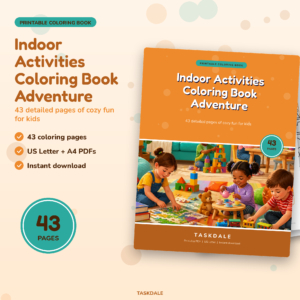
Indoor Activities Coloring Book Adventure
Price: $2.99 | Best for: Rainy days and sick days at home
43 detailed scenes of things kids really do indoors: building a blanket fort, baking cookies, reading in a cozy corner and finishing a jigsaw. Each page shows one busy, friendly room, so younger children can fill the big shapes while older kids spend half an hour on the details. Print a blanket fort page and then build the real thing.
For more free and printable options to keep on hand, our roundup of coloring book PDFs you can print tonight covers good free sources too.
Printing and organizing your dinosaur book
- Print at actual size so the name letters and fact text stay readable.
- Use a ring binder with 26 alphabet tabs. Finished pages go in order, and the binder becomes a dinosaur encyclopedia your child made.
- Print fact cards on cardstock so they survive being shuffled and quizzed.
- Laminate one landscape for dry-erase coloring on car journeys.
- Print spares of the favorite letters. T. rex will be requested more than once.
Mistakes that slow a young paleontologist down
- Racing through all 26 at once. The magic is in the daily ritual. Spread it out.
- Skipping the names. If you only color, half the learning is lost. Say the name every time.
- Correcting colors. Nobody can prove your child’s green Triceratops wrong.
- Calling every prehistoric animal a dinosaur. Flying pterosaurs and swimming reptiles were relatives, not dinosaurs. Kids love knowing the difference.
Frequently asked questions
What age is an A to Z dinosaur coloring book for?
Roughly 3 to 10. Younger children color big-shape pages while you read the facts. Older kids read and quiz you.
Is there a real dinosaur for every letter of the alphabet?
Yes, though a few letters stretch the list. Q is usually Quetzalcoatlus, which was a flying reptile rather than a dinosaur.
How do you pronounce dinosaur names?
Break them into chunks and clap the syllables. Most names reuse parts such as saurus (lizard) and ceratops (horned face).
Can I use a dinosaur coloring book for homeschool?
Yes. One letter a day with the facts read aloud makes a gentle science and literacy block of 15 to 20 minutes.
What colors should dinosaurs be?
Any color. Scientists know the likely colors of only a handful of small feathered dinosaurs, so kids can choose freely.
How long does it take to finish an A to Z dinosaur book?
At one letter per school day, about five to six weeks including a review week.
Your next step
Tomorrow morning, ask your child which letter their name starts with and find that dinosaur. Clap the name together, read the three facts, then color. That is day one of your 26-day plan, and the Roar to Z Dinosaur Coloring Book A to Z has every letter ready to print.