A coloring page becomes a lesson the moment you ask one good question about it. Why is this wizard stirring a tornado in a teacup? What does that gear do? Which planet is that octopus juggling? Kids color, then they think, talk and write. That is the whole method.
This guide is for classroom teachers, homeschool parents and tutors who want printable coloring pages for classroom activities and homeschool lessons that do more than fill time. You will find a subject-by-subject plan, ready-to-use follow-up tasks for science, STEM, math and writing, a weekly rhythm for families teaching several ages at once, and the practical side of copying a class set. Four printable books on Taskdale fit neatly into these lessons, and we show where each one slots in.
Quick picks for lesson-ready coloring
| Product | Best for | Price | Link |
|---|---|---|---|
| Cloud Casters Printable Coloring Book | Weather units and creative writing | $3.99 | View |
| Gearhead Zoo Printable Coloring Book | Simple machines and STEM talk | $3.99 | View |
| Orbit Pals Printable Coloring Book | Space and solar system units | $3.99 | View |
| Hop to Ten Color by Number for Kids | Number sense and early math, ages 3 to 6 | $4.49 | View |
Why coloring earns a place in real lessons
Coloring has a reputation as a time filler. Used well, it does far more. Fine motor control improves every time a child steers a pencil into a small space, and that same control shows up later in handwriting. Children also look at a picture more closely when they have to color it. A child who has shaded every bolt on a robot rhino has noticed the bolts.
There is a calmer benefit too. A class of 28 coming in from a windy lunch break can take ten minutes to settle. Put a page and a question on each desk and the room drops to a hum. You get your lesson back faster, and the quiet kids get a moment to think before the loud ones start answering.
The key is the follow-up. A coloring page with no question is a quiet activity. A coloring page with a question is the start of a lesson.
Matching pages to subjects
Here is a quick map you can pin above your desk.
| Subject | Page idea | Follow-up task |
|---|---|---|
| Science: weather | Storms, rainbows, snow, wind | Label the weather type and describe where it happens |
| Science: space | Planets, comets, moons, stars | Write two true facts about the planet in the picture |
| STEM | Machines, gears, springs, wheels | Circle each simple machine and say what it does |
| Math | Color by number, color by answer | Check work with the answer key |
| Writing | Any funny character page | Write a caption, a list of adjectives or a short story |
| Art | Any page | Use only warm colors, or only three colors, and explain why |
Keep the follow-up short. Five minutes of thinking after fifteen minutes of coloring is a good ratio for children up to about ten.
Science: a weather lesson built on one page
Weather is a favorite unit from kindergarten through about fourth grade, and it is very visual. Here is a 40-minute lesson for a class of eight-year-olds.
- Hook (5 minutes): show a page of a wizard brewing a storm. Ask what kind of weather he is making.
- Coloring (15 minutes): children color the page. Rule: the sky colors must match the weather.
- Talk (10 minutes): pairs explain their sky. Why grey? Why the purple streaks?
- Write (10 minutes): three sentences on what this weather is like in real life and how people prepare for it.
Kids remember a thunderstorm better when they have spent a quarter of an hour giving it color. And the whimsy helps. A snail racing lightning is far more memorable than a diagram of a cloud.
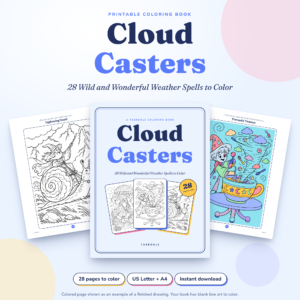
Cloud Casters Printable Coloring Book
Price: $3.99 | Best for: Weather units for ages 7 and up
Cloud Casters has 28 full-page drawings of weather wizards at work, from a tornado stirred in a teacup to a snail racing lightning. You get US Letter and A4 PDFs, a single-page PNG pack for reprinting one picture and an illustrated user guide with print settings. Pick one page per weather type and build a five-day unit around them.
STEM: simple machines with robot animals
Gears, levers, wheels, springs and pulleys sound dry on a worksheet. Put them inside a clockwork lion and children lean in. Machine-themed coloring pages are a natural way to start a simple machines unit.
Try this with a group of nine-year-olds. Hand out a robot animal page. Before coloring, give them five minutes to circle every gear in red, every wheel in blue and every spring in green. Then they color the rest freely. Afterward, ask: if this gear turns clockwise, which way does the next one turn? Some children will grab two pencils and try it with their hands. That is exactly the kind of thinking you want.
For older students, add a design task. On the back of the page, draw an invention of your own made from three simple machines. Label each part.
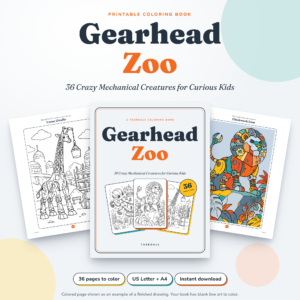
Gearhead Zoo Printable Coloring Book
Price: $3.99 | Best for: STEM lessons and machine-mad kids
Gearhead Zoo has 36 full-page drawings of animals built from gears, rockets, springs and wheels, including a clockwork lion and an octopus that doubles as a lighthouse. It comes as US Letter and A4 PDFs plus a PNG pack and a user guide. The pages have plenty of small bolts and panels, so they suit children from about seven up.
Space: planets, moons and a little humor
Space units run in most elementary classrooms, and children arrive already full of questions. A funny space coloring page gives them a way in that does not feel like a textbook.
After coloring an animal floating near a ringed planet, ask: which real planet has rings like this? What would happen to a capybara on the moon? Children who giggle at the picture will happily look up the answer. Pair each page with a fact card and let children copy one true fact under the picture. In a week, the class has a wall of colorful, accurate space facts. Proud faces all round.
Homeschool families can turn this into a mini project. Color one page a day for a week, add a fact each day, then staple the pages into a booklet. Grandparents love getting it in the post.
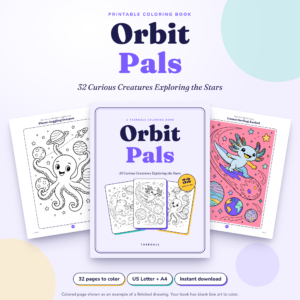
Orbit Pals Printable Coloring Book
Price: $3.99 | Best for: Space units and young astronomers
Orbit Pals has 32 drawings of animals loose in outer space, from an axolotl surfing a comet to an octopus juggling planets. It includes US Letter and A4 PDFs, a single-page PNG pack and a 9-page user guide. Print one page per child at the start of a space unit and add a real fact card to each.
Math: color by number and color by answer
For younger learners, math and coloring fit together beautifully. Color by number builds number recognition. Color by answer adds simple sums. The picture is the answer key, which makes checking quick and satisfying.
In a pre-K or kindergarten room, use a color by number page as morning work. Children find the number, match it to the crayon key and color. Early finishers can trace number words on the back. By the end of a week, a child who struggled to tell 6 from 9 often gets it right without thinking.
For homeschool, these pages work as a calm start to math time. One page, five minutes of practice, then on to the main lesson.
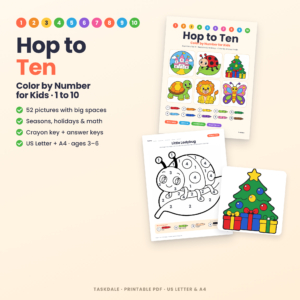
Hop to Ten Color by Number for Kids
Price: $4.49 | Best for: Pre-K to kindergarten math
Hop to Ten has 52 color by number pictures using only the numbers 1 to 10, organized from easy to harder: numbers 1 to 5, numbers 6 to 10, mixed numbers, seasons and holidays, and color by answer pages with sums to 10 and take-away within 10. Full-color answer keys and a one-teacher classroom licence are included. Start the class on Part 1 in the first week.
Writing and literacy extensions
Any character page can become a writing prompt. This is where funny, original art really pays off, because children have something to say about it.
- Ages 5 to 6: write one word that describes the character. Add a sentence if you can.
- Ages 7 to 8: write three adjectives and one sentence about what the character is doing.
- Ages 9 to 10: write a short story with a beginning, a problem and an ending.
- Ages 11 and up: write a news report about the event in the picture. Weather wizard floods village!
Display the pages with the writing underneath. Parents at open evening go straight to them.
Art: color theory with any page
You do not need a special art book to teach color. Any line drawing works, and the same page can carry three different lessons.
- Warm and cool: color one half of the page in reds, oranges and yellows, the other half in blues, greens and purples. Ask which half feels hotter.
- Limited palette: allow only three colors. Children discover that fewer colors often look better.
- Light and shadow: pick where the sun is, then make everything on the far side a little darker.
- Complementary pairs: color the main character orange and the background blue, and watch it pop.
Hang two versions of the same page side by side, one warm and one cool. Children are amazed at how different the same drawing feels. It is a small lightbulb moment, and those are the best part of teaching.
A homeschool week for mixed ages
Homeschool families often teach a five-year-old and a ten-year-old at the same table. One theme, different tasks, keeps everyone together. Here is a sample week on weather.
- Monday: everyone colors a storm page. The younger child names the colors. The older child writes how storms form.
- Tuesday: rainbow page. Count the colors together. The older child looks up why rainbows appear.
- Wednesday: snow page. Cut paper snowflakes. The older child measures and records the temperature outside.
- Thursday: wind page. Make a paper windsock. The older child writes instructions for making one.
- Friday: everyone presents their pages to a parent or grandparent on a video call.
For more ideas on shaping the homeschool day around activities like this, see our homeschool schedule examples.
Early finishers, wet days and substitute plans
Coloring pages also earn their keep outside the planned lesson. Every teacher has a child who finishes the math in four minutes, a lunch break cancelled by rain, and a sick day when a substitute takes the class.
Keep a labeled tray for each. Early finishers get pages linked to the current unit, with the follow-up question stapled on. The wet-day tray holds funnier pages and a few word searches. The substitute folder gets three complete lessons, each with a page, a question and clear timings, so a stranger can run them without guessing. That folder alone can save a stressful morning.
Copying, storing and planning a class set
A few practical habits make coloring lessons painless.
- Check the licence. Some books cover home use only, some include a single-teacher classroom licence. Read before you copy 30.
- Print one master. Print one clean page, then photocopy. It is cheaper and faster than printing 30 from the computer.
- Choose the right paper size. US Letter in the US, A4 elsewhere. Printable books that offer both save resizing.
- Keep a master folder. One folder per unit, with the master page and the follow-up task clipped to it.
- Plan in your teacher planner. Pencil the page into the lesson so it is a planned activity, not a last-minute rescue.
If you are setting up a new planner, our guide to choosing a teacher planner shows how to fit activities like these into your weekly layout.
Mistakes to avoid
- Coloring with no purpose. Always add one question or task.
- Pages too hard for the age. A six-year-old with a page full of tiny bolts gets frustrated. Match detail to age.
- Letting it run too long. Set a timer. Fifteen to twenty minutes is plenty for most ages.
- Forgetting names. Write names at the top before handing out, every time.
- Grading the coloring. Grade the thinking and the writing, never the neatness of the coloring.
Frequently asked questions
Is coloring a good classroom activity for older students?
Yes, with the right pages. Detailed, funny or themed pages work with ages 9 to 12, especially when paired with a writing or research task.
How do I use coloring pages in a homeschool lesson?
Pick a page that matches the topic, color for 15 minutes, then ask a question or set a short writing task based on the picture.
Can I photocopy printable coloring books for my class?
Only if the licence allows it. Check the product description for classroom or teacher use before copying.
What subjects can coloring pages support?
Science, math, writing, art and history all work. Weather, space, machines and number practice are especially easy to start with.
What age is color by number suitable for?
Simple color by number with numbers 1 to 10 suits ages 3 to 6. Older children can handle color by answer with sums and bigger numbers.
How long should a coloring activity take in class?
About 15 to 20 minutes of coloring plus 5 to 10 minutes of follow-up works for most elementary classes.
Your next step
Look at next week’s lesson plan, find one topic that could start with a picture, and print a page and a single question for it. If weather is on your list, the Cloud Casters Printable Coloring Book gives you a week of pages in one download.