Most interview questions come straight off your own CV. “Tell me about this project.” “How did you get that number?” “Why did you leave here after eight months?” The interviewer has your page in front of them, pen in hand, and they will pick the lines that interest them.
That is good news. It means a large part of the interview is predictable. If you know every line on your CV well enough to talk about it for a minute or two, with a real example, you walk in with most of your answers already prepared.
This guide shows you how to audit your CV line by line, build a short story for each bullet, get ready for questions about numbers, gaps and skills, and run a mock interview at home. It suits anyone with an interview coming up, whether it is tomorrow or in three weeks.
Quick picks: tools for CV-based interview prep
| Product | Best for | Price | Link |
|---|---|---|---|
| Wellspoken LinkedIn Profile Template & Interview Prep Workbook | STAR worksheets and 50 common questions | $6.99 | View |
| Offerline Job Application Tracker Spreadsheet | Tracking which CV version went where, plus interview rounds | $5.99 | View |
| Marlowe Resume Template | A clean CV plus a playbook with interview questions | $4.79 | View |
| Hirelight Employment Application Kit | An interviewer’s scorecard for realistic mock interviews | $2.79 | View |
Why interviewers question your CV line by line
A CV is a set of claims. The interview is where those claims get tested. An interviewer is trying to answer three things: is this true, did this person really do it, and will they do it again here?
So they pick lines that stand out. A big number. A job title that sounds senior. A skill that matters for the role. A gap. A short stay. Then they ask you to open it up.
The candidates who struggle are rarely lying. More often they wrote the CV months ago, or someone helped polish it, or an AI tool tidied the wording, and now a line reads slightly bigger than they can comfortably explain. “Led a cross-functional project” sounds great until someone asks, “Who was on the team, and what did you lead exactly?”
Knowing your own CV cold is the fix. It also does wonders for nerves. There is a quiet confidence in knowing that whatever line they point at, you have something real to say.
Step 1: Audit every line on paper
Print your CV, the exact version you sent to this employer. Then sit down with a pen for 30 to 45 minutes.
Go through every line and mark it with one of three symbols:
- Tick: I can talk about this for two minutes with a real example.
- Question mark: I did this, but I would struggle to explain the details.
- Cross: I cannot back this up well. It is vague, inflated or I have forgotten it.
Be strict. A typical first pass on a one-page CV turns up four or five question marks and one or two crosses. That is normal. Those marks are your homework.
For crosses, you have two choices. Find the real detail (old emails, reports, a call to a former colleague) or, if the application has not gone out yet, soften the line. If it has gone out, prepare an honest, smaller version: “That one sounds bigger on paper than it was. What I actually did was…” Interviewers respect that far more than bluffing.
Step 2: Build a short story for every bullet
Every bullet on your CV is a headline. In the interview, you need the story underneath. The simplest structure is STAR:
- Situation: where you were and what was going on (one or two sentences)
- Task: what you needed to do
- Action: what you did, step by step, using “I” not “we”
- Result: what changed, with a number if you have one
Worked example
The CV bullet: “Reduced customer complaint backlog from 140 cases to 20 in six weeks.”
The story: “When I joined the support team, complaints had built up after a system change, and there were about 140 open cases, some over a month old. My manager asked me to clear them without letting new ones pile up. I sorted the backlog by type and found that nearly half were the same billing error, so I wrote one standard reply and got the fix approved for all of them at once. Then I worked through the rest oldest first, an hour each morning before the phones got busy. Six weeks later we were down to about 20, all under a week old, and the standard reply became part of our team’s templates.”
That takes about 70 seconds to say. Specific, believable, and it shows thinking, not just effort.
Write a story like that for every ticked and question-marked bullet. Bullet points only, not full scripts. You want to remember the shape, not recite a speech.
A worksheet makes this much faster than a blank page, especially when you have ten or more bullets to cover.
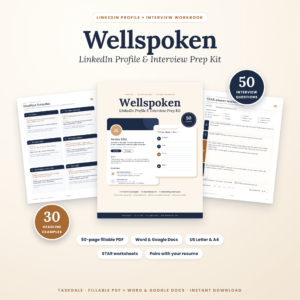
Wellspoken LinkedIn Profile Template and Interview Prep Workbook
Price: $6.99 | Best for: anyone with an interview coming up
Wellspoken’s interview half is a fillable workbook with 50 common interview questions, STAR answer worksheets, company and salary research pages, checklists, thank-you emails and an application tracker. The first half helps you line up your LinkedIn profile with your CV, using headline formulas and About section templates. Use it as a 50-page fillable PDF or edit the templates in Word or Google Docs. Fill one STAR sheet for each bullet on your CV before you start on the general questions.
Step 3: Get ready for the numbers questions
Numbers make a CV stronger. They also draw the sharpest questions. For every figure on your page, prepare answers to three follow-ups.
- How did you measure it? “Our system logged response times, and I pulled a report at the start and end of the quarter.”
- What was your part in it? If a team of five hit a target, be clear about your share.
- What was it before? “Cut costs by 15 percent” needs a starting point to mean anything.
If a number on your CV was an estimate, say so calmly: “That is my best estimate from the weekly reports. I did not have a precise figure, but it was around that.” Honest and fine. What hurts is a number you cannot explain at all.
Step 4: Prepare for gaps, short stays and changes
Interviewers look at dates. Expect questions about anything that breaks the pattern. Prepare a calm, short answer for each, two or three sentences, then move the conversation forward.
| What they see | What they might ask | Shape of a good answer |
|---|---|---|
| A gap of six months or more | “What were you doing here?” | What happened, one useful thing from that time, why you are ready now |
| A job under a year | “Why did you leave so quickly?” | Honest reason without blame, what you learned about the kind of role you want |
| A change of field | “Why the switch?” | What drew you, which skills carry over, proof you have started (a course, a project) |
| A step down in title | “Why take a junior role?” | What you gained: a new field, a better team, more stability |
Practise these out loud. They are the questions people most often fumble, mostly because they feel awkward. Said once or twice in your kitchen, they lose their sting.
Step 5: Make sure you can prove every skill
The skills section is a list of invitations. Any skill on it can become a question: “You list Excel. What is the most complex thing you have built?” “You list Spanish. Can we switch for a minute?” Yes, that second one does happen.
For each skill, have one concrete example ready. For software, a task you did with it. For languages, an honest level. For soft skills such as leadership or negotiation, a short story. If you cannot think of an example for a skill, that is a sign it should come off the next version of your CV.
A good CV template helps by keeping the skills section short and specific in the first place, and some kits include interview material alongside the layout.
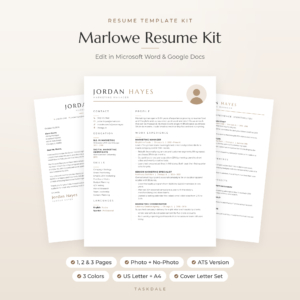
Marlowe Resume Template
Price: $4.79 | Best for: job seekers refreshing their CV and prep
Marlowe’s bonus Resume Playbook is a 10-page PDF covering how recruiters read resumes, before-and-after bullet examples, 120+ action verbs, 12 interview questions with the STAR method and a final checklist. The kit itself has 1, 2 and 3 page resumes with and without a photo, an ATS version, a cover letter, references page and thank-you letter, in Sand, Sage and Slate, US Letter and A4. If your audit turned up crosses, rewrite those lines in Marlowe before your next application.
Run a mock interview with your CV on the table
Reading your stories silently is not the same as saying them under a little pressure. Ask a friend, partner or relative to play interviewer for 30 minutes. Give them your CV and this list.
- Walk me through your CV.
- Pick any bullet and ask: tell me more about that.
- Pick any number and ask: how did you measure that?
- Point at a date and ask: what happened here?
- Point at a skill and ask: give me an example.
- What are you most proud of on this page?
- What would your last manager say you need to work on?
If your helper wants to play the role properly, an interviewer’s scorecard gives them a structure. The Hirelight Employment Application Kit is made for employers, and its one-page Interview Scorecard rates eight criteria from 1 to 5 with space for notes, strengths and concerns. Seeing your answers scored the way a hiring manager might score them is eye-opening, and a little humbling the first time.
Record the session on your phone if you can bear it. Listen back once. Most people notice two things: they talk too long on easy questions and too briefly on the important ones.
Keep track of which CV they have
If you have tailored your CV for different employers, you need to know exactly which version each interviewer is holding. Nothing rattles you faster than being asked about a bullet you deleted two versions ago.
Note the file name of each CV you send, the date, and the role. Our guide to keeping a job application tracker shows a simple way to do it in one spreadsheet.
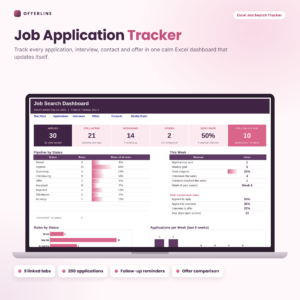
Offerline Job Application Tracker Spreadsheet
Price: $5.99 | Best for: people juggling several applications
Offerline is an Excel job search tracker with nine linked tabs. The Applications tab holds up to 200 roles with a resume version column, contact, status and an automatic next follow-up date. The Interviews tab logs up to 60 rounds with format, interviewers, prep done, thank-you sent and a countdown, and an Offers tab compares up to six offers side by side. Before each interview, filter by company to see exactly which CV version you sent.
The night before and the morning of
The night before
- Read your CV once, slowly, out loud.
- Review your stories for the three bullets most relevant to this job.
- Re-read the job advert and circle the two things they care about most.
- Print two clean copies of the CV you sent, one for you and one spare.
- Stop prepping by 9 p.m. Sleep matters more than one more read-through.
The morning of
- Glance at your one-line answers for any gaps or short stays.
- Say your “walk me through your CV” answer once, in under two minutes.
- Leave early. Arriving flustered undoes a week of preparation.
Afterwards, send a short thank-you message within a day. Our guide to the thank-you email after an interview has templates and timing tips.
Frequently asked questions
How do I prepare to talk about my CV in an interview?
Print the exact version you sent, mark each line by how well you can explain it, and prepare a short STAR story for every bullet. Then practise out loud with someone asking follow-up questions.
What does “walk me through your CV” mean?
The interviewer wants a short spoken tour of your career, usually in two minutes or less. Start with your current role, give one highlight per job, and finish with why this role is your logical next step.
What if they ask about something I cannot remember well?
Be honest. Say what you do remember, give the general shape, and offer to follow up with detail. Bluffing is far riskier than admitting a fuzzy memory.
Should I bring a copy of my CV to the interview?
Yes. Bring two printed copies of the version you sent. Interviewers sometimes forget theirs, and having one lets you follow along when they refer to a line.
How long should my answers about CV bullets be?
Around one to two minutes. Long enough for the situation, your actions and the result, short enough that the interviewer can ask a follow-up.
How many STAR stories should I prepare?
One for each main bullet on your CV, usually 8 to 12. Many of them will also answer general questions such as “tell me about a challenge you faced”.
Your next step
Print the CV you sent and do the tick, question mark and cross audit tonight. It takes less than an hour. Then fill in a STAR story for each question mark, using the worksheets in the Wellspoken Interview Prep Workbook or a plain notebook. By the time you sit down across from the interviewer, every line on that page will be yours.