Finished pages deserve better than a drawer. If you have been colouring for a few months, you probably have a folder of pages you are quietly proud of, and nowhere to put them. Colouring for adults feels even more rewarding when the results are on a wall, a shelf or a card on someone else’s mantelpiece.
This guide is full of practical display ideas, from proper frames and gallery walls to washi tape, pegs and handmade cards. You will also learn how to protect pencil and marker work from smudging and fading, how to plan a wall so it looks deliberate rather than random, and which printable sets give you pages that sit well together.
Quick picks: printable sets that look good on display
| Product | Best for | Price | Link |
|---|---|---|---|
| Hue & Harmony Color by Number for Adults | Polished pages for frames and gallery walls | $4.99 | View |
| Kettle & Quilt Cozy Coloring Book | Warm kitchen and living room displays | $6.99 | View |
| Easy Mandala Coloring Book | Cards, coasters and round cut-outs | $3.49 | View |
| Farm Animals Coloring Book | Shared displays with grandchildren | $3.49 | View |
Before you display: finish and protect the page
Ten minutes of finishing makes a page look intentional rather than torn from a pad. Do these steps before anything goes on a wall.
- Sign and date it. A small signature in the bottom corner, in pencil or fine pen, turns a colouring page into your piece. Future you will love seeing the date.
- Let markers dry overnight. Alcohol and gel inks can smudge for hours, especially in dark areas.
- Fix pencil work. Wax-based pencils can develop a cloudy film called wax bloom after a few weeks. A light coat of workable fixative spray, used outdoors or by an open window, keeps colours crisp.
- Trim the edges. Use a craft knife and a metal ruler to remove any printer margin or page number you do not want to show.
- Flatten curled pages. Leave them under a few heavy books for a day.
If you printed on thin copy paper and want a page to last, consider reprinting it on heavier card next time. Pages on 160 to 250 gsm card hang flatter and survive handling far better.
Framing: the simplest way to make a page look like art
A frame changes everything. The same page that looked like a hobby on the kitchen table suddenly looks like something you might buy. Here is how to do it well on a budget.
Choose a mount
A mount is the card border between the picture and the frame. It gives the page breathing space. An A4 page sits nicely in a 30 by 40 cm frame with a mount cut for A4. White or cream mounts suit most pages. A grey mount can make bright colours glow.
Match frames, not pages
If you are framing several pages, use the same frame colour and size for all of them. Matching frames pull very different pictures together into one set.
Keep it out of direct sun
Coloured pencil and marker fade in strong sunlight over months. Hang framed pages on a wall that does not catch the afternoon sun, or use frames with UV-filtering glazing if a sunny wall is the only option.
Planning a gallery wall that looks deliberate
A gallery wall of finished pages is a lovely thing to build over a year. The trick is to plan it so it looks curated rather than cluttered.
Here is a worked example for six A4 pages. Lay them out on the floor first in a grid of three across and two down. Leave a 5 cm gap between every frame. Hang the centre of the whole group at about eye level, roughly 150 cm from the floor. Before you put a single nail in, cut paper templates the size of each frame and stick them on the wall with putty adhesive. Live with the templates for a day. Move them until it feels right.
Pages that share a style look best together. A set with the same line weight and a planned colour key makes this much easier, because every page already feels like part of a family.

Hue and Harmony Color by Number
Price: $4.99 | Best for: adults who want display-ready pages
Hue & Harmony has 30 colour by number designs for adults, from Easy to Advanced, covering flowers, animals, landscapes and mandalas. Each page has a colour key with named swatches, and a full-colour Finished Gallery shows how each design should look. It prints on A4 or US Letter. For a gallery wall, choose three Advanced pages, such as the peacock, the koi pond and the jewel mandala.
One more tip for gallery walls: keep one empty space in the layout. Fill it when you finish your next favourite page. Having a gap waiting for you is a gentle push to keep colouring.
No-frame displays for a changing collection
Frames are lovely but fixed. If you finish a page a week, you need a display that swaps easily. These are cheap, quick and renter-friendly.
- String and pegs. Run a length of twine between two small hooks and peg pages along it. Add a new page at one end and take the oldest off the other.
- Clipboard wall. Hang three to six plain clipboards in a row. Clip a page to each. Swapping takes seconds.
- Washi tape corners. Patterned paper tape holds a page to a wall or door without marking paint, and the tape becomes part of the look.
- Picture ledge. A narrow shelf lets you lean pages in clip frames and layer them, so you can shuffle the order whenever you like.
- Magnetic strips. Wooden poster hangers with magnets top and bottom give a page a neat, finished edge without glass.
A rotating display also keeps you motivated. Seeing your newest page go up on a Sunday evening is a small but real moment of pride.
Cosy pages for kitchens and living rooms
The warmest spots for coloured pages are the rooms where you spend your evenings. Kitchens suit pages of teapots, bakeries and cats on chairs. Living rooms suit firesides, quilts and lamplit windows. Pages that match the room’s mood feel at home there, rather than stuck on.
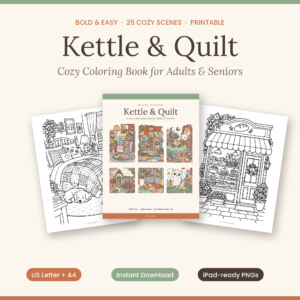
Kettle and Quilt Cozy Coloring Book
Price: $6.99 | Best for: adults and seniors who love cosy scenes
Kettle & Quilt has 25 bold and easy cosy scenes, including sleepy cats in armchairs, a corner bakery, thatched cottages by the sea, a fireside fox and a lantern-lit owl. You get A4 and US Letter PDFs, plus 300 dpi PNG pages for tablets. One scene per page means you can print single-sided and display each one on its own. Start with the corner bakery for a kitchen wall.
Pick a colour from the room, like the shade of your tea towels or a cushion, and use it somewhere on the page. That one link makes the picture look as though it belongs.
Turning finished pages into cards, tags and gifts
Some pages are best shared. A coloured page folded into a card or cut into a tag means far more to the person who receives it than anything from a shop.
- Greeting cards. Print a page at half size, colour it, then glue it to the front of a folded A5 card. Write inside as normal.
- Gift tags. Cut small sections, like a single flower or a little animal, and punch a hole for ribbon.
- Bookmarks. Cut a strip about 5 by 18 cm from a patterned area and laminate it.
- Coasters. Cut a round mandala to fit a cork coaster, glue it on and seal it with a coat of clear craft varnish.
- Wrapping paper. For a small gift, a fully coloured A4 page makes a striking wrap.
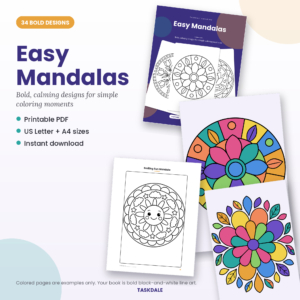
Easy Mandala Coloring Book
Price: $3.49 | Best for: crafters making cards and coasters
Easy Mandala has 34 bold mandalas such as Petal Sun, Heart Bloom, Starburst and Butterfly Wings, each on its own page in A4 and US Letter PDFs. The round designs and thick outlines make them easy to cut out cleanly for cards and coasters. Print two mandalas at half size on one sheet of card to make a matching pair.
Shared displays with children and grandchildren
A wall where adults and children display pages side by side is a lovely thing in a family home. A grandparent and grandchild colouring the same farm scene, then hanging both versions next to each other, makes for a cheerful comparison and a lot of laughter about purple cows.
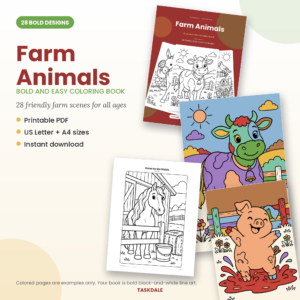
Farm Animals Coloring Book
Price: $3.49 | Best for: grandparents colouring with grandchildren
Farm Animals has 28 bold and easy barnyard scenes, including Friendly Cow in a Meadow, Pig in a Puddle, Hen with Eggs and Rooster at Sunrise. Thick outlines suit young children and adults alike. It comes as A4 and US Letter PDFs. Print the same page twice and colour one each, then hang them side by side.
Label each page with the artist’s name and age. In a few years, those labels will be the best part of the display.
Rotating your display through the year
A display that changes with the seasons stays interesting for you and for anyone who visits. Choose four slots in the year and swap a few pages at each one.
- Spring: blossom, birds and pale greens. Bring out flower mandalas and garden scenes.
- Summer: seaside cottages, bright florals and sunny farm scenes.
- Autumn: foxes, falling leaves and warm oranges and plums.
- Winter: firesides, snowy cottages and a lamplit window or two.
Store the pages that come down in your portfolio rather than throwing them away. By the second year you will have a box of seasonal art ready to go, and setting up a new season takes five minutes. It also gives you a reason to colour with the calendar, so you always know what to start next. If you want easy pages that finish in one evening for this kind of rotation, our guide to simple colouring books for adults has good options.
Keeping a portfolio of every page
Not every page needs a wall. A portfolio keeps your whole collection safe and lets you see how far you have come.
- A ring binder with clear sleeves. Simple, cheap and easy to flip through. Use A4 sleeves and slip a plain sheet behind each page.
- A dated photo on your phone. Photograph every finished page in daylight on a plain table. An album called Colouring is a lovely thing to scroll through on a rough day.
- A printed photo book. At the end of a year, put your best twelve pages into a small photo book. It makes a thoughtful gift for yourself.
Looking back through a binder after six months is often surprising. Early pages look flat next to recent ones, and you can see your shading improve page by page.
Displays for clubs, libraries and care homes
Group colouring sessions produce lots of pages, and displaying them gives everyone a lift. A noticeboard covered in finished pages, each with the colourist’s first name, turns a corridor into a gallery. Change it monthly so every session’s work gets a turn. Our guide to colouring books for seniors has more ideas for running sessions in care settings.
For groups, choose bold pages with big spaces so everyone can finish one in a session. Check each product’s licence before printing copies for a group.
Mistakes that spoil a display
- Sticky tape on the front. It yellows and tears the page when removed. Use washi tape, putty adhesive or clips.
- Hanging in a steamy bathroom. Damp warps paper and makes ink run.
- Mixing too many frame styles. Five different frames look like a jumble sale. Pick one style.
- Skipping the fixative on pencil work. Wax bloom can dull a page within weeks.
- Displaying only perfect pages. Your slightly wonky first page is part of the story. Give it a spot too.
If you use markers, the paper you print on matters a lot for display. Our guide to the best markers for adult colouring books covers which papers stop bleed-through.
Frequently asked questions
How do I frame a colouring page?
Trim the page, put it behind a mount cut for its size, and place it in a frame with glass. An A4 page in a 30 by 40 cm frame with a mount looks smart and balanced.
How do I stop coloured pencil from smudging?
Spray a light coat of workable fixative in a well-aired space, holding the can about 30 cm away. Two thin coats are better than one heavy one.
Will my coloured pages fade on the wall?
They can in strong sunlight. Hang them away from sunny windows or use UV-filtering glass.
What can I do with old colouring pages?
Turn them into cards, gift tags, bookmarks, coasters or wrapping paper, or keep them in a dated binder.
Can I hang colouring pages without damaging the walls?
Yes. Washi tape, putty adhesive, removable hooks and string with pegs all come off cleanly. Test any adhesive on a hidden spot first if your paint is fresh.
What paper is best if I plan to frame a page?
Smooth card around 160 to 250 gsm. It holds colour well, stays flat in a frame and lasts longer than copy paper.
Your next step
Pick your three favourite finished pages tonight, sign and date them, and peg them on a length of string in the room you use most. If you want a matched set made for framing, download Hue & Harmony and colour three Advanced pages for your first gallery wall.