Color by number coloring pages for preschool math practice turn a sum into a small mystery. A space says 2+3. The child counts on fingers, gets 5, finds the 5 in the crayon key and colors the space blue. Do that twelve times and a whale appears. Nobody called it homework, but that was a dozen addition problems.
This guide is for preschool and pre-K teachers, homeschool parents and anyone helping a four- or five-year-old get comfortable with early math. You will learn which math skills these pages can practice, how to step from plain numbers to color by answer, how to use objects alongside the page, and how to make your own math pages when you need one for tomorrow morning.
Quick picks for early math coloring
| Product | Best for | Price | Link |
|---|---|---|---|
| Hop to Ten Color by Number for Kids | Numbers 1 to 10, then sums to 10 and take-away | $4.49 | View |
| Crayon Campus Preschool Learning Coloring Worksheets | Counting, graphing, more or less and numbers to 20 | $4.99 | View |
| Starmane Meadow Unicorn Coloring Book for Kids | Dot-to-dot counting practice with a fun theme | $4.49 | View |
Which early math skills a coloring page can practice
A color by number page can carry more math than people expect. It all depends on what is printed inside each space.
- Numeral recognition. The space says 6, the child finds the 6. This is the base layer.
- Counting. The space shows four dots instead of a 4. The child counts the dots, then finds the color.
- Addition within 10. The space says 3+4. The child solves it to find the color for 7.
- Subtraction within 10. The space says 8-2, and the answer 6 leads to the color.
- Number words. The space says “five” in letters, which links reading and math.
- Ten frames. The space shows a ten frame with seven boxes filled. The child reads the quantity.
You do not need all of these at once. Most preschoolers spend months on the first two, and that is exactly right.
The order to teach it in
Skipping steps is the most common reason a child starts guessing colors at random. Here is a gentle path that works for most children between ages 3 and 6.
| Step | What the spaces show | Ready when the child can |
|---|---|---|
| 1 | Numerals 1 to 5 | Name 1 to 5 out loud |
| 2 | Numerals 6 to 10 | Find 1 to 5 on a page without help |
| 3 | Mixed 1 to 10 | Find 6 to 10 on a page without help |
| 4 | Dot groups or ten frames | Count objects to 10 accurately |
| 5 | Addition to 10 | Add small groups of objects with fingers |
| 6 | Take-away within 10 | Show “3 take away 1” with blocks |
Move one step at a time, and only when the current step feels easy. A child who colors a mixed 1 to 10 page quickly and correctly twice in a row is ready for addition. A child who still hesitates over 7 and 8 needs another week at Step 3, and that is fine.
Start with numbers, then move to sums
The best math pages build on each other. A child who has colored twenty pages with plain numerals already knows how the key works. When the first sum appears, all their attention can go to the math, not to figuring out the page.
That is why a set that starts with plain numbers and ends with color by answer is easier to use than a pile of mixed free pages. The style stays the same. Only the challenge grows.
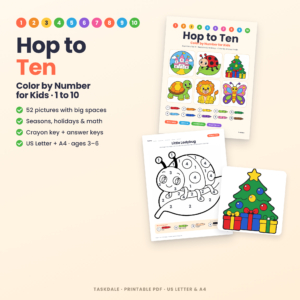
Hop to Ten Color by Number for Kids
Price: $4.49 | Best for: kids stepping from numbers to sums
Fifty-two original pictures in five parts that climb from numbers 1 to 5, through 6 to 10 and mixed pages, to a Color by Answer section with seven addition pages (sums from 3 to 10) and three take-away pages within 10. Two Number Practice pages include ten frames and tracing. Full-color finished pictures double as answer keys, in US Letter and A4 PDFs with a one-teacher licence. Start at Part 1 even with a confident child.
Use real objects next to the page
Preschool math lives in the hands first and on paper second. A cup of counters beside the page makes every sum make sense.
For counting pages
Put ten small objects in a cup: buttons, pasta shapes, toy cars. When a space shows five dots, the child puts five buttons in a line, then finds the matching color. It is slow at first. By the third page, they often stop needing the buttons.
For addition pages
A space says 2+3. The child puts out two red counters and three blue counters, pushes them together and counts five. Then they color. This is the moment many children first understand what the plus sign means, and you can see it land on their face.
For take-away pages
A space says 6-2. Six blocks in a row, take two away, count what is left. Let the child physically move the blocks off the table. Subtraction is much less abstract when something actually disappears.
Keep the counters in a lidded tub next to the coloring folder. If they are always there, nobody has to go looking.
A math-focused week for home or class
Here is a simple five-day plan for a child at Step 3 or 4. Each session is ten to fifteen minutes.
- Monday: a mixed 1 to 10 page. Warm up by counting stairs or steps in the hallway.
- Tuesday: a counting page with dot groups. Use buttons for every space.
- Wednesday: a ten frame page. Fill a paper ten frame with counters to match each one.
- Thursday: one addition page with sums to 5 only. Counters on the table.
- Friday: child’s choice of any page from the week, plus a sticker on a chart.
Write the date on each finished page and keep them in order. Comparing Monday’s page with Friday’s is a nice way to show a child how much they did, and it gives a parent or teacher a clear picture of where they are.
More than color by number: counting and comparing pages
Color by number is one tool. Other coloring pages practice math skills it does not cover so well, such as comparing amounts, graphing and finding missing numbers. A mix keeps things fresh and builds a wider base.
- “Which has more?” pages ask children to color the bigger group, which builds number sense.
- Count and graph pages have children count pictures and color one box per item in a simple bar graph.
- Missing number charts ask them to fill gaps in a 1 to 20 line, then color.
- Dot-to-dots practice number order, with a picture to color at the end.
For tips on page design that suits small hands, see our guide to preschool coloring pages with big shapes.
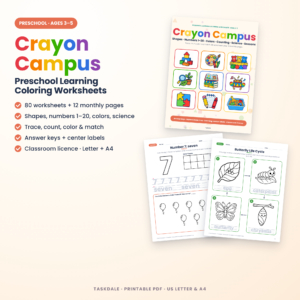
Crayon Campus Preschool Learning Coloring Worksheets
Price: $4.99 | Best for: pre-K teachers building math centers
Eighty preschool worksheets with sections for Shapes, Numbers 1 to 20, Counting and Math, Colors, Matching and Science, plus 12 monthly pages. The Counting and Math pages include How Many, count and graph, Which Has More, dot-to-dots to 10 and 20, a color-by-number hot air balloon and a missing numbers chart. Each Numbers page pairs a ten frame with tracing. US Letter and A4, with answer keys and a skills checklist.
Make your own color by answer page tonight
Sometimes you need a page for a specific skill tomorrow morning. Here is how to make one in about fifteen minutes from any simple coloring page.
- Pick a page with 10 to 20 big spaces. A fish, a house or a butterfly works well.
- Choose four answers. For example 3, 5, 7 and 9. Each one gets a color: 3 = yellow, 5 = blue, 7 = green, 9 = red.
- Write sums in the spaces. For the blue spaces write 2+3, 4+1 and 1+4. For green, 4+3 and 5+2. Mix them so the child must solve each one.
- Write the key at the bottom. Show the answer number, a blob of color and the color word.
- Solve it yourself first. Color a copy as the answer key. You will catch any mistakes before the child does.
Worked example: a butterfly with 14 spaces, sums to 6, three colors. A five-year-old solved it in eighteen minutes with counters, then asked to make one for her little brother. That request is the best sign the page worked.
Checking answers without taking the fun away
Math pages have right answers, which brings a risk. If an adult marks every mistake, the coloring stops feeling like play.
A better way is the self-check. Keep a colored answer picture nearby and let the child compare when they finish. If a wing is green where it should be blue, ask them to find the sum in that space and solve it again with counters. Most children fix it themselves and feel clever doing it. That feeling is worth far more than a perfect page.
For the youngest, skip checking altogether on the first few pages. Confidence first, accuracy later.
Dot-to-dots as counting practice
Dot-to-dots are an underrated math tool. Joining 1 to 15 means saying and finding each number in order, which is counting with a pencil. As the numbers climb to 30, 50 or 70, children practice the patterns of bigger numbers: 21, 22, 23 and so on.
A theme a child loves makes the counting feel like a race to see the hidden picture. Then they color the finished shape, which is a nice reward for the effort. If you want to tie it back to color by number, ask them to color the picture using a mini key you write in the corner.

Starmane Meadow Unicorn Coloring Book for Kids
Price: $4.49 | Best for: unicorn fans practicing counting
Seventy-eight pages of original unicorn art, including six dot-to-dots that grow from 1 to 15 up to 1 to 70, four color by number pages, three mazes and a word search, all with answer keys and finished pictures. Preschool pages have extra-thick outlines for small hands, and older kids get detailed fantasy scenes. Prints in US Letter or A4. Start with the star dot-to-dot.
Ideas for a pre-K math center
In a classroom, one table can run a math coloring center with almost no adult help once routines are set.
- A tray with four printed pages at the same level, so four children can work at once.
- A cup of crayons that match the key, one cup per child.
- A tub of counters and a laminated ten frame for each seat.
- An answer card in a sheet protector for self-checking.
- A finished-work basket where pages go when done.
Rotate groups every ten to twelve minutes. Change the page level per group, not the setup. Children quickly learn what to do, and you are free to work with a small group nearby.
Signs the math pages are working
Progress in preschool math is quiet. There is no test score. Instead, watch for small changes in everyday life over three or four weeks.
- The child counts things without being asked: plates on the table, cars at a red light, stairs to bed.
- They say “that’s five” when they see five objects, without counting one by one.
- On a page, they spot every 8 quickly instead of hunting space by space.
- They start solving 2+1 or 3+2 in their head, then check with fingers.
- They ask for a “hard one” with sums, which means they feel ready.
When two or three of these show up, move up one step in the table. That small promotion, said out loud, makes a child feel very grown up.
Mistakes that slow math progress
- Jumping to sums too early. If a child cannot find a 7 on the page, a sum that equals 7 is too much.
- Taking away the counters too soon. Let them use objects until they stop reaching for them on their own.
- Using pages with too many answers. Four or five answer colors is plenty for a preschool math page.
- Long sessions. Ten minutes of focused math beats thirty minutes of tired guessing.
- Only using worksheets. Counting stairs, grapes and toy cars matters just as much as paper.
Frequently asked questions
What is color by answer for preschoolers?
It is a color by number page where each space shows a small sum, such as 2+2. The child solves it and colors the space with the crayon for the answer.
At what age can kids do addition color by number?
Many children can try sums to 5 around age 4 or 5, once they can count objects to 10 and find numbers 1 to 10 easily.
Should preschoolers use counters with math coloring pages?
Yes. Buttons, blocks or pasta make each sum concrete. Most children stop needing them on their own once the idea clicks.
How many math problems should one page have?
Ten to twenty spaces is a good size. Fewer for younger children, more once they work confidently.
Can I make my own color by answer pages?
Yes. Take any simple coloring page, pick four answers with a color each, and write sums that equal those answers in the spaces.
Do color by number pages help with math readiness for kindergarten?
They give lots of gentle practice with numerals, counting and simple sums, which are common skills kindergarten builds on.
Your next step
Fill a small tub with ten buttons, print one counting page and sit with your child for ten minutes tomorrow. If they enjoy it, follow the step table above and move up when each level feels easy. For a set that goes all the way from first numbers to sums and take-away, begin with Part 1 of Hop to Ten Color by Number for Kids. If you want more on the basics first, our guide to color by number pages for preschool learning is a good companion.