Anime colouring looks hard from the outside. Glossy hair, eyes that sparkle, shadows sharp enough to cut paper. Then you learn the secret: most of it is a simple system of flat colour, one shadow shape and a couple of white highlights. Once you know the steps, anime colouring book pages for beginners become one of the most rewarding things you can put pencil to.
This guide is for teens and adults who love anime and manga art and want to colour it well without years of practice. You will learn what makes a page beginner-friendly, the four-stage method most anime artists use, how to tackle eyes, hair and skin, what tools are worth buying, and how to colour simple, cute backgrounds. We also show three printable books from Taskdale that suit beginners, including one built around original anime-style characters with shading guides.
Quick picks for beginner anime colouring
| Product | Best for | Price | Link |
|---|---|---|---|
| Ink & Glint Manga Coloring Book | 24 original characters with step-by-step shading guides | $4.99 | View |
| Kettle & Quilt Cozy Coloring Book | Bold, cosy scenes for background practice | $6.99 | View |
| Forest Cabins Coloring Book | Detailed woodland scenery and hidden objects | $3.49 | View |
What makes an anime page beginner-friendly
Not every anime page suits a first-timer. Some are packed with tiny details, layered clothing and complicated poses that would challenge an experienced artist. A beginner page has a few clear traits.
- One character, clearly drawn. A single figure from the waist up is far easier than a crowded action scene.
- Clean, closed lines. Every shape is fully outlined, so you always know where one colour stops and the next starts.
- Big hair shapes. Hair split into a few large locks rather than hundreds of strands.
- Simple clothing. A school uniform, a hoodie or a cloak. Few folds, few patterns.
- A light background. A plain or simple setting lets you focus on the character.
Pages with a short character profile are a bonus. Knowing that a character is a cheerful sprinter or a quiet rooftop sketcher helps you choose colours that suit their personality.
The four-stage method
Almost all anime colouring follows the same order. Learn it once and you can apply it to any character, any page.
- Line art. The printed black outline. Leave it alone. Your job is to fill the shapes.
- Flat base colour. Fill every area with one even colour: skin, hair, eyes, clothes. No shading yet. This stage alone should make the page look clean and bright.
- Shadow shapes. Pick where the light comes from, then add one darker tone on the opposite side of each shape. Under the fringe, under the chin, inside folds of fabric.
- Highlights. Add small white or very light marks where light hits hardest: a shine on the hair, a dot in the eye, a gleam on a button.
That is cel shading, the style used in most anime. The shadows have hard edges, like they were cut from paper. It is actually easier than soft shading, because you do not need to blend. You colour one shape on top of another.
A book that teaches as you colour
The quickest way to learn is to see each stage done on the same drawing you are about to colour. Guessing where a shadow goes is frustrating. Seeing it worked out, then copying the idea, is not.
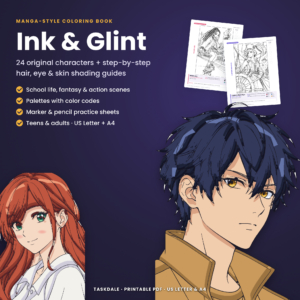
Ink and Glint Manga Coloring Book
Price: $4.99 | Best for: anime fans learning to colour
This book has 24 original anime-style characters in school-life, fantasy and action scenes, each with a profile, suggested palette and shading tip. Six guides show the four stages on the book’s own art, covering light and shadow basics, long hair, dark hair, sparkly eyes, narrow eyes and skin tones with blush. There are 42 coded palettes, practice sheets and a design-your-own character page, in US Letter and A4 PDFs, so begin with Light and Shadow Basics and then one practice portrait.
The cast is diverse, with twelve skin tone palettes and hairstyles that include box braids, locs and curls. That makes it a good place to practise colouring a range of characters properly, not only the pale-skinned, straight-haired default many books stick to.
Colouring anime eyes step by step
Eyes are the heart of an anime face. Get them right and the whole character comes alive. They look complicated, but they break down into five simple steps.
- Fill the iris with your base colour, say a mid blue.
- Darken the top third of the iris with a deeper blue. The upper eyelid casts a shadow there.
- Colour the pupil in the darkest tone, nearly black.
- Add a lighter colour to the bottom of the iris, like a pale aqua. This is reflected light and it makes eyes glow.
- Add one or two white highlights on the same side as your light source. A big one and a tiny one look best.
Leave the eye whites mostly white, with a hint of pale grey or lilac under the top lid. That small shadow stops the eye looking pasted on.
Colouring anime hair
Hair is where anime colouring really shines, literally. The trick is the shine band.
Base and shadow
Fill all the hair with your base colour. Then add shadow under each lock where it overlaps another, under the fringe where it meets the forehead, and on the side away from the light. Keep the edges of the shadow crisp.
The shine band
Anime hair usually has a curved band of light running across the top of the head, broken into small zigzag shapes as it crosses each lock. Colour it in a much lighter version of the base colour, or leave the paper white. It instantly makes hair look glossy.
Dark hair
Black or dark brown hair looks flat if you colour it all in black. Use a very dark blue or purple for the base, black only for the deepest shadows, and a cool grey-blue for the shine. Dark hair with cool highlights is one of the most striking looks in anime.
Fantasy colours
Pink, mint, lilac and silver hair are part of the fun. Pink hair with violet shadows, or mint hair with teal shadows, always look good. Pick a shadow colour that is darker and slightly cooler than the base.
Skin tones and blush
Skin needs three colours: a base, a shadow and a blush. The shadow goes under the fringe, under the chin, on the neck and along one side of the face. Blush is a soft pink or coral oval on the cheeks.
For lighter skin, a pale peach base with a warm pink-beige shadow works well. For medium skin, a golden tan base with a warm brown shadow. For deep skin, a rich brown base with a deeper red-brown or plum shadow, and a warm highlight on the cheekbone and nose. Avoid grey for skin shadows on any tone. It makes faces look tired and dull.
One simple rule makes faces look more natural: let the shadow colour have a little warmth in it, like red or orange. Skin is warm, so its shadows are warm too.
Tools for beginners
You can colour anime pages with almost anything, but some tools make cel shading much easier.
- Alcohol markers give the flat, even colour anime is known for. They bleed through thin paper, so print single-sided on heavier paper and slide a spare sheet underneath.
- Coloured pencils are cheaper, more forgiving and easier to control on small areas like eyes. Build colour in layers.
- A white gel pen for highlights. This is the most useful single tool for anime colouring.
- A fine black fineliner for tidying lines and adding small details.
- Paper around 120 to 160 gsm for markers, or 100 to 120 gsm for pencils.
Many beginners start with a pencil set they already own, add a white gel pen, and only buy markers once they know they love the hobby. That is a sensible order. For a closer look at markers and paper, our guide to the best markers for adult colouring and the paper to print on compares the options.
Clothes, uniforms and fabric folds
Clothes are where beginners often relax too much and the page goes flat. A school blazer in one even navy looks like cardboard. Two minutes of shadow fixes it.
Look for the fold lines in the printed art. Each fold has a top edge that catches light and an inside that sits in shadow. Colour the whole garment in its base colour first, then add your shadow tone inside every fold, under the collar, under the arms and wherever one layer sits on top of another, like a jacket over a shirt. Keep those shadows crisp, just as you did with the hair.
White shirts need care. Leave most of the shirt as bare paper and shade the folds in a pale blue-grey or lilac. Black clothes work like dark hair: a deep navy or charcoal base, true black only in the deepest creases, and a cool grey sheen along the top of the shoulders. Small details like buttons, ribbons and badges are perfect places for your accent colour and a tiny white gleam.
Cute scenes and simple backgrounds
Beginners often leave the background blank, and that is fine at first. When you are ready, simple backgrounds make a character pop without taking hours.
- Gradient sky: two colours that fade into each other, like peach at the bottom and lilac at the top.
- Sparkle field: a soft wash of colour with small white stars and sparkles drawn on top with a gel pen.
- Cherry blossom: pale pink petals scattered on a light blue sky.
- Cosy room: a window, a bookshelf, a mug. Warm creams and browns.
Keep the background softer and lighter than the character. That way the eye goes to the face first.
Practising cosy scenes
A lot of slice-of-life anime is set in warm, cosy places: a café corner, a rainy window, a bakery. Bold, simple scene pages are a nice way to practise colouring rooms and objects before you put them behind a character.
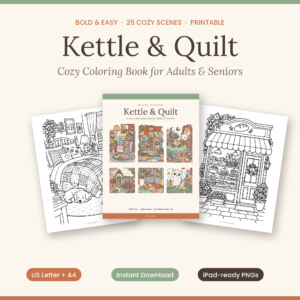
Kettle and Quilt Cozy Coloring Book
Price: $6.99 | Best for: beginners practising cosy scenes
This book has 25 bold and easy cosy scenes with thick outlines, such as an afternoon nap, a corner bakery, a little bookshop, a thatched cottage and a bunny’s tea party. You get US Letter and A4 PDFs, PNG files for colouring apps, six palettes with hex codes and a colour inspiration gallery. Try The Little Bookshop page and practise cel shadows on the shelves and windows.
These pages are not anime, but the skills transfer directly. A shadow under a shelf is the same shape logic as a shadow under a fringe.
Anime-style scenery
Some of the most loved anime moments are the landscapes: sunlit forests, lakes, mountain cabins and starry skies. If you enjoy those, detailed scenery pages give you room to practise light, colour and atmosphere.

Forest Cabins Coloring Book
Price: $3.49 | Best for: colourists who love scenery
This book has 30 detailed woodland scenes with rustic cabins, tall trees and hidden objects, including a lakeside retreat, a treehouse cabin, a cabin by a waterfall and a moonlit mountain cabin. You get US Letter and A4 PDFs. Choose the moonlit mountain cabin and practise a deep blue night sky with one warm glowing window, a classic anime contrast.
Scenery is a slower project, often several evenings per page. It is a nice change of pace between character pages.
Beginner mistakes and quick fixes
- Shading everywhere. Fix: keep most of each shape in its base colour. Shadows sit only on one side.
- Muddy shadows. Fix: use a darker version of the same colour, not grey or black.
- Light coming from two directions. Fix: draw a tiny arrow in the margin before you start, and keep all shadows on the opposite side.
- Flat hair. Fix: add a shine band across the top of the head.
- Dull eyes. Fix: darken the top third of the iris and add a white highlight.
- Markers bleeding through. Fix: heavier paper, single-sided printing, a scrap sheet underneath.
A four-week practice plan
Short, regular practice beats one marathon session. Twenty to thirty minutes, three times a week, adds up fast.
- Week 1: Flat colour only. Colour two characters with no shading at all. Focus on neat edges.
- Week 2: Add shadow shapes. Pick one light direction and stick to it.
- Week 3: Eyes and hair. Practise both on practice sheets, then on a full character.
- Week 4: Add a simple background, like a gradient sky or a sparkle field.
Keep your first page. At the end of the month, put it next to your latest one. The difference is usually big enough to make you grin. For more teen-friendly pages to try next, see our guide to colouring pages for teens that don’t feel babyish.
Frequently asked questions
Is anime colouring good for beginners?
Yes. Cel shading uses flat colour and hard-edged shadows, so there is no tricky blending. Simple, single-character pages are the best place to start.
What is the easiest way to colour anime hair?
Fill it with a base colour, add a darker shadow under each lock, then add a curved shine band across the top in a much lighter tone.
Do I need alcohol markers for anime colouring?
No. Coloured pencils work well, especially for beginners. Markers give a smoother look but need heavier paper.
How do I make anime eyes sparkle?
Darken the top of the iris, add a lighter colour at the bottom, and finish with one big and one small white highlight.
What paper should I print anime colouring pages on?
Around 100 to 120 gsm for pencils and 120 to 160 gsm for markers. Print single-sided if you use markers.
Are Taskdale anime characters based on existing shows?
No. The characters in Ink and Glint are all original, with their own names and profiles.
Your next step
Print one simple character page and colour it in flat base colours only, with no shading. Next time, add shadows on one side. If you want the steps shown on the same art you colour, open the Ink and Glint Manga Coloring Book at Light and Shadow Basics.