Paint by number helps color recognition because it makes a child match the same color to the same symbol, over and over, with a picture as the reward. Find the 3. The key says 3 is red. Pick up the red crayon. Color. Every space repeats that loop of look, match, name and check, and repetition is how young children learn colors.
This guide explains what color recognition actually involves, how each part of a paint by number game builds it, what to expect at different ages, the words to use while your child colors, and a simple five-day plan. There is also a section for adults who want to get better at telling similar shades apart. We point to a few printable books on Taskdale along the way.
Quick picks for color learning
| Product | Best for | Price | Link |
|---|---|---|---|
| Hop to Ten Color by Number for Kids | First color by number, ages 3 to 6 | $4.49 | View |
| Starmane Meadow Unicorn Coloring Book for Kids | Themed color by number plus puzzles, ages 3 to 12 | $4.49 | View |
| Hue & Harmony Color by Number for Adults | Telling similar shades apart | $4.99 | View |
What color recognition really involves
Knowing colors sounds like one skill. It is actually several, and children pick them up in roughly this order.
- Noticing that things have different colors at all.
- Matching two things that are the same color, without naming them.
- Pointing to a color when you say its name. Show me the blue one.
- Naming a color when you point to it. What color is this? Blue.
- Reading the written color word.
- Telling shades apart, like light blue and dark blue, or orange and peach.
Matching usually comes well before naming. That surprises many parents. A two-year-old who cannot yet say green can often put the green block on the green mat. Paint by number works with that natural order, because it starts with matching and adds names on top.
How the game builds each skill
Every space on a color by number page is a tiny lesson. Here is what is happening, step by step.
Matching a symbol to a swatch
The child finds a number in the picture, then finds the same number in the key. That is visual matching. Then they find the crayon that looks like the swatch next to the number. That is color matching.
Hearing and saying the name
Good keys print the color name under the swatch: Red, Light Blue, Brown. When an adult reads it aloud, or the child does, the name gets attached to the color. Thirty spaces, thirty repetitions.
Checking the result
As the page fills in, a picture appears. A frog that comes out purple tells the child something went wrong. Pages with a finished picture to compare against make checking even easier, and self-checking is where real confidence grows.
Holding the color in mind
Older children color all the 3s before moving on. That means remembering which crayon is 3 while scanning the page. It is a small working memory workout, and it makes the color stick.
Ages and stages: what to expect
Ages 2 to 3
Most children are matching and starting to point to colors by name. Color by number is usually too much at this age. Use single-color pages instead: here is the red crayon, let us color the apple red.
Ages 3 to 4
Many children can name a few basic colors and recognize the numbers 1 to 5. Very simple color by number pages with big spaces and four or five colors are a good first step. Sit with them and read the key together.
Ages 4 to 5
Children often know the main colors and numbers to 10. They can follow a key with more confidence and start to notice light and dark versions of a color. This is the sweet spot for color by number.
Ages 5 to 7
Children begin to read color words and enjoy harder pages with more colors. Color by answer pages, with simple sums, add a math twist.
Ages 8 and up
Older kids enjoy detailed pages and start caring about shades and how colors look together. Some move on to adult designs.
Every child is different. A four-year-old who loves trains may know every shade of blue on a locomotive and still mix up purple and pink. That is completely normal.
Choosing a first color by number book
For a beginner, the page matters more than anything else. Look for:
- Numbers 1 to 5 only at first, then up to 10.
- Big spaces so a chunky crayon fits easily.
- A crayon key with simple color names printed under each swatch.
- Unnumbered spaces left white, so the rules stay simple.
- A finished picture to check against.
A book that builds slowly from easy to harder keeps the early wins coming. That matters, because a child who succeeds on day one asks for another page on day two.
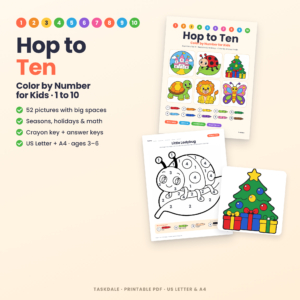
Hop to Ten Color by Number for Kids
Price: $4.49 | Best for: First color by number for ages 3 to 6
Hop to Ten has 52 pictures that use only the numbers 1 to 10, starting with numbers 1 to 5. Every page has big spaces, big numbers and a crayon key with plain color names such as Red, Light Blue and Brown. A My Crayon Box page helps children match the 14 colors to their own crayons, and every picture has a full-color answer key.
For more on choosing pages for this age group, see our guide to preschool coloring pages.
What to say while they color
The game does a lot on its own. Your words do the rest. Short, simple phrases work best.
- Before: Let us find number 2. What color is 2? Yes, yellow.
- During: You are using yellow. What else is yellow? The sun, a banana, your raincoat.
- Comparing: Is this blue or light blue? Which one is darker?
- Checking: Does the frog look right? What color should it be?
- After: How many colors did you use? Which was your favorite?
Avoid quizzing every space. One or two questions per page is plenty. The goal is a happy chat, not a test. You will hear color words creeping into everyday talk within a week or two. Pass me the green cup. That little moment is a real win.
From basic colors to shades
Once a child knows red, blue, yellow and green, the next step is shades and in-between colors. Light blue and dark blue. Orange and peach. Pink and purple. These are harder because the differences are smaller.
Color by number is ideal for this, because a good key uses both. A whale might be blue with a light blue belly. A fox might be orange with a brown tail. The child has to look closely at the swatch and pick the right crayon from two that look similar.
Help by laying the two crayons side by side and asking which is lighter. Then scribble each one on scrap paper. Seeing them next to each other makes the difference obvious.
Themed pages keep children coming back
Repetition builds color recognition, and children repeat what they enjoy. A theme they love, whether unicorns, dinosaurs or space, makes them ask for another page. That is the secret ingredient.
Mixed activity books work well here too. A color by number page one day, a dot-to-dot or a maze the next. The variety keeps interest high, while the color by number pages keep the color practice going.

Starmane Meadow Unicorn Coloring Book
Price: $4.49 | Best for: Unicorn fans aged 3 to 12
Starmane Meadow has 78 pages of original unicorn art, from easy Little Hooves pages for preschoolers to detailed fantasy unicorns for older kids. Its games section includes color by number, dot-to-dot, mazes, a word search and drawing pages, with answer keys for every puzzle. Use the easy pages to name colors, then the color by number pages to practice matching.
Color words and early reading
Color words are some of the first words children learn to read, partly because they see them so often. Color by number keys put the word right under the color, so the child sees red next to a red swatch dozens of times.
Try this with five- and six-year-olds. Cover the swatches in the key with a strip of paper, leaving only the words. Can they still color the page correctly by reading the color names? Many can, and they are thrilled to discover it. If they get stuck, peel the paper back for a peek. No pressure.
A five-day color recognition plan
Ten minutes a day is enough. Here is a gentle plan for a four- or five-year-old.
| Day | Activity |
|---|---|
| Monday | Match crayons to the key. Scribble each one next to its swatch and say the name. |
| Tuesday | Color an easy page using numbers 1 to 5. Read each color name aloud. |
| Wednesday | Color hunt: find something in the house for each color on the key. |
| Thursday | A page with one light and one dark version of a color. Compare them. |
| Friday | Check the finished pages against the answer pictures. Celebrate. |
Repeat the plan the following week with a new set of pictures. After a month, most children are naming colors with ease and starting to notice shades.
Adults: training your eye for subtle shades
Color recognition is not just for children. Many adults struggle to tell apart similar shades, such as sage and olive, coral and salmon, or slate and charcoal. Adult color by number helps here in the same way it helps kids: repeated matching of a named color to a swatch.
Adult keys often use descriptive names like Sky Blue, Rust or Lavender, and advanced pages can use up to fourteen colors. Matching your own pencils to those named swatches trains your eye to see small differences. After a few pages, you start noticing that the walls you thought were grey are actually a warm greige. It is a quietly satisfying skill.

Hue & Harmony Color by Number for Adults
Price: $4.99 | Best for: Adults sharpening their eye for color
Hue & Harmony has 30 adult designs in Easy, Medium and Advanced, using five to fourteen colors per page. Every key has named swatches such as Sky Blue, Rust and Lavender, and a Swatch Chart lets you test and record your closest pencil for each one. Fill in the Swatch Chart first; it is a color recognition exercise in itself.
Paper or app for learning colors?
Tap-to-fill apps are bright and fun, but they often skip the most useful step. The app fills the space with the right color for you. The child never has to find, compare and choose a crayon. Paper pages make the child do the matching, and that is where the learning happens.
Apps still have a place, for example in the car or a waiting room. For daily color practice, paper and real crayons do more. For a look at digital options, see our roundup of online coloring games.
If a child keeps mixing up certain colors
Most color mix-ups are just part of learning. Purple and blue, pink and purple, and orange and brown are common ones that sort themselves out with time and practice.
If a child of five or older consistently mixes up the same pair, especially reds and greens, even after plenty of practice, it is worth mentioning at their next check-up. Some children see certain colors differently, and knowing early simply means you can choose pages and keys that suit them, such as keys with clear color names and patterns.
Common mistakes when teaching colors with coloring
- Starting with too many colors. Four or five is plenty for beginners.
- Using crayons that do not match the key. Spend two minutes matching crayons first.
- Correcting every space. Let small slips go. Talk about them at the end.
- Rushing to shades. Secure the basics before moving on.
- Long sessions. Ten happy minutes beats thirty tired ones.
For more ideas on keeping coloring fun for young kids, see our guide to coloring pages for kids.
Frequently asked questions
Does color by number help toddlers learn colors?
It helps most from about age three, once children can recognize a few numbers. Younger toddlers learn more from simple one-color pages and naming games.
At what age should a child know their colors?
Many children name several basic colors between ages three and four, but there is a wide normal range. Matching usually comes before naming.
Is paint by number on an app as good as paper?
Apps are fun but often fill the color for you. Paper pages make children find and match the crayon themselves, which builds recognition more directly.
How many colors should a beginner color by number page have?
Four to six colors with big spaces is a good start. Add more once the child is confident.
Can color by number help with reading?
Yes. Keys with printed color names give lots of practice reading simple color words.
Can adults improve color recognition too?
Yes. Matching pencils to named swatches on adult pages trains your eye to tell similar shades apart.
Your next step
Tomorrow, sit down with your child for ten minutes, match the crayons to a key together and color one easy page. For a gentle first book that starts with numbers 1 to 5 and plain color names, print Hop to Ten Color by Number for Kids.