Coloring worksheets for science work because young scientists learn by looking closely. A child who colors the roots brown, the stem green and the petals yellow has just studied the parts of a plant, slowly and with full attention. Add a label to trace and a question to answer, and a coloring page becomes a real science lesson.
This guide is for preschool and early elementary teachers, homeschool parents and anyone planning science time for children aged about three to nine. You will find what makes a good science coloring worksheet, ready activity ideas for plants, animals and weather, a two-week plan, a simple way to turn any coloring page into a worksheet, and four printable sets from Taskdale that fit the topics.
Quick picks: printable sets for science coloring
| Product | Best for | Price | Link |
|---|---|---|---|
| Crayon Campus Preschool Learning Coloring Worksheets | Ready science worksheets with answer keys | $4.99 | View |
| Farm Animals Coloring Book | Animal babies, life cycles and habitats | $3.49 | View |
| Cloud Casters Printable Coloring Book | Creative weather and sky lessons | $3.99 | View |
| Botanical Animals Coloring Book | Older kids, nature study and detailed drawing | $3.49 | View |
Why coloring and science go so well together
Early science is mostly about three skills: noticing, naming and ordering. Coloring builds all three.
- Noticing. To color a butterfly’s wings, a child has to look at their shape and pattern. That close looking is the start of observation.
- Naming. A worksheet with labels like root, stem, leaf and flower attaches words to the parts a child is coloring.
- Ordering. Life cycle and sequencing pages ask children to color and number the steps: egg, tadpole, froglet, frog.
Coloring also gives children time. A ten-second glance at a diagram teaches little. Ten minutes of coloring the same diagram means the picture is still in their head at bedtime, and they may well tell you about frog eggs over dinner.
It is practical for teachers too. A kindergarten teacher with 24 children and one set of real pond samples can only let a few children look at a time. While they wait their turn, the rest color and label the frog life cycle, so nobody is left sitting idle and the whole room is on the same topic.
What a good science coloring worksheet includes
Not every coloring page is a science worksheet. The useful ones share a few features.
- One concept per page. Parts of a plant. Or what plants need. Not both, plus the weather.
- Clear labels or words to trace. Children learn the vocabulary as they color.
- A task beyond coloring. Circle, match, count, number the steps or draw one thing.
- Simple instructions an adult can read aloud. One line is enough.
- Big, bold art. Small hands need room, especially ages three to five.
- An answer key. Saves time for busy teachers and lets substitutes run the lesson.
If you are just starting out with very young learners, our guide to preschool coloring pages covers what works for ages two to five.
Plants: parts, needs and life cycles
Plants are the easiest science topic to start with. They are everywhere, they are safe to touch, and children can watch one grow on a windowsill while they color.
Key ideas for young children
- A plant has roots, a stem, leaves and often flowers.
- Plants need sun, water, air and soil to grow.
- Plants grow from seeds and make new seeds.
Hands-on ideas to pair with the page
- Bean in a jar. Put a dried bean against wet paper towel inside a clear jar. Children color the parts of a plant worksheet, then watch real roots appear over the next week.
- Leaf rubbing. Put a leaf under paper and rub over it with the side of a crayon. Compare it with the leaf on the worksheet.
- Plant needs test. Grow two cress pots, one on a sunny sill and one in a cupboard. Color a page for each and compare after five days.
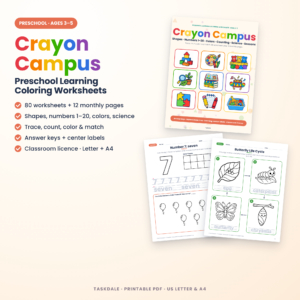
Crayon Campus Coloring Worksheets
Price: $4.99 | Best for: preschool and pre-K teachers and homeschoolers
Crayon Campus has 80 preschool worksheets in seven sections plus 12 monthly pages. The Simple Science section has 12 pages, including parts of a plant, what plants need, four life cycles (plant, butterfly, frog and chicken), weather watch, animal babies, animal homes and land, water or sky. You get US Letter and A4 PDFs, answer keys, a skills checklist and learning-center labels. Start with parts of a plant alongside the bean jar.
Animals: homes, babies and life cycles
Animals are where most children’s love of science begins. Coloring pages make three big animal ideas easy to teach.
Where animals live
Sort animals into land, water and sky. Color each one, cut it out, and glue it onto a big sheet divided into three parts. A duck makes a lovely debate: it walks, swims and flies.
Babies and grown-ups
Match a hen with a chick, a cow with a calf and a sheep with a lamb. Children color both, then draw a line between them. Learning the special names for animal babies is a favorite for four-year-olds.
Life cycles
Chickens, frogs and butterflies are the classic early life cycles. Color each stage, then cut them apart and ask your child to put them back in order. If they can sequence four pictures on their own, they understand the cycle.
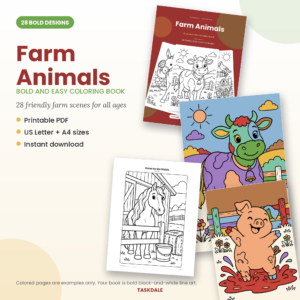
Farm Animals Coloring Book
Price: $3.49 | Best for: young learners studying farm animals
Farm Animals has 28 bold, friendly scenes including Hen with Eggs, Duck Family at the Pond, Fluffy Sheep in a Field, Friendly Cow in a Meadow and Rooster at Sunrise. Thick outlines suit small hands. It comes as US Letter and A4 PDFs, one design per page. Use Hen with Eggs to introduce the chicken life cycle.
For other habitats, from safari to ocean, see our roundup of animal coloring pages.
Weather: watching the sky
Weather is the one science topic children can study every single day. A weather chart by the window turns the morning routine into a tiny science lesson.
Simple weather activities
- Daily weather chart. Each morning, a child looks outside and colors the matching symbol: sun, cloud, rain, snow or wind.
- Dress for the weather. Color a child figure in clothes that suit today’s sky. Rain boots or sunhat?
- Cloud spotting. Lie on a blanket and look at clouds. Back inside, color fluffy, flat and wispy clouds.
- Weather graph. At the end of the month, count the colored symbols and make a bar chart. Which weather won?
Weather is also a great topic for imagination. Once children know the basics, a playful weather page lets them invent stories about where storms come from, which builds their vocabulary for wind, fog, rain and sunshine.
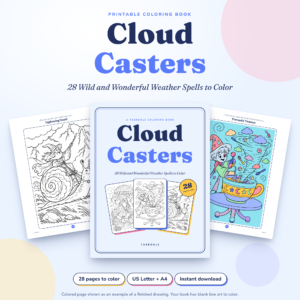
Cloud Casters Coloring Book
Price: $3.99 | Best for: kids who love weather and stories
Cloud Casters has 28 full-page scenes of weather wizards at work, such as Tornado Teacup, Fog Library and Cloud Bakery. The pages are imaginative rather than factual, which makes them good for weather vocabulary and creative writing after a real weather lesson. You get US Letter and A4 PDFs, single PNG pages and a user guide. Ask children to name the real weather on each page.
Older kids: nature study and detailed drawing
Children from about eight or nine are ready for more detailed science coloring. Scientists have long used careful drawings to study plants and animals, and older kids can try the same thing in a nature journal: color an animal or plant carefully, label its parts and write two facts beside it.
Detailed pages work well here because they reward close looking. A fox among ferns asks a child to notice fur, leaf shapes and patterns in a way a simple outline never does.
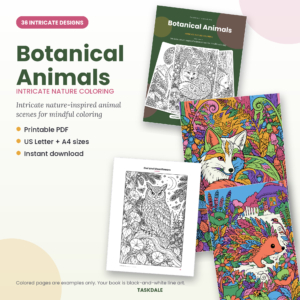
Botanical Animals Coloring Book
Price: $3.49 | Best for: older kids keeping a nature journal
Botanical Animals blends creatures and plants across 36 detailed scenes, such as Fern Fox, Hummingbird Hibiscus, Stag in Wildflowers and Hedgehog Garden. The finer lines suit children around nine and up. It comes as US Letter and A4 PDFs. Use Hummingbird Hibiscus to talk about how birds and insects help flowers make seeds.
For older students moving into biology, our look at anatomy coloring books shows how the same color-and-label method scales up.
A two-week science coloring plan
Here is a simple plan for ten school days, about twenty to thirty minutes each.
| Day | Topic | Coloring page | Hands-on |
|---|---|---|---|
| 1 | Parts of a plant | Labeled plant | Start the bean jar |
| 2 | What plants need | Sun, water, soil, air | Start the cress test |
| 3 | Plant life cycle | Seed to flower | Check the bean jar |
| 4 | Animal homes | Land, water, sky sort | Cut and glue sort |
| 5 | Animal babies | Hen and chick, cow and calf | Matching game |
| 6 | Frog life cycle | Egg to frog | Cut and sequence |
| 7 | Butterfly life cycle | Egg to butterfly | Fold-and-paint butterfly |
| 8 | Weather watch | Weather symbols | Start the daily chart |
| 9 | Dress for the weather | Clothes for today | Cloud spotting |
| 10 | Review | Child’s favorite page | Show and tell |
Day 10 is the best part. Each child picks one page and explains it to the group or a family member. Teaching it back is the clearest sign the learning stuck.
Turn any coloring page into a science worksheet
You do not always need a ready-made worksheet. Any clear coloring page can become one in five minutes.
- Pick a page with one clear subject. A cow, a flower, a cloud.
- Add three label lines. Draw lines pointing to parts, and write the words in dotted letters for tracing.
- Write one instruction at the top. “Color the leaves green. Trace the words.”
- Add one question at the bottom. “What does this animal eat?” with a box to draw the answer.
- Photocopy it. Your homemade worksheet is ready for the whole group.
This works well with animal and nature coloring books. One page of a hen with eggs can become a labeling sheet, a counting sheet and a life cycle starter, depending on what you write around it.
Science through the seasons
The calendar gives you a free science curriculum. Each season brings something new to notice, and a matching coloring page helps children record it.
- Autumn: falling leaves, seeds and nuts, animals storing food. Color leaves in the real colors you collected outside.
- Winter: snow, ice, animals that hibernate or migrate. Color a page of a sleeping hedgehog or a bird flying south.
- Spring: buds, baby animals, frogspawn in ponds. Perfect for life cycles and animal babies.
- Summer: bees, flowers, long sunny days and thunderstorms. Color a bee on a flower and talk about pollen.
Monthly pages make this easy. Hang the month’s page by the classroom door and let children add a drawing of something they noticed outside that week. By June, the door tells the story of a whole school year.
Mistakes that weaken a science coloring lesson
- Coloring without talking. The page is the hook. The conversation is the lesson. Ask at least three questions while children color.
- Too many ideas on one page. A worksheet about plants, weather and animals at once confuses young learners.
- Insisting on realistic colors. A purple frog is fine on a creative page. Save real colors for labeled diagrams, and explain why.
- Skipping the hands-on part. A real bean sprouting beats any picture of one.
- No review. Coming back to last week’s page for two minutes on Monday helps the words stick.
Classroom tips for science coloring
- Print in black and white. Good science worksheets are designed to print clearly without color ink.
- Keep a science folder per child. Pages go in after each lesson. By the end of a unit, each child has a science book of their own.
- Use real objects alongside. A real leaf, feather or pine cone on the table makes the page come alive.
- Check the license. Some sets include a classroom license for one teacher. Read the terms before sharing with colleagues.
- Read instructions aloud. Most children aged three to five cannot read them yet.
Frequently asked questions
What science topics are best for preschool coloring worksheets?
Parts of a plant, what plants need, animal homes, animal babies, simple life cycles and daily weather all work well for ages three to five.
Are coloring worksheets enough to teach science?
They work best alongside hands-on activities like growing a bean, sorting real leaves or watching the weather. The page helps children name and remember what they see.
How do I teach life cycles with coloring pages?
Color each stage, cut them apart and ask the child to put them back in order. Being able to sequence the pictures shows they understand the cycle.
What age are science coloring worksheets for?
Simple, bold worksheets suit ages three to six. Detailed nature pages and labeled diagrams suit children around eight and older.
How long should a science coloring activity take?
About twenty minutes for ages three to five and up to thirty for older children, including the talk and the hands-on part.
Can I use science coloring pages for homeschool?
Yes. A short daily routine of one page plus one hands-on activity fits easily into a homeschool morning.
Your next step
Tomorrow morning, start a bean jar and color a parts of a plant page with your learners while you wait for roots. To get the whole set of ready science pages with answer keys, download Crayon Campus and follow the two-week plan above.