You do not need a museum ticket to spend an evening with Van Gogh. A night sky, a pack of blue and yellow pencils and a little patience is enough. Borrow his swirling brushstrokes for one page and you will look at the sky outside differently on the walk home.
This guide is for curious adults, art-loving families and homeschool parents who want to try art coloring inspired by famous masterpieces at home. You will learn where to find free coloring pages based on classic paintings, how to borrow a painter’s technique for any coloring page, step-by-step ideas for six famous styles, and how to run a simple art night at the kitchen table.
Quick picks: pages that take a masterpiece style well
| Product | Best for | Price | Link |
|---|---|---|---|
| Orbit Pals Printable Coloring Book | Swirling night skies, kids and adults | $3.99 | View |
| Cozy Cottage Coloring Book | Soft, painterly gardens and cottages | $3.49 | View |
| Easy Mandala Coloring Book | Gold patterns and bold circles | $3.49 | View |
| Snug Hours Cozy Coloring Book | Flat color and window light indoors | $5.99 | View |
Where to find free masterpiece coloring pages
If you want an actual famous painting as a coloring page, there are a few honest places to look.
- Museum education pages. Many art museums publish free activity sheets based on works in their collections, made for school visits and families.
- Library and museum coloring campaigns. Each year, many libraries, archives and museums share free coloring pages drawn from their own collections, often under the hashtag #ColorOurCollections. Searching that tag turns up hundreds of downloadable pages.
- Open-access image collections. Several large museums let you download high-resolution images of older public-domain works for free. You can trace the main shapes yourself with a black marker over a printed copy and a sunny window.
A quick word on rights. Paintings by artists who died long ago, such as Van Gogh, Monet, Vermeer and Hokusai, are generally in the public domain, so making your own outline of them is fine for home use. Works by more recent artists may still be protected, and a museum’s own photo of a painting can carry its own terms. If you are making pages for a class or anything shared beyond your home, check the source’s terms first.
Free masterpiece pages can be uneven, though. Some are beautiful line drawings. Others are a muddy photo turned into outlines with a filter. That is why many people prefer a different approach.
Borrow the technique, not the picture
Here is the idea that makes masterpiece coloring so much fun: you do not need a copy of the painting. You need the painter’s way of using color. Swirls, dabs, dots, flat shapes, gold patterns. Every famous style comes down to a handful of habits you can copy with ordinary pencils and markers.
Take any coloring page, a cottage, a cat, a mandala, a space whale, and color it “as if” a famous painter had done it. The result is original, a little surprising, and often far more personal than a traced copy of a famous canvas. It is also a gentle way to learn about art. A ten-year-old who colors a planet in Van Gogh swirls tends to remember Van Gogh.
You do not need special supplies either. A 24-pack of colored pencils covers most styles. Add a set of fine-tip markers for Seurat’s dots and Klimt’s patterns, and one gold gel pen for a bit of shine. Everything else is technique, and technique is free.
The six styles below each work best on a particular kind of page. Start with the one that matches the pages you already have. For a quick refresher on picking good adult pages in general, our guide to coloring pages for adults covers free sheets and paid sets.
Van Gogh swirls for night skies
Van Gogh’s The Starry Night, painted in 1889, is probably the most famous sky in art. What makes it special is movement. The sky is not flat blue. It swirls and pulses, with short, curved strokes of color side by side.
How to color it
- Choose three or four blues (navy, cobalt, sky blue, turquoise) and two yellows.
- Instead of filling the sky smoothly, make short curved strokes, like commas, all flowing in the same direction.
- Let the blues sit next to each other in bands. Do not blend them.
- Around each star or moon, draw small rings of yellow and pale blue, as if the light is spinning.
- Press harder near the light sources and softer at the edges.
Any page with a big sky works. Space scenes are especially fun, because the swirls make planets and comets look like they are really moving.
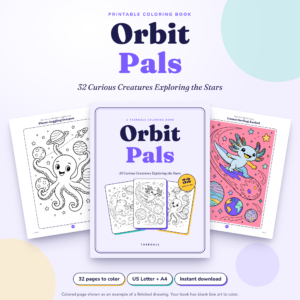
Orbit Pals Printable Coloring Book
Price: $3.99 | Best for: night skies for kids and adults
Orbit Pals has 32 original space animal pages, such as a comet-surfing axolotl, a planet-juggling octopus and a starry space whale, each full of stars, rings and craters. That big sky is perfect for Van Gogh swirls. It includes US Letter and A4 PDFs plus single-page PNGs for reprinting. Print the starry space whale twice: one smooth, one swirled, and compare.
Monet’s soft dabs for gardens and cottages
Claude Monet painted his water lilies and garden at Giverny again and again. His style, called Impressionism, is about light rather than detail. Up close, his paintings are made of small dabs and dashes of color. Step back, and they become a garden in afternoon sun.
How to color it
- Use short, quick dabs and flicks instead of long, careful strokes.
- Put pure colors side by side (a dab of yellow next to a dab of green) and let your eye mix them.
- Skip black for shadows. Use deep blue and purple instead, as the Impressionists often did.
- Let colors cross the lines a little. Soft edges are part of the look.
Garden and cottage pages are ideal, because they already have flowers, paths and windows catching light. A cottage gate colored in soft dabs of lilac, pink and leaf green looks like a summer afternoon in France.
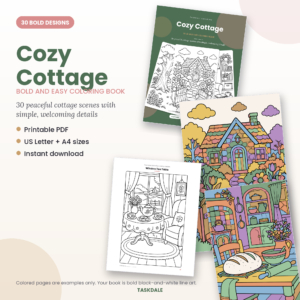
Cozy Cottage Coloring Book
Price: $3.49 | Best for: impressionist gardens and cottages
Cozy Cottage has 30 bold, easy scenes of home and garden: a cottage garden gate, a flower basket porch, a woodland cottage path, a vegetable patch and a cottage at sunset. Thick outlines and large shapes leave plenty of room for loose Impressionist dabs. It comes as US Letter and A4 files. Try the garden gate first, using only dabs and no black at all.
Klimt gold and Kandinsky circles for mandalas
Two very different painters, both perfect for round designs.
Klimt’s gold
Gustav Klimt’s best-known paintings, like The Kiss, glow with real gold leaf and are covered in small patterns: spirals, rectangles, circles and flowers. To borrow the look, color a mandala mostly in warm golds, ochres and browns, then add small patterns inside larger shapes with a fine marker. Finish with a metallic gold gel pen on the edges. Under a lamp, it really shines.
Kandinsky’s circles
Wassily Kandinsky painted a famous study of squares filled with rings of bright color, one circle inside another. Each ring is a strong, flat color that contrasts with the next: red inside green inside yellow inside blue. Mandalas are made of rings already, so this style is a natural fit. Pick six bold colors and never put two similar ones side by side.
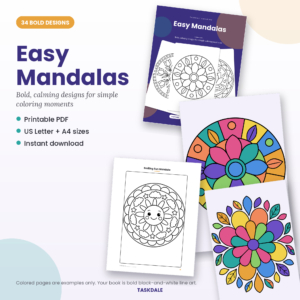
Easy Mandala Coloring Book
Price: $3.49 | Best for: Klimt gold and Kandinsky rings
These 34 bold mandalas, including a petal sun, a starburst, a heart bloom and a leafy garden mandala, have thick outlines and open rings that suit both styles. Each is its own page in US Letter and A4, and you can reprint favorites for personal use. Print the same design twice, then color one in Klimt gold and one in Kandinsky brights, and hang them side by side.
If you love bold geometric looks, our guide to geometric coloring books for adults has more pattern-heavy designs to try these styles on.
Matisse flat color and Vermeer window light for cozy rooms
Matisse
Henri Matisse loved bold, flat areas of color. In many of his room paintings, a table, a wall and a window are each a single strong color with almost no shading. Late in life he made famous paper cut-outs, bright shapes of pure color. To borrow it: choose five or six bright colors, fill each shape flat and solid, and make the wall or tablecloth a pattern of simple shapes. It looks joyful and modern.
Vermeer
Johannes Vermeer, a Dutch painter of the 1600s, painted quiet indoor scenes lit by soft daylight from a window. His trick was light. The side of the room nearest the window is bright and warm. The far side fades into soft shadow. To borrow it: decide where the window is, color the nearest surfaces in lighter, warmer shades, and gradually deepen the color as you move away. Add a small white highlight on anything shiny.
Cozy interior pages are perfect for both. Do one in Matisse brights and one in Vermeer light, and they will look like two entirely different rooms.
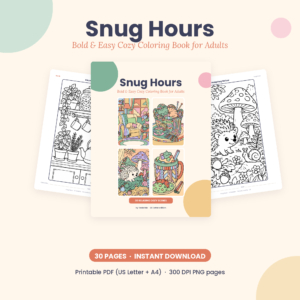
Snug Hours Cozy Coloring Book
Price: $5.99 | Best for: indoor scenes and window light
Snug Hours has 30 bold, easy cozy scenes, including a reading nook, a rainy window seat, a country kitchen shelf and a corner café, many with windows and lamps that are ideal for light effects. It includes US Letter and A4 PDFs, 300 DPI PNGs, a color test page and six palette ideas. Try the rainy window seat in Vermeer light first.
Three more styles to try on any page
Seurat’s dots
Georges Seurat built whole paintings out of tiny dots of pure color, a method called pointillism. Use fine-tip markers and fill an area with dots of two colors, such as blue and yellow for green grass. It is slow and strangely calming. Try it on one small area first, like a single leaf.
Mondrian’s grids
Piet Mondrian is known for paintings of black grid lines with a few blocks of red, yellow and blue on white. Pick any page with simple shapes and color only a few areas in pure primaries, leaving the rest white. Thicken a few outlines with a black marker.
Mondrian pages look striking framed in a plain black frame, and they are quick: a whole page can take 15 minutes. That makes them a good warm-up before a slower style like Seurat.
Hokusai’s waves
Katsushika Hokusai’s woodblock print of a great wave uses a limited palette of deep blue, pale blue and cream, with crisp, clawed foam. On any page with water or sky, use only three shades of blue and an off-white, and keep every edge sharp and clean.
Host a masterpiece art night at home
This makes a lovely family evening, a homeschool lesson or a calm night with friends. It needs about an hour and very little setup.
- Pick one painter. Look up two or three of their famous paintings together on a laptop or a library book. Spend five minutes looking. What colors do you notice? What kind of strokes?
- Hand out pages. Everyone gets the same page, or each person picks their own.
- Color for 40 minutes in that painter’s style. Play music from the same era if you like.
- Hold a mini gallery. Lay the pages out and give each one a title, like a museum label: “Space Whale, after Van Gogh, by Maya, age 9.”
For younger children, keep the looking time short and the instructions simple. “Van Gogh made his sky with lots of little curly lines. Can you do that?” is all a six-year-old needs. They will get the idea and make it their own.
Kids especially love the labels. There is something about writing “after Monet” under their own work that makes them stand a little taller. Do a different painter each month and by the end of the year you have twelve styles, twelve stories and a small, proud folder of art.
Frequently asked questions
Where can I find free coloring pages of famous paintings?
Look at museum education pages and the yearly library and museum coloring campaign often shared under #ColorOurCollections. You can also trace public-domain artworks from museum open-access images.
Is it legal to make coloring pages from famous paintings?
Older works by artists who died long ago are generally public domain and fine to trace for home use. More recent works may still be protected, so check before sharing.
How do I color like Van Gogh?
Use short, curved strokes in bands of blue and yellow, flowing in one direction, with rings of light around stars and moons. Do not blend smoothly.
What is the easiest famous art style for beginners?
Matisse-style flat color or Mondrian-style blocks. Both use bold, solid colors with no shading, so they look good quickly.
Can kids do masterpiece-inspired coloring?
Yes. Show them two or three paintings first, then let them copy the colors and strokes on a simple page. Van Gogh swirls and Matisse shapes are big favorites.
Your next step
Choose one painter tonight, look at three of their paintings for five minutes, and color one page in their style. Van Gogh is a good first choice because the swirls are easy and the result is dramatic. Start with a big night sky from Orbit Pals and a handful of blue and yellow pencils.