The coloring pages that work best with wax crayons have thick outlines, big open spaces and very few tiny details. Crayons have a blunt, waxy tip. They are wonderful for filling a sun, a sofa or a mandala petal, and frustrating in a space the size of a grain of rice. Match the page to the tool and crayon color goes from scratchy to rich.
This guide is for parents, grandparents, teachers and grown-ups who still love a box of crayons. You will learn what to look for on a page, which paper to print on, and the handful of techniques that make crayon color look bright and smooth instead of streaky and pale.
Quick picks: crayon-friendly printable books
| Product | Best for | Price | Link |
|---|---|---|---|
| Easy Mandala Coloring Book | Open mandala sections that suit blunt tips | $3.49 | View |
| Snug Hours Cozy Coloring Book | Bold cozy scenes for adults and teens | $5.99 | View |
| Orbit Pals Printable Coloring Book | Big space animals for kids around seven and up | $3.99 | View |
What makes a page good for crayons
Three things, in this order.
Line weight
Look for outlines at least as thick as a ballpoint pen line, and ideally thicker. Bold lines hold crayon color in place and hide the fuzzy edge that wax always leaves. On a page with hairline outlines, that fuzzy edge spills over and the drawing loses its shape.
Shape size
A good rule: most shapes on the page should be bigger than a thumbprint. A standard crayon tip covers about five millimeters, so a section smaller than that gets filled in one blob. Pages with a handful of large shapes and a few medium ones are the sweet spot.
Open background
Crayon pages look best with white space around the main picture. A dense background of tiny stars or pebbles takes forever with crayons and usually ends up half-done. Simple backgrounds let a child finish the page, and finishing is what makes them want another one.
If you want a quick way to judge a page on screen, zoom out until it is the size of a postcard. If you can still see every shape clearly, crayons will handle it.
Mandalas: a surprisingly good match
Mandalas sound fiddly, but easy mandalas are made of big repeating petals and rings. Each section is a closed shape, the outlines are bold, and the pattern tells you where to put each color. That makes them great for crayons, especially for older kids and adults who want a calm page.
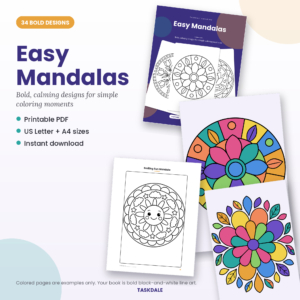
Easy Mandala Coloring Book
Price: $3.49 | Best for: crayon fans who like calm patterns
Easy Mandala has 34 bold mandalas with thick outlines and generous open spaces, including sun, daisy, heart, leaf and butterfly designs. You get US Letter and A4 files, and each design is its own page, so you can reprint a favorite for personal use. Start with a sun mandala and color one ring per crayon, working from the center out.
One tip for mandalas with crayons: work in rings, not slices. Coloring a whole ring with one crayon keeps your pressure even, so all the matching petals come out the same brightness.
The paper you print on matters more than the crayon
Crayon wax grips the tiny bumps on the paper surface. Too smooth and the wax slides around. Too rough and you get a speckled look, with white dots wherever the paper dips.
- Standard 20 lb copy paper: Fine for everyday kids’ coloring. It is thin, though, so heavy pressing can wrinkle it.
- 24 lb or 28 lb paper: A small step up that makes a big difference. Holds more layers and does not curl.
- Smooth cardstock (65 lb to 80 lb): The best all-round choice for crayon pages you want to keep or frame. It takes firm pressure without tearing.
- Textured or linen cardstock: Avoid it for crayons unless you want the grain to show on purpose.
A worked example: a teacher printing 25 copies of one page for a class can use copy paper. A grandparent printing a single page for a five-year-old to finish and send back in the mail should print on cardstock. It will arrive flat and the colors will still be bright.
Print at 100 percent or actual size with the best quality setting, so the outlines come out solid black. Faint gray lines vanish under crayon color.
How to get bright crayon color
Pale, washed-out crayon color usually comes from one thing: not enough wax on the paper. Here is how to fix that without tearing the page.
Layer, do not grind
Instead of pressing as hard as you can in one pass, color the shape three times with medium pressure. Each layer adds wax and fills more of the paper grain. Three medium layers look brighter than one heavy one and do not rip the sheet.
Light color first
If you are mixing, put the lighter crayon down first. Yellow then orange looks bright and warm. Orange then yellow looks muddy, because the yellow wax cannot cover the orange.
Use a white crayon to burnish
This is the trick that surprises people. Once a shape is fully colored, go over it hard with a white crayon. The white pushes the color into the paper, smooths out the speckles and leaves a soft shine. Kids call it the magic crayon. It is the white one nobody ever uses, finally earning its place in the box.
Warm crayons glide better
Crayons kept in a cold car or a chilly garage go hard and scratchy. Leave the box at room temperature for an hour before a coloring session and the wax goes on far more smoothly.
How to get smooth crayon color
Streaks and stripes come from strokes that all go in different directions, or from pressing hard on some strokes and softly on others.
- Small circles for big spaces. Tiny overlapping circles fill a sky or a wall evenly, with no visible stroke lines.
- One direction for long shapes. For a tree trunk or a stripe, color in strokes that follow the shape, all the same way.
- Use the side of the crayon. Peel back a little paper and lay the crayon on its side for large areas. It covers fast and evenly.
- Use the tip for edges. A crayon broken to a fresh corner gives a sharp point for outlines. Many families keep a few broken crayons for exactly this job.
For a grown-up, smooth crayon work on a cozy scene can look a lot like soft pastel. That surprises people who think crayons are just for kids.
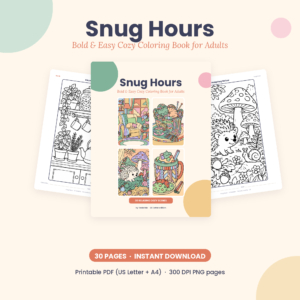
Snug Hours Cozy Coloring Book
Price: $5.99 | Best for: adults and teens using crayons
Snug Hours has 30 bold, easy scenes of everyday comfort: a cat in a reading nook, a bakery counter, a rainy window seat, a garden tea party and a snowy log cabin. It includes US Letter and A4 PDFs plus 300 DPI PNG pages, a color test page and six palette ideas. Try the rainy window seat with crayons and burnish the window glass with white for a soft glow.
Matching crayon types to pages
Not all wax crayons behave the same, and the page you choose should match the crayon in the child’s hand.
Jumbo and triangular crayons
Made for small hands from about age two. The tip is wide, so pick pages with very few, very large shapes. One animal, one sun, and nothing else.
Standard crayons
The classic box of 24. These handle most kids’ pages and easy adult pages. Shapes the size of a thumbprint or bigger are ideal.
Twistable and retractable crayons
Often a little softer and smoother. They do well on mid-detail pages, and they stay sharp longer because the tip is protected.
Beeswax blocks
Flat rectangles popular in some schools. Brilliant for big backgrounds and skies, awkward for outlines. Pair them with pages that have large open areas.
Kids’ pages that suit a box of crayons
For children of about seven and up, crayons are still a great choice, as long as the main subject is big. A space animal with a planet behind it is perfect: the animal and planet are large and easy, and the small stars can be dotted in with a fresh crayon tip or left white.
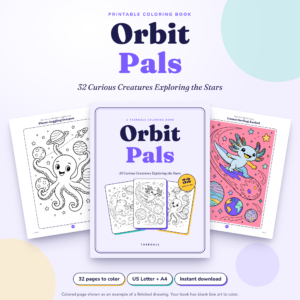
Orbit Pals Printable Coloring Book
Price: $3.99 | Best for: kids around seven and up
Orbit Pals has 32 full-page drawings of animals in space, like a comet-surfing axolotl and a planet-juggling octopus. You get US Letter and A4 PDFs plus a single-page PNG pack for reprinting one picture. Let younger kids color the big animal with crayons first and leave the tiny stars for later, or skip them.
For more ideas on picking pages by age, our guide to coloring pages for kids covers what works from toddlers up.
Setting up a crayon session that goes well
A little setup saves a lot of frustration, especially with children under eight. The goal is a table where nothing slows the coloring down.
- Pick eight crayons, not 64. Red, orange, yellow, green, blue, purple, brown and white. Fewer choices means more coloring and less rummaging.
- Put a placemat or a sheet of cardboard under the page. A hard, smooth surface gives even color. Coloring on a tablecloth or a carpet leaves the texture of the fabric showing through the wax.
- Tape the corners down for small kids. Two strips of masking tape stop the page from sliding around, which is half the battle for a three-year-old.
- Keep a sharpener and a scrap sheet nearby. Scribble on the scrap to warm up a crayon and check its color before it touches the real page.
On a rainy Saturday, this setup takes about two minutes and can buy you a calm 30 minutes. That trade is worth it every time.
Common mistakes with crayon pages
- Printing detailed adult pages for young kids. Intricate designs meant for fine pens will frustrate a child with a crayon. They give up, and that is not their fault.
- Using thin paper with heavy pressure. The page tears halfway through a sky. Use a heavier sheet.
- Peeling all the paper off every crayon. Bare crayons snap more easily. Peel only a centimeter at a time.
- Coloring dark over light in the wrong order. Dark first, then light, gives murky color. Light goes down first.
- Leaving finished pages stacked face to face. Wax transfers onto the back of the page above. Store finished pages in a folder with plain sheets between them.
Crayon resist and other fun extras
Once a page is colored, crayons let you do things markers cannot. Print a page on cardstock, color only parts of it with crayon pressed hard, then brush thin watercolor over the whole sheet. The wax pushes the paint away and the colored parts shine through. A night sky behind a space animal looks wonderful this way.
Another favorite is scratch art. Color a small section in bright crayons, cover it with a thick layer of black crayon, then scratch a design through the black with a paper clip. It is messy and loud and children love it.
If you are hunting for more pages to try these ideas on, see our guide to printable coloring pages for where to find good free and paid sets.
Frequently asked questions
What kind of coloring pages are best for crayons?
Pages with thick outlines, large shapes about the size of a thumbprint or bigger, and plain backgrounds. Easy mandalas, cozy bold scenes and big animal pages all work well.
What paper is best for coloring with crayons?
Smooth cardstock between 65 lb and 80 lb gives the brightest result and takes firm pressure. Standard copy paper is fine for everyday coloring, though it can wrinkle under heavy pressing.
How do you make crayon coloring look smooth?
Color in small overlapping circles with even pressure, build up two or three layers, and then go over the shape firmly with a white crayon to blend and smooth it.
Why do my crayons look pale on paper?
There is not enough wax on the page. Add more layers with medium pressure rather than one hard pass, and make sure the crayons are at room temperature.
Can adults use crayons on adult coloring pages?
Yes, on bold and easy designs. Crayons can look a lot like soft pastels when layered and burnished. Very detailed adult pages are better suited to fine pens or pencils.
How do I stop crayon wax smearing on finished pages?
Store each finished page with a plain sheet on top, or slip it into a plastic sleeve. For pages you want to frame, a light coat of fixative spray made for pastels helps lock the wax in place.
Your next step
Print one design from the Easy Mandala Coloring Book on cardstock, pull the white crayon out of the box, and color one ring at a time. Burnish each ring when you finish it. By the outer edge, you will see exactly how bright plain crayons can look.