A journal planner for plans and reflections closes a loop most people leave open. A planner looks forward: what will I do today? A journal looks back: how did today actually go? Kept in separate books, they never talk to each other. Kept on the same page, they start teaching you things. Tuesday’s reflection quietly shapes Wednesday’s plan, and after a month your plans get noticeably more realistic.
This guide is for people who have tried a planner and a journal and found that one of them always gets dropped. You will learn how the daily, weekly and yearly loops work, which reflection prompts actually change your plans, how much to write, and four Taskdale journal planners for paper or tablet.
No need to be a writer. Most of this takes five minutes in the morning and five at night.
Quick picks
| Product | Best for | Price | Link |
|---|---|---|---|
| Rise & Rest Digital Gratitude Journal | A five-minute morning plan and evening reflection | $4.50 | View |
| 2027 Cozy Doodle Journal | Weekly spreads, trackers and a year in review on paper | $21.99 | View |
| Turning Leaf Year in Review and 2027 Goal Planner | Looking back on 2026 before planning 2027 | $8.99 | View |
| Golden Hour Vision Journal | Turning a vision board into dated goals | $3.99 | View |
Why plans and reflections belong together
Plans on their own tend to be optimistic. You write eight tasks for Thursday, finish four, and feel bad. Then you write eight again on Friday. Without a reflection step, nothing tells you that four is your real number on a workday with two meetings.
Reflections on their own tend to drift. You write lovely pages about how stretched you feel, but nothing changes, because the insight never reaches the place where tomorrow gets planned.
Put both on the same page and the loop closes. Plan, do, reflect, adjust. A nurse working 12-hour shifts might notice, after a fortnight of evening notes, that she never manages errands on the day after a night shift. So she stops planning them there. Simple. But she only saw it because her reflection sat right above her next plan.
The daily loop: plan in the morning, reflect at night
The smallest loop is one day. It needs two short sections on one page.
Morning (3 to 5 minutes)
- Up to three intentions or must-do tasks.
- One line: what would make today good?
- A quick check: how did I sleep, how is my energy?
Evening (3 to 5 minutes)
- Three good things, however small.
- What got done, and what did not, without judgement.
- One note for tomorrow’s plan.
- A star rating for the day, one to five.
That last line in the evening, the note for tomorrow, is the hinge. It is where the reflection hands something to the plan. “Start the report before email.” “Leave Thursday evening empty.” “Ask for help with the bins.”
A page split into morning and evening halves makes the loop almost automatic.
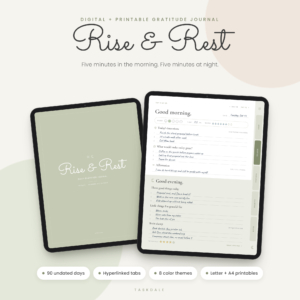
Rise and Rest Digital Gratitude Journal
Price: $4.50 | Best for: busy people wanting a five-minute habit
Rise & Rest has 90 undated daily pages numbered Day 1 to Day 90, each split into a morning section for intentions, what would make today great and an affirmation, and a tinted evening section for three good things, gratitude, a brain dump and a one-to-five star rating. A check-in strip tracks mood, sleep and water. It works as a hyperlinked PDF on iPad or Android, or you can print it. Start on Day 1 tomorrow morning, whatever the date.
For more ideas on the evening half, these gratitude journal prompts give 90 days of morning and evening questions.
The weekly loop: Sunday plan, Friday review
Daily notes catch small things. A weekly review catches patterns. Give it ten to fifteen minutes on Friday afternoon or Sunday evening.
Read the week’s daily pages, then answer four questions:
- What went well this week, and why?
- What did I plan that did not happen? What got in the way?
- Where did my energy go up, and where did it drop?
- What is one thing to do differently next week?
Then plan the coming week with those answers in front of you. If question two keeps showing “admin piled up”, block an admin hour on Monday. If question three shows energy dipping every Wednesday afternoon, stop scheduling hard tasks there.
There is a quiet pride in this. After six weeks, you can flick back through your reviews and see a person who knows herself a bit better than she did in week one.
A sample week, plans and reflections side by side
Here is how one week looked for Lena, a freelance illustrator with a school-age son:
| Day | Morning plan | Evening note |
|---|---|---|
| Mon | Finish book cover sketch, invoice March, gym | Sketch done. No gym. Invoice tomorrow. |
| Tue | Invoice, client call, start color pass | Call ran long. Color pass not started. Felt rushed. |
| Wed | Color pass only | Good day. One big task works better. |
| Thu | Color pass, school play at 2 | Lovely play. Work stopped at 1:30, that was fine. |
| Fri | Send cover, plan next week | Sent. Relief. |
Her Friday review wrote itself: one big task a day beats three medium ones, and client calls need a 30-minute buffer after them. Next week’s plan used both. That is the loop working.
Reflection prompts that improve your plans
Not every journal prompt helps with planning. “What is your favorite memory?” is lovely, but it will not change Tuesday. These prompts point straight at your next plan:
- What took longer than I expected today?
- What did I avoid, and what is the first small step on it?
- When did I feel most focused today?
- What drained me that I could say no to?
- Who helped me, and do I need to ask them again?
- If tomorrow goes well, what will I have done first?
Pick two and rotate them. Answer in a line or two. You are not writing an essay. You are leaving notes for future you.
If you like the idea of writing toward the person you want to become, this guide to future self journaling shows how to fold it into a daily page.
A journal planner on paper
A printed journal planner suits people who like to slow down with a pen. You can doodle, color in a mood tracker, stick in a ticket stub. The weekly spread sits open on the desk all week, with plans on one side and notes filling in as the days pass.
Look for weekly spreads with room to write, monthly trackers you can color, and a few yearly pages such as goals and a year in review. Those yearly pages are where the biggest reflections land.
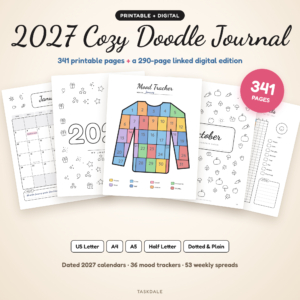
2027 Cozy Doodle Journal
Price: $21.99 | Best for: people who love coloring their pages
The 2027 Cozy Doodle Journal has 341 printable pages in black line art, plus a hyperlinked digital edition for iPad. It includes dated 2027 calendars and weekly spreads, 44 Year in Pixels trackers, yearly pages such as Word of the Year, Goals Bingo and a Year in Review, and a Page Finder index, in US Letter, A4, A5 and Half Letter, dotted and plain. Print January’s month pages and the first weekly spread, then add color as you go.
Comparing 2027 options before you print? This round-up of the best 2027 journals compares printable and digital picks.
A journal planner on a tablet
A tablet changes the feel but not the loop. The big advantage is links: tap from today’s page to this week’s review, or from a reflection straight to the goal it relates to. Nothing gets lost at the back of a binder.
Tablets also make it easy to keep going on busy days. A five-minute evening entry on the sofa, with a stylus, is easier than finding a pen and the right book. And because digital pages never run out, there is no reason to squeeze a reflection into a tiny box.
The trade-off is the screen itself. If you write your evening reflection on the same device you scroll on, it is tempting to drift off into messages. A simple fix: open the journal first, write, close it, and only then pick up anything else. Some people also keep the tablet’s notifications off during their journaling minutes. Small habit, big difference.
The yearly loop: review before you plan
November and December are the best time of the year for a journal planner. Most people jump straight to new goals. The better order is the reverse: look back at the year first, then plan the next one from what actually happened.
A good year review asks a handful of questions:
- Month by month, what stood out?
- What were my three biggest wins?
- What was hard, and what did it teach me?
- Which area of life got too little attention?
Only then pick goals for next year, and keep it to three. A goal that comes from “I noticed I never see my friends” is far more likely to last than one copied from a list of popular resolutions.
Book four check-ins across the year, one each quarter. They are the yearly version of the Friday review.
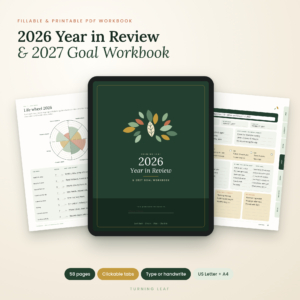
Turning Leaf Year in Review Workbook
Price: $8.99 | Best for: people closing out 2026 and planning 2027
Turning Leaf is a 58-page fillable and printable PDF with clickable side tabs. You look back with month-by-month notes, a life wheel, wins, hard parts and lessons, then plan three goals by quarter, design the habits behind them, track those habits month by month and return for four check-ins during 2027. Type into it on a computer or print it. Fill in the month-by-month look back first, before you go near the goal pages.
When your reflections point to a bigger goal
Sometimes a few weeks of reflection reveal something bigger than a better Tuesday. You keep writing that you want to change jobs. Or move closer to family. Or finally start that small business. At that point, a vision journal helps turn a recurring wish into a plan with dates.
The process is simple. Write what you want in a sentence. List the first three steps. Put a date beside the first one, ideally within a week. Then let your daily and weekly pages carry the steps. Reflection found the goal. Planning moves it.
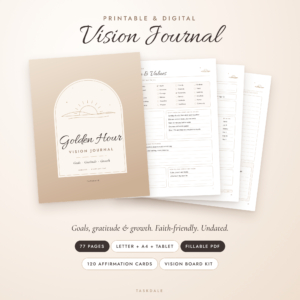
Golden Hour Vision Journal
Price: $3.99 | Best for: goal setters who want a real plan
Golden Hour is a 77-page undated vision board journal and goal planner in US Letter and A4, as a print-ready PDF, a fillable version and a linked tablet version, with 120 printable affirmation cards and a cut-out vision board kit. A 7-Day Kickstart walks you through values, a Wheel of Life, a dream day, a vision board and your first goal, then daily and weekly pages keep it moving. It is faith-friendly with an optional prayer section. Start with Day 1 of the Kickstart.
How much should you write?
Less than you think. Two or three lines per section is plenty for most days. Long entries feel good at first and then become a chore, and chores get skipped.
A useful rule: the daily page should take less time than making a cup of tea. The weekly review should take less time than a TV episode. The yearly review can take an afternoon, and it deserves one.
On hard days, write one line. “Rough day. Tomorrow: sleep first, plan second.” That still counts. A short honest entry beats a blank page every time.
Mistakes that break the loop
Reflecting without acting
If your evening notes never change your morning plans, the loop is open. Make the last line of every reflection a note for tomorrow.
Planning too much
Three tasks a day is a good start. Let your reflections tell you whether to add more.
Judging yourself on the page
Write what happened, not what it says about you. “Did not finish the report” is useful. “I am hopeless” is not.
Skipping the weekly review
Daily notes without a weekly look back are like photos you never look at. The pattern only shows when you read them together.
Frequently asked questions
What is a journal planner?
It is a planner with space for reflection as well as plans. Each day, week or year has a section for what you intend to do and a section for how it went, so your notes shape your next plan.
Should I journal in the morning or at night?
Both, briefly. Plan in the morning, reflect at night. If you can only do one, an evening reflection with a note for tomorrow gives you the most value.
What should I write in a reflection journal?
What went well, what did not and why, where your energy rose or fell, and one thing to try tomorrow. Two or three lines each is enough.
Is a digital journal planner as good as paper?
It depends on you. Digital journals are light and searchable. Paper ones feel slower and calmer and are easy to color and decorate. Many come with both versions.
When is the best time to do a year in review?
Late November or December works well, before you set goals for the new year. A mid-year check in June is a useful extra.
Your next step
Tonight, write three lines: what went well today, what did not, and one note for tomorrow. Tomorrow morning, read that note before you plan. That is the whole loop, in miniature. If you want a page that splits morning and evening for you, start Day 1 of the Rise & Rest Digital Gratitude Journal.