A name has one job before it does anything else. Someone hears it once, at a school gate or on a busy market day, and they need to find you again that evening. If they cannot remember it, or cannot spell it into a search bar, the best service in town loses the sale.
This guide is about business names that are easy to remember. It covers what makes a name stick, eight ways to build one, the tests you can run in a single afternoon with friends and strangers, and the habits that quietly make names forgettable. It suits anyone naming a new business, a shop, a side hustle or a product line.
Every example name below is made up for this article. Some are good, some are deliberately bad. You will see why.
Quick picks for naming and launching
| Product | Best for | Price | Link |
|---|---|---|---|
| Spark & Shingle Business Name Workbook | Brainstorming, scoring and checking names | $6.99 | View |
| Business Launch Planner | Name check, brand basics and the full launch plan | $14.99 | View |
| Business HQ Undated Small Business Planner | Running the business once the name is chosen | $3.95 | View |
What makes a name easy to remember
Memorable names tend to share a few plain traits. None of them are magic. They just make the name easier to hear, say, picture and type.
It is short
One to three syllables is the sweet spot for most small businesses. “Kettle & Crumb” is easier to carry home in your head than “The Artisan Bakery and Patisserie of Maple Grove”. Long names get shortened by customers anyway, often into something you did not choose.
It sounds the way it is spelled
If you have to say “that’s Kwik with a K” every time, the name is costing you. People search for what they heard. A name that is spelled the way it sounds lands in the right place on the first try.
It paints a picture
Brains hold onto images better than abstract words. “Blue Heron Landscaping” gives people a bird to picture. “Premier Solutions Group” gives them nothing. A concrete noun, an animal, a color or an object gives the name a hook.
It has rhythm
Repeated sounds stick. Alliteration (“Pip’s Pet Pantry”), rhyme (“Snip and Clip”) and a bouncy beat all help. Do not overdo it. One sound trick is charming. Three is a tongue twister.
It fits what you do
A name that hints at the work saves you explaining it. “Brightside Window Cleaning” needs no follow-up question. You can go more creative, but then the logo, tagline and first sentence on your page have to do more work.
Eight ways to build a memorable name
Staring at a blank page rarely works. Using a few naming methods gives your brain something to push against. Here are eight that tend to produce names people remember.
- Object plus trade. Pick a simple object connected to your work and add what you do. “Copper Kettle Catering”. “Lantern Lane Lighting”.
- Place names. A local street, hill, river or nickname. “Ridgeview Plumbing” tells locals you are nearby.
- Your own name, with a twist. “Rosa’s Rolling Kitchen” is warmer and easier to recall than “Rosa Mendez Food Services”.
- Compound words. Two short words glued together. “Leafnest”. “Tidybird”. Check the join reads cleanly.
- Metaphor. A word that captures the feeling you sell. A calm yoga studio might be “Still Water”. A fast courier might be “Swift Fox”.
- Alliteration. Two or three words starting with the same sound. “Bramble & Bloom”.
- An action word. Something that moves. “Lift Fitness”. “Spark Tutoring”.
- Invented words. Short, made-up and easy to say, like “Zoola” or “Pindle”. Memorable once learned, but you need to teach people what they mean.
Try each method for ten minutes and write every idea down, even the silly ones. A list of 40 rough names will usually hide five good ones.
A workbook with word banks and naming methods laid out takes the panic out of this step.
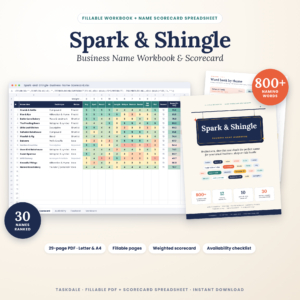
Spark & Shingle Business Name Workbook
Price: $6.99 | Best for: anyone stuck on a blank naming page
A 29-page fillable PDF workbook in US Letter and A4 with 16 themed word banks, words sorted by tone, and 12 naming techniques with fictional examples. It includes brainstorm pages, a 10-point shortlist scorecard that rates how easy a name is to say, spell and remember, an availability checklist and a feedback survey, plus an Excel and Google Sheets scorecard for up to 30 names. Start with the brand foundations page, then do a technique sprint.
Memorable names by type of business
What sticks for a plumber is not what sticks for a candle shop. The kind of business you run changes which naming style works best.
Local trades and services
Clarity wins here. People search “plumber near me” or ask a neighbor for “that window cleaner with the blue van”. A place name or object plus the trade works well: “Oak Hollow Electric”, “Bluebird Cleaning”. Customers remember the picture and the trade together.
Shops and makers
A bit more personality is welcome. Alliteration, a cozy object or a playful compound suits candle makers, bakers and gift shops: “Wick & Wren”, “Honeycomb Bakehouse”. Make sure the name still fits if you add new products next year.
Home-based and online businesses
Your name often lives in a web address and a social handle, so shorter is better and odd spellings hurt more. A home business also tends to change shape in its first year, so leave room to grow. Our guide to setting up a home business without wasting money covers the other early choices.
Advice and professional services
Bookkeepers, coaches and consultants often do well with their own name plus a clear word: “Hannah Cole Bookkeeping”. Trust is personal in these fields, and a real name helps people feel they know who they are hiring.
The habits that make names forgettable
Plenty of names fail the memory test for the same few reasons. Spot them early and you save yourself a rebrand.
- Generic words stacked together. “Quality Pro Services” sounds like a hundred other firms. Nobody can tell yours apart.
- Odd spellings for the sake of it. “Phlowr Phactory” might look clever on a logo. It is a nightmare on the phone.
- Initials. “JRT Solutions” means a lot to J, R and T. To customers it is three random letters.
- Trendy endings. Names ending in -ify, -ly or -io can feel dated fast and blur together.
- Too narrow. “Tuesday Cupcakes” is cute until you open on Saturdays and start selling bread.
- Hard to say out loud. If friends stumble over it, customers will too. And they will not recommend what they cannot pronounce.
Tests to run before you fall in love
You will probably have a favorite within a day. That is normal and slightly dangerous. Put your top five names through these quick tests before you get attached.
The phone test
Call a friend and say: “I’m thinking of calling the business Copper Kettle Catering.” Then ask them to text you the name. Did they spell it right? Did they remember all three words? This one test catches more problems than any other.
The next-day test
Tell five people your shortlist in passing, then ask them the following day which names they remember. The ones they recall without help are the ones customers will recall too. The ones they mix up are telling you something.
The noisy room test
Say the name in a busy cafe or across a crowded parking lot. Names with soft, similar sounds get lost in noise. Names with clear consonants carry.
The search test
Type the name into a search engine as someone would after hearing it. If the results are full of a big company with a similar name, your customers may end up there instead.
The logo test
Write the name by hand, small, in the corner of a page. Is it still readable? Does it look balanced? Long names get squeezed and lose their charm on a van door or a market banner.
Check it is free to use
A memorable name is no use if someone else already owns it. Before you print anything, run four quick checks.
- Your state’s business name search. Most states have a free online lookup for registered business names.
- The USPTO trademark search. Look for marks in your field that match or sound close to yours.
- Domain names. Check the .com and any local options you care about.
- Social handles. Check the two or three platforms you will actually use.
If a name fails one check, it does not always mean no. A taken handle can often be solved with a small add-on like “shop” or “studio”. A trademark clash in your own field is a different matter. Walk away from that one, or talk to a trademark attorney if you are unsure.
The naming step sits inside a bigger list of setup jobs, and it helps to see them together.
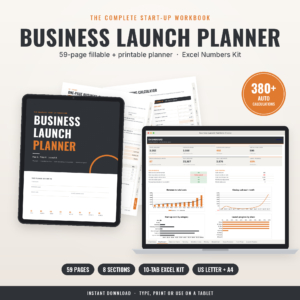
Business Launch Planner
Price: $14.99 | Best for: founders setting up from scratch
A 59-page fillable and print-and-digital PDF planner in US Letter and A4, plus a 10-tab Excel Numbers Kit. The Set Up section includes a business name checker, brand basics, business structure and registration notes, and a tracker for licenses, permits and insurance. Fill in the name checker with your top three names, then move straight to brand basics once one passes.
A worked example: from 40 names to one
Meet Tom, starting a mobile bike repair service in a hilly town. He gave himself one Saturday morning.
From 9am to 10am he brainstormed with the eight methods and wrote 42 names. Some were awful: “Tom’s Two-Wheel Tune-Up Team” was a mouthful. Some had promise: “Spoke & Sprocket”, “Hilltop Bikes”, “Pedal Rescue”, “Chainline”.
At 10am he crossed out anything over four words, anything with odd spelling and anything that did not hint at bikes. Twelve were left.
He picked his top five and did the phone test with three friends. “Spoke & Sprocket” kept coming back spelled “Spoke and Socket”. “Chainline” puzzled one friend who thought it was a jewelry shop. “Pedal Rescue” was spelled right every time and made people smile.
The next day, four of five people remembered “Pedal Rescue” without a prompt. The state search and domain check came back clear. By Sunday lunch he had a name, and a weight off his shoulders that he had been carrying for a month.
After you choose: make the name work hard
A good name gets stronger the more consistently you use it. Once it is chosen, put it to work.
- Use it the same way everywhere. Same spelling, same ampersand or “and”, same order on every sign, page and invoice.
- Add a short line underneath. “Pedal Rescue: bike repairs at your door.” The line does the explaining so the name can stay short.
- Say it often. Answer the phone with it. Put it on your email signature. Repetition is how names get remembered.
- Keep it on everything. Your van, your apron, your stickers, your receipts. Every small touch adds up.
Once the name is settled, the real work of running the business starts. Our guide to starting a business in your first 30 days picks up from here, and a planner keeps every part of it in one place.
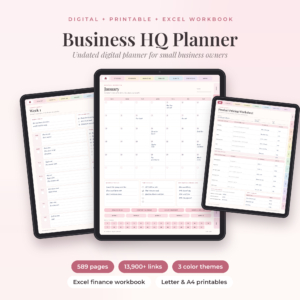
Business HQ Undated Small Business Planner
Price: $3.95 | Best for: new owners organizing the whole business
An undated hyperlinked digital planner for GoodNotes and similar apps, with printable US Letter and A4 pages and an Excel finance and pricing workbook. It gives strategy, products, pricing, marketing, money and clients their own sections, with a short prompt under every box. Start with the Start Here page, which points you to the six pages that matter most for your type of business.
Frequently asked questions
How long should a business name be?
Aim for one to three words and under about 15 letters if you can. Shorter names are easier to recall, type and fit on signs.
Is it a good idea to use my own name for my business?
It can be, especially for personal services where people buy you. Adding a word about what you do, or a little twist, makes it easier to remember and search.
Are made-up words good business names?
They can be very memorable once people learn them, and they are often easier to secure as domains. The trade-off is that you have to teach people what you do, so pair them with a clear tagline.
How do I know if a business name is catchy?
Test it. Say it to five people and ask them the next day what they remember. The names they recall unprompted are the catchy ones.
Should my business name include what I do?
It helps, especially for local service businesses where customers search by trade. A creative name can work too, as long as your tagline explains it.
What if my favorite name is taken as a domain?
Try a short add-on such as your town or trade, or a different ending. If a business in your field already uses the name, choose another to avoid confusion and legal trouble.
Your next step
Set a timer for one hour this weekend and write 40 names using the eight methods above. Then run the phone test on your top five. If you want word banks, a scorecard and an availability checklist ready to fill in, grab the Spark & Shingle Business Name Workbook.