Looking for a free birth plan template you can fill in tonight? Below you can download Bloomday Lite, a one-page visual birth plan with 12 icon tiles and tick boxes. Type into it on screen or print it and write by hand. Then read on for a simple, stage-by-stage guide to what a birth plan should include, how to word it, and how to make sure your care team actually reads it.
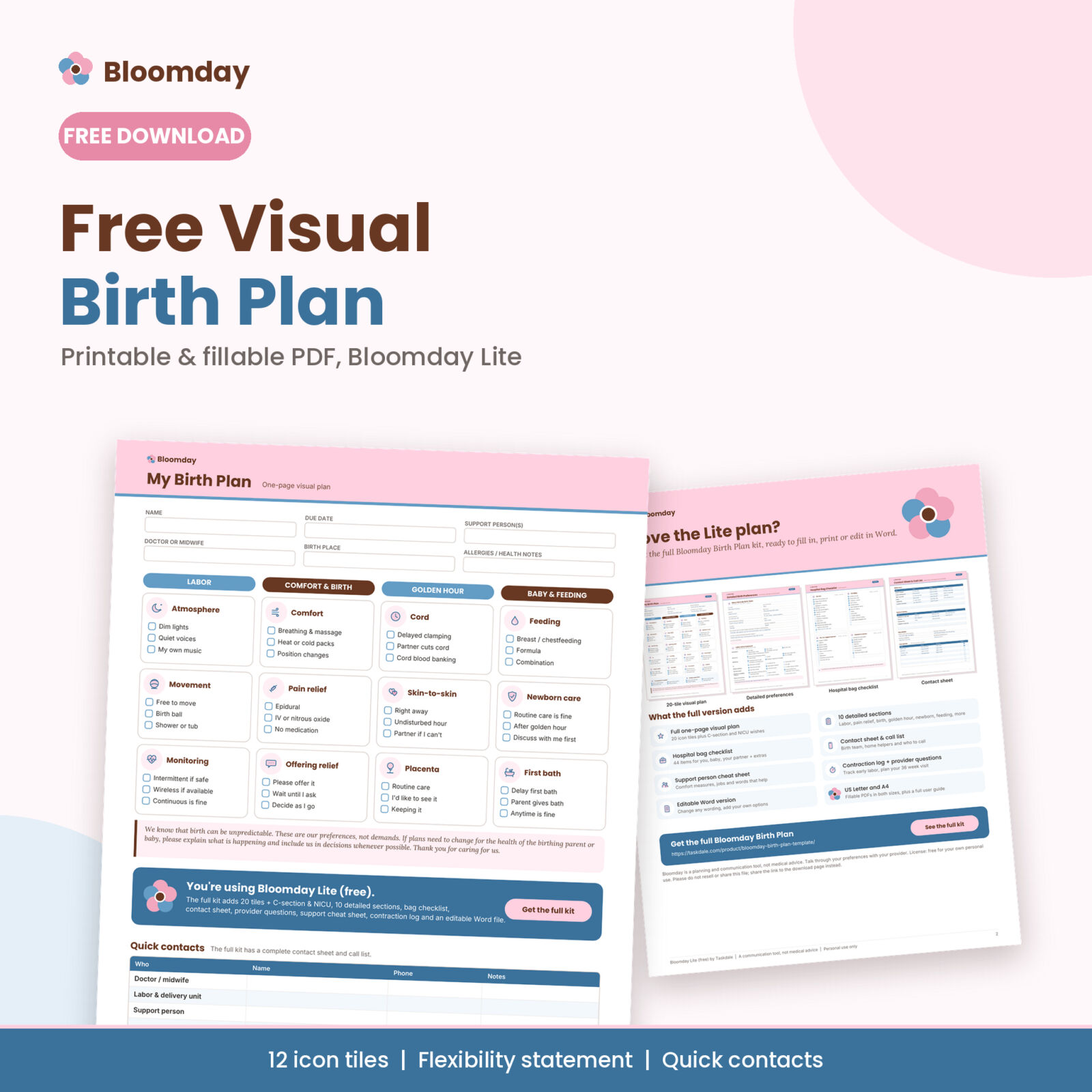
Bloomday Lite: Free Visual Birth Plan Template (Fillable PDF)
Get the free one-page visual birth plan with 12 icon tiles, a flexibility statement and quick contacts. Fill it in on screen or print it at home.
Want everything unlocked?
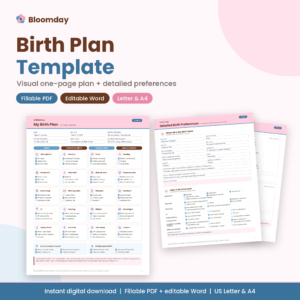
Birth Plan Template Printable & Editable | Bloomday Visual One-Page Birth Plan, Fillable PDF + Word
The free file is a sample. The full version has every page, tab and feature, plus the user guide.
See the full versionThe free download is a fillable PDF in US Letter size. You’ll need to enter your email address to get it, and free downloads are limited to 3 per day.
What is a birth plan, and do you need one?
A birth plan is a short document that tells your care team what matters to you during labor, birth and the first hours with your baby. It covers things like the atmosphere in the room, pain relief, who cuts the cord and how you plan to feed your baby.
It is not a contract, and it is not a script. Birth can change direction quickly. Think of your plan as a way to start a conversation, so the people looking after you know your wishes before you’re in the middle of a contraction and can’t explain them.
Do you need one? Not strictly. But writing one has a quiet benefit: it makes you learn your options. Many parents only find out about delayed cord clamping, intermittent monitoring or a clear drape during a cesarean because a template asked them about it.
What to include in a birth plan
A good birth plan follows the order of the day. Here are the sections that matter most, and the questions to ask yourself in each one.
1. The basics
- Your name and the name you like to be called
- Your due date, birth place, doctor or midwife and pediatrician
- Who will be with you, including a doula if you have one
- Allergies and any health notes the team should know
2. Labor and the room
How do you want the room to feel? Dim lights, quiet voices and your own music are common requests. Think about movement too: would you like to walk, use a birth ball or get in the shower? Ask your hospital how they usually monitor the baby, and whether a saline lock instead of a running IV is an option if everything is going well.
3. Pain relief
This is where wording matters most. Instead of a yes or no, many parents find it easier to choose a statement, such as “I’d like to try comfort measures first and decide as I go.” Also say how you want pain relief offered. Some people want to be asked. Others would rather ask themselves.
4. Pushing and the birth
- Pushing when you feel the urge, or guided pushing
- Positions you’d like to try
- Warm compresses and perineal support
- A mirror, touching your baby’s head, or discovering the sex yourselves
5. Cord, placenta and the golden hour
The first hour after birth is often called the golden hour. Common wishes include skin-to-skin right away, delayed cord clamping, a partner cutting the cord and waiting to weigh and measure the baby. If you plan cord blood banking, note the company and bring the kit.
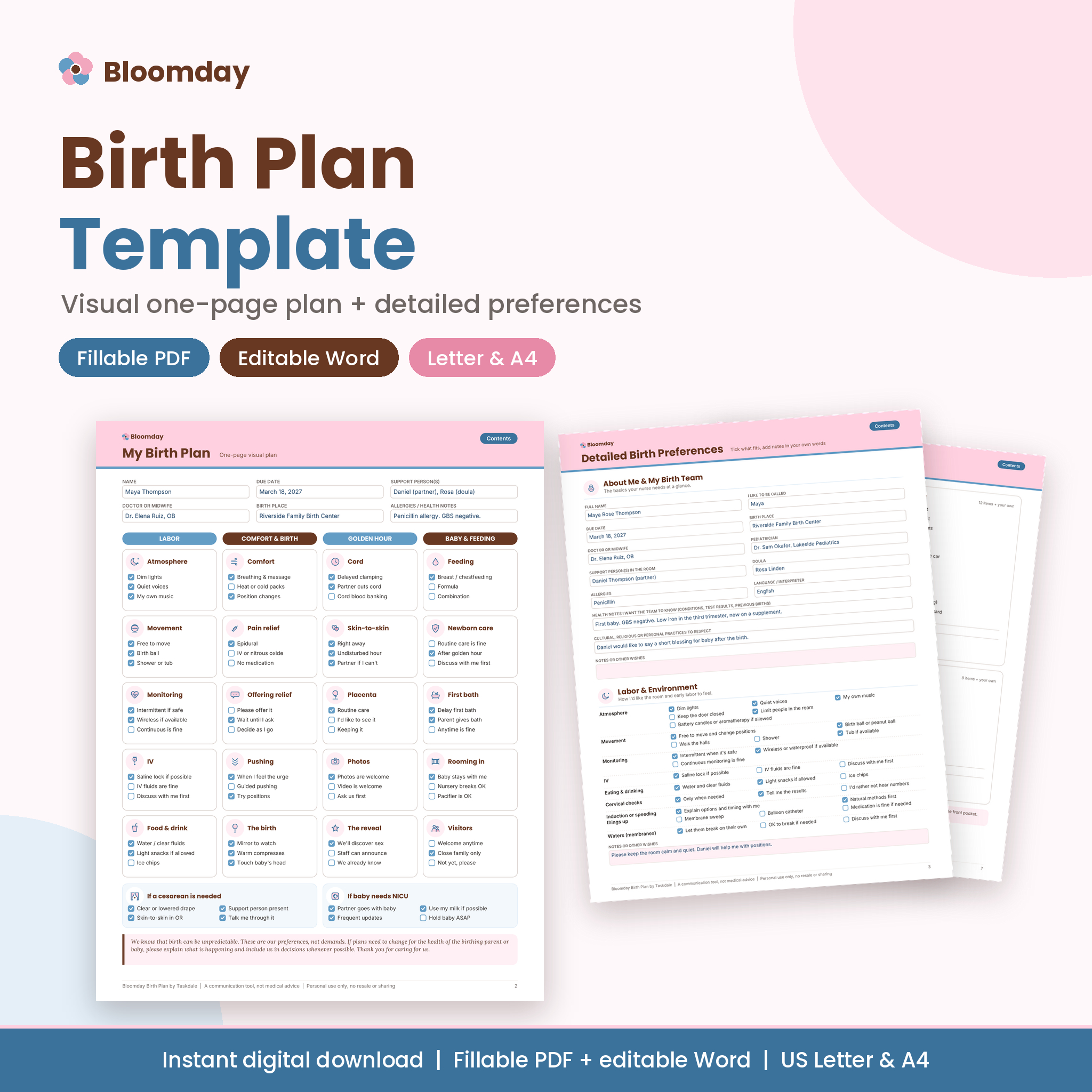
The complete visual birth plan with detailed preferences for every stage.
- 20 icon tiles plus C-section and NICU wishes
- 10 detailed sections from labor to going home
- Fillable PDF and editable Word, Letter and A4
6. Newborn care and feeding
Routine newborn care usually includes vitamin K, eye ointment and the hepatitis B vaccine. You can say whether you’re happy for these to happen as usual, after the golden hour, or after a chat with you first. Add your feeding plan: breastfeeding or chestfeeding, formula, combination feeding, or pumping. Every option is a good option. What matters is that the team knows how to support you.
7. If a cesarean is needed
This is the section most people skip, and the one they’re most glad to have. Even if you’re planning a vaginal birth, write down a few wishes: your support person with you, a clear or lowered drape, someone talking you through what’s happening, and skin-to-skin in the operating room if possible.
8. If your baby needs extra care
If your baby goes to the NICU, who goes with them? Would you like frequent updates, help to start pumping early, or photos if you can’t be there? A few lines here can make a stressful moment a little easier.
How to write a birth plan your nurse will read
Nurses work long shifts and care for more than one family. The most useful birth plans have a few things in common.
- Keep the main page to one page. A visual layout with icons and tick boxes is the fastest to scan.
- Use friendly wording. “I’d like” and “if possible” land better than “do not” or “I refuse.”
- Add a flexibility statement. One or two sentences saying you understand plans can change, and you’d like to be included in decisions.
- Skip what’s already standard. Ask your hospital about its routines first. You may find half your wishes are already normal practice.
- Review it with your provider. Weeks 34 to 36 are a good time. Bring a list of questions.
- Print several copies. One for your chart, one for your nurse, one for your support person and a spare for shift change.
When to write your birth plan
Most parents start around weeks 28 to 32. That leaves time to take a class, tour the hospital and talk it through with your provider before the final weeks. Keep a printed copy in your hospital bag from week 36.
How to use the free Bloomday Lite birth plan
- Download the PDF and open it in Adobe Acrobat Reader or a desktop browser.
- Fill in the six boxes at the top: name, due date, support people, provider, birth place and health notes.
- Tick the options that fit you in each of the 12 tiles. Leave blank anything you want to decide on the day.
- Add your key contacts at the bottom, save the file and print it at 100% scale.
The Lite version covers the core of labor, comfort, the golden hour and early baby care. It’s a solid one-page plan on its own. If you’d like more room, the full version adds the rest of the tiles, the detailed pages and the planning extras.
Everything you need to share your wishes and pack with confidence.
- Hospital bag checklist with 44 items
- Contact sheet, call list and provider questions
- Support person cheat sheet and contraction log
Frequently asked questions
Is this birth plan template really free?
Yes. Bloomday Lite is free for personal use. Enter your email to download it. Free downloads are limited to 3 per day.
Can I fill in the free birth plan on my computer?
Yes. It’s a fillable PDF. Type into the boxes and click the tick boxes, then save. Some phone apps can’t fill forms, so a computer or Adobe Acrobat Reader works best.
How long should a birth plan be?
Keep the page your nurse reads first to one page. If you want to share more detail, put it on separate pages for your provider.
Should I include a C-section section if I’m planning a vaginal birth?
Yes. Around one in three births in the US is a cesarean, and having your wishes written down in advance means nobody needs to ask in a rush.
What does the full version add?
The full Bloomday Birth Plan Template adds 8 more icon tiles, C-section and NICU tiles, 4 pages of detailed preferences across 10 sections, a hospital bag checklist, a contact sheet and call list, questions for your provider, a support person cheat sheet and a contraction log. It comes as a fillable PDF and an editable Word file, in US Letter and A4, with a full user guide.
Is a birth plan medical advice?
No. It’s a way to share your preferences. Always talk through your plan with your doctor or midwife.