Looking for a free tarot journal printable that does more than give you a blank box to write in? This one comes from Moonquill, a full tarot journal we designed for readers who want to learn the cards, not just log them. The free version is a real, usable sample: card meanings for the first three Major Arcana, a daily card pull page and a three-card spread page. Print it, or type straight into it on your computer.

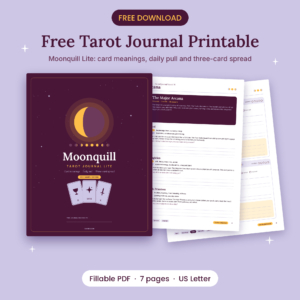
Moonquill Lite: Free Tarot Journal Printable
Get 7 fillable pages: card meanings for The Fool, The Magician and The High Priestess, a daily card pull page and a three-card spread. Print it or type into it.
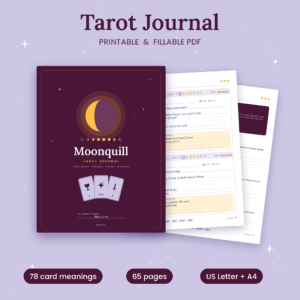
Want everything unlocked?
Tarot Journal Printable & Fillable PDF | Moonquill Tarot Card Meanings, Spreads and Moon Journal
The free file is a sample. The full version has every page, tab and feature, plus the user guide.
See the full versionThe download is free. You will be asked for your email address so we can send the file, and free downloads are limited to 3 per day.
What is inside the free tarot journal printable
Moonquill Lite is a 7-page fillable PDF in US Letter size. Here is what you get:
- A card meanings sample. The Major Arcana introduction plus The Fool, The Magician and The High Priestess, each with upright and reversed keywords, a short meaning, a journal prompt and space for your own notes.
- A daily card pull page with two entries. Each has the date, a moon phase selector, an energy scale, first impression, a message for the day and an evening check-in.
- A three-card spread page with blank position labels, so you can use Past, Present, Future or any layout you like.
- Printing and typing tips, plus a page that shows what the full journal adds.
Every line and check box is a form field. Open the file in a PDF reader that supports forms, click and type. If you prefer pen and paper, print it at Actual size.
Why keep a tarot journal at all?
Tarot is easy to start and hard to remember. You pull the Seven of Cups on Monday, it feels meaningful, and by Friday you cannot recall what you thought it meant. A journal fixes that. It gives you a record of what you drew, what you felt and what happened next.
Over a few weeks, that record becomes far more useful than any guidebook. You start to notice that a certain card appears whenever you are anxious about money, or that the Page of Cups shows up on days when an old friend gets in touch. These personal connections are what turn a list of keywords into real understanding.
A journal also keeps you honest. When you write your first impression before you look up a meaning, you can later compare the two. Sometimes your instinct was spot on. Sometimes it was wishful thinking. Both are worth knowing.
How to start a tarot journal in five steps
- Pick a time. Morning works well for a daily pull because you can check in again that evening. Five minutes is enough.
- Ask a simple question. Open questions work best: What do I need to focus on today? How can I handle this conversation well? Avoid yes or no questions while you are learning.
- Write your first impression first. Look at the card for a moment. Note the colors, the figures and how it makes you feel. Do this before you read any meaning.
- Then read the meaning. Compare the traditional meaning with your impression and write a one-line message for the day.
- Check in at night. Write two lines about how the card showed up. This step is where most of the learning happens, and it is the one most people skip.
What to write after a daily card pull
If you stare at a blank page, use these prompts. They work with any card and any deck:
- What is the first thing I noticed in this card?
- Which figure or symbol do I relate to today?
- Where in my life does this card feel true right now?
- If this card were advice from a friend, what would it say?
- What would the reversed version of this card look like in my day?
Keep entries short on busy days. Two honest lines every day will teach you more than one long entry a month.

All 78 card meanings, a month of daily pulls and seven spreads in one fillable PDF.
- Original upright and reversed meanings with a prompt for every card
- Celtic Cross, Five-Card Cross, Deck Interview and a custom spread designer
- US Letter and A4, plus a monthly refill pack
Three-card spreads worth trying
The three-card spread is the most flexible layout in tarot. The free printable leaves the position names blank on purpose, so you can try different versions:
- Past, Present, Future for a quick look at how a situation is moving.
- Situation, Action, Outcome when you need practical advice.
- Mind, Body, Spirit for a check-in with yourself.
- You, Them, The Connection for questions about a relationship or friendship.
- Option A, Option B, What to Know when you are choosing between two paths.
Write each position name above its card, note what each card says on its own, and then write the story they tell together. Finish with one thing you will actually do. That last line turns a reading into a decision.
How to spot patterns in your readings
Patterns are the real reward of keeping a tarot journal. A few simple habits make them visible:
- Count your suits. At the end of each month, count how many Cups, Wands, Swords, Pentacles and Major Arcana cards you drew. A month heavy in Swords often lines up with stress or big decisions. Lots of Cups usually points to emotions and relationships.
- Track repeat visitors. When a card appears three or four times in a month, give it a page of its own. Write what was happening each time.
- Note reversals. If you read reversals, count them too. A run of reversed cards can mean energy that feels blocked or delayed.
- Review monthly. Set a date, such as the first Sunday of the month, to read back through your entries and write a short summary.
Pairing your tarot journal with the moon
Many readers like to match their practice to the lunar cycle. At the new moon, pull cards about what you want to begin and write a few intentions. At the full moon, pull cards about what has come to light and what you are ready to let go of. In between, a single card at each phase is a gentle way to stay consistent.
You do not need special knowledge to start. Check a moon calendar or weather app for the current phase, then use it as the theme for your pull. Over a few cycles, you may notice that your readings feel different at different points in the month.
Tips for printing and typing
- Print at Actual size or 100% scale so the lines stay the right size.
- The pages are mostly white, so they are light on ink. Print in color for the accents, or grayscale to save more.
- Save a blank copy of the PDF before you type into it, so you always have a fresh master.
- Some browser PDF viewers let you type but do not save form data. If your text disappears, download the file and use a full PDF reader.
- Three-hole punch your printed pages and keep them in a binder with your deck.
Get the complete Moonquill journal
Turn a few free pages into a full year of tarot practice.
- New Moon, Full Moon and Lunar Cycle Tracker pages
- Monthly Review with a color-in suit balance chart
- Card Frequency Tracker for all 78 cards across twelve months
Frequently asked questions
Is this tarot journal printable really free?
Yes. Moonquill Lite is free for personal use. Enter your email address in the download box and the file is yours.
Why do I need to enter my email?
The download box sends the file to you after you enter your email. Free downloads are limited to 3 per day.
What does the full version add?
The full Moonquill Tarot Journal has 65 pages in US Letter and A4: original meanings for all 78 cards, a clickable Card Finder, a month of daily pull pages, a Month at a Glance log, the Five-Card Cross, a two-page Celtic Cross, a Deck Interview, a custom spread designer, New Moon, Full Moon and Lunar Cycle pages, a Monthly Review with a suit balance chart, a Card Frequency Tracker, Card Study and Year in Cards pages, plus a 33-page monthly refill pack and a user guide.
Does it work with any tarot deck?
Yes. The pages work with any standard 78-card tarot deck.
What paper size is the free version?
The free version is US Letter. It also prints on A4 if you choose Fit to page, although the margins will be slightly different. The full journal includes a dedicated A4 file.
Can I share the free file with friends?
Please send them a link to this page instead. The file is for your personal use, and sharing the link lets your friends get their own copy.