A good soap lye calculator tells you exactly how much lye and water your oils need. A great one also tells you what each bar costs and what to charge for it. This guide walks you through how lye calculations work, how to read soap quality numbers, and how to price soap and candles so you actually make money. You can grab our free soap lye calculator spreadsheet for Excel and Google Sheets right below.
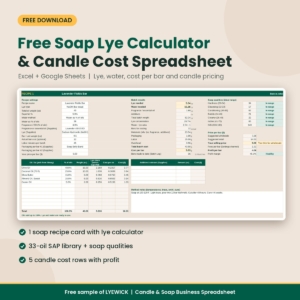
Free Soap Lye Calculator & Candle Cost Spreadsheet (Excel + Google Sheets)
A free sample of the Lyewick workbook: 1 soap recipe card with a working lye calculator, soap quality scores and cost per bar, a 33-oil SAP library, 20 supply rows and 5 candle cost rows with suggested prices and profit.

Want everything unlocked?
The free file is a sample. The full version has every page, tab and feature, plus the user guide.
See the full versionWhat is in the free soap lye calculator spreadsheet
The free sample is a working cut of our full Lyewick candle and soap making business spreadsheet. It is not a demo with locked results. It includes:
- 1 soap recipe card with a full lye calculator for NaOH bar soap or KOH liquid soap
- A library of 33 oils and butters with SAP values and fatty acid profiles
- Soap quality scores: hardness, cleansing, conditioning, bubbly, creamy, iodine and INS
- Cost per bar, suggested wholesale and retail prices and profit after fees
- 20 supply rows and 5 candle cost rows
- Settings for your currency, ounces or grams, labor rate and markups
How a soap lye calculator works
Every oil needs a set amount of lye to turn into soap. That amount is its saponification value, or SAP value. Olive oil needs about 0.135 units of sodium hydroxide for every unit of oil. Coconut oil needs more, about 0.183. Castor oil needs less.
The calculator multiplies each oil weight by its SAP value and adds them up. That is the lye needed to turn every drop of oil into soap. Then it takes off your superfat.
1. Pick your oils and percentages
Choose oils from the dropdown and type the percentage of each. A classic beginner bar might be 40% olive oil, 25% coconut oil, 15% shea butter, 15% sweet almond oil and 5% castor oil. The percentages must total 100%. The spreadsheet shows a clear warning if they do not.
2. Set your superfat
Superfat is the share of oil left unsaponified on purpose. It makes the bar milder and gives you a safety margin, because real oils vary a little from batch to batch. Most soap makers use 5% for body bars. Kitchen and laundry bars made mostly from coconut oil often go higher, up to 15% or 20%.
3. Choose a water method
The calculator gives you three ways to set water, so you can work the way you were taught:
- Water as % of oils: try 33 to 38. Higher water gives more time to work and swirl.
- Lye concentration: try 28 to 35. Higher concentration means less water and a faster unmold.
- Water to lye ratio: try 1.8 to 2.5 parts water to 1 part lye.
4. Read lye, water and batch weight
The highlighted cells show lye and water in your chosen unit. For a 40 oz batch of the recipe above with 5% superfat, you get about 5.54 oz of lye and 15.2 oz of water at 38% of oils. The sheet also shows fragrance weight, total batch weight and an estimate of how many bars you will cut.
Soap quality numbers, explained
Quality numbers come from the fatty acids in each oil. They do not replace testing, but they help you predict how a bar will feel before you make it.
- Hardness (29 to 54): how firm and long-lasting the bar is.
- Cleansing (12 to 22): how strongly it removes oil. Very high numbers can feel drying.
- Conditioning (44 to 69): how gentle it feels on skin.
- Bubbly and creamy: the two sides of lather, big bubbles versus dense cream.
- Iodine and INS: softness and overall balance for bar soap.
The spreadsheet marks each one Low, In range or High. A pure castile bar or a coconut scrub bar will fall outside the ranges on purpose, and that is fine.
How to price handmade soap and candles
Here is where most free lye calculators stop. They tell you how to make the bar, not what it is worth. Pricing by guesswork, or by copying the shop next door, is the fastest way to work for nothing.
Count every cost
Your cost per bar is more than oils and lye. Add fragrance, additives, the label or box, your labor and a share of overhead such as electricity, tools and molds. Time one batch with a timer. Most makers guess their labor too low.
Use the bars you actually cut
A loaf mold might promise 12 bars, but trimming and end pieces often leave you with 11. Type the real number into the spreadsheet and the cost per bar updates.
Apply a markup, then check the fees
A common formula is cost times 2 for wholesale, then wholesale times 2 for retail. The spreadsheet does this for you, then takes off selling fees for your chosen channel so you see real profit per bar. If your cost is more than about a quarter of your selling price, wholesale will be hard. The sheet flags that too.
Candles follow the same rules
For candles, type the jar capacity and fragrance load. The candle calculator uses a fill factor to work out wax and fragrance weights, then adds the jar, wick, lid, label and labor. You see cost, wholesale, retail and profit for each candle or wax melt.
Free sample vs the full Lyewick workbook
The free file is perfect for checking a recipe and pricing a few products. When you start selling regularly, the full version keeps your whole candle and soap business in one place.
| Feature | Free sample | Full Lyewick |
|---|---|---|
| Soap recipe cards with lye calculator | 1 | 8, with a recipe index |
| Candle and wax melt products | 5 | 40 |
| Supplies | 20 | 150 with stock on hand |
| Automatic supply deduction after each batch | No | Yes |
| Batch Log with cure dates and status | No | Yes |
| Batch Planner and soap batch scaler | No | Yes |
| Sales log with channel fees | No | Yes |
| Dashboard with 8 KPI cards and 4 charts | No | Yes |
| Step-by-step user guide | No | Yes |
See the full Lyewick candle and soap business spreadsheet
Lye safety basics
- Weigh lye on a digital scale. Never measure it by volume.
- Add lye to water, never water to lye, in a well-ventilated space.
- Wear goggles, gloves and long sleeves. Keep children and pets away.
- Run any new recipe through a second lye calculator before your first batch.
Frequently asked questions
Does the free soap calculator work in Google Sheets?
Yes. Upload the file to Google Drive and open it with Google Sheets.
Can I use grams?
Yes. Choose g in Settings. Every weight then uses grams and jar capacity switches to ml.
Can it calculate liquid soap?
Yes. Choose KOH as the lye type. KOH purity is set to 90% and you can change it.
Where do the SAP values come from?
They are the commonly published averages used by popular soap calculators. You can edit any oil or add your own.
Get your free soap lye calculator
Download the free spreadsheet, plug in your favorite recipe and see what each bar really costs. When you are ready to track batches, stock and sales too, the full Lyewick workbook is waiting.
Get the free soap lye calculator above ↑ (enter your email in the download box near the top of this page)