Kids remember what they do far better than what they hear. Tell a six-year-old about Zacchaeus and they may nod politely. Let them color Zacchaeus, cut him out, tape him to a craft stick and climb him up a paper sycamore tree, and they will tell the story to their grandmother on Sunday afternoon without being asked.
This guide shares fun, hands-on ways to use Bible coloring pages for kids so the stories stick: sequencing games, paper puppets, verse puzzles, Bible bingo and more. It is for parents, grandparents, homeschoolers and Sunday school helpers with children roughly 4 to 10. You will also find a list of New Testament stories that work brilliantly with these games, each with a short King James verse. Three Taskdale products are featured.
Quick picks for playful Bible learning
| Product | Best for | Price | Link |
|---|---|---|---|
| Ark and Star Bible Story Coloring Book for Kids | 40 story pages plus a maze, word search and story tracker | $4.99 | View |
| Friendship Fun Coloring Book | Kindness and “love your neighbor” follow-up pages | $2.99 | View |
| Psalm and Petal Bible Verse Coloring Pages for Adults | Parents coloring their own verse alongside | $4.49 | View |
Why games beat lectures for young children
Young kids learn through their bodies and their hands. Sitting still and listening for ten minutes is hard work at five. Moving, cutting, sorting and acting things out is how they naturally make sense of the world.
A coloring page on its own is already a step up from listening. The child looks closely at the picture, makes choices and spends time with the story. Add a simple game, and the page becomes a tool for retelling, ordering and remembering. That is when the story moves from “something I heard” to “something I know”.
There is joy in it too. A child who wins a round of Bible bingo or gets the story cards in the right order beams with pride. Learning about God becomes something they look forward to, not something they sit through.
Game 1: Story sequence cards
Perfect for ages 5 and up, and for any story with a clear beginning, middle and end.
- Choose a story and pick or draw four simple scenes. For Jesus calming the storm: the boat setting off, the big waves, Jesus standing up, the calm sea.
- Let your child color all four.
- Cut them apart and mix them up.
- Ask your child to put them in order and tell the story as they go.
Store each set in an envelope labeled with the story name. After a few weeks you have a small library of story sets, and kids love pulling them out to “teach” a younger sibling or a stuffed bear.
Game 2: Color, freeze and retell
Great for a group of kids at a table.
Everyone colors the same story page. Every few minutes, call out “Freeze!” All crayons go down. Point to one child and ask a question about the story: “Who was in the boat?” “What did Jesus say to the wind?” Answer correctly and everyone unfreezes and keeps coloring.
It keeps the story in the room while the kids color, and the giggles at every “freeze” keep energy high without chaos.
Game 3: Memory verse puzzle
For kids who can read a little, or with a helper for those who cannot.
- Write the memory verse in big letters on a strip of paper, or use the verse printed on the coloring page.
- Let the child color around or inside the words.
- Cut the verse into single words.
- Mix them up and rebuild the verse in order.
For Luke 10:37, “Go, and do thou likewise,” that is just five pieces. Perfect for a five-year-old. Older kids can tackle longer verses like John 13:34. Time them, then try to beat the time next week.
Game 4: Paper puppets and story theater
This is the one kids talk about for weeks.
- Color the characters from a story page.
- Cut them out carefully (an adult helps with the fiddly bits).
- Tape each one to a craft stick or a straw.
- Use a cardboard box or the back of a sofa as a stage.
- Act out the story. Grown-ups can narrate while kids move the puppets.
Zacchaeus in the tree is wonderful for this. So is the lost sheep, where one child hides the sheep puppet and another plays the shepherd searching for it. When the sheep is found, everyone cheers: “Rejoice with me; for I have found my sheep which was lost” (Luke 15:6).
A book with bold, friendly characters that are easy to cut out makes puppet day much simpler.
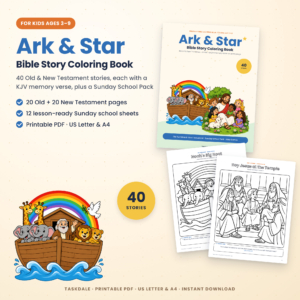
Ark and Star Bible Story Coloring Book
Price: $4.99 | Best for: story games for ages 3 to 9
Forty original story pages from Creation to Paul’s shipwreck, including Zacchaeus in the Tree, The Lost Sheep, Jesus Calms the Storm and He Is Risen. Each page gives the chapter to read and a short KJV memory verse. It also includes a Find the Lost Lamb maze, a Bible word search, a verse tracing page and a story tracker where kids color a star for each story. Try the Zacchaeus page for your first puppet show.
Game 5: Bible story bingo
A great review game after you have covered eight or more stories.
- Make a simple 3 by 3 grid for each child.
- In each square, draw or paste a tiny picture from a story you have colored: a star, a boat, a tree, a sheep, five loaves.
- Call out clues: “The man who climbed a tree to see Jesus.” Kids cover the matching square.
- Three in a row wins. The winner gets to choose next week’s story.
Kids get to recall stories from weeks ago, and the clues test real understanding rather than just picture matching.
Game 6: The story star chart
Simple, but powerful. Keep a chart on the fridge with every story you plan to cover. Each time your child colors a story and can retell it in their own words, they color a star beside it.
Watching the stars fill up is motivating. At 10 stars, celebrate with something small: a picnic, a special pancake breakfast, choosing the family movie. It is a gentle way to show that learning God’s Word is worth celebrating.
A simple game-day supply box
Nothing kills a fun activity faster than hunting for scissors while three kids wait. Keep one box ready, and game day takes two minutes to set up.
- A tub of crayons and a few washable markers.
- Child-safe scissors and one sharp pair for the grown-up.
- Craft sticks or paper straws for puppets.
- Tape and a glue stick.
- Envelopes for storing sequence card sets and verse puzzles.
- A few printed story pages, so you can start the moment someone asks.
Label the box clearly and keep it somewhere the kids can see. When a child pulls it out on a rainy Saturday and says “Can we do a Bible story?”, you will know the habit has taken root.
New Testament stories that work brilliantly
These stories have clear pictures, simple plots and natural games built in.
Jesus is born
Verse: “For unto you is born this day in the city of David a Saviour, which is Christ the Lord.” Luke 2:11
Game: Sequence cards with Mary and Joseph traveling, the stable, the shepherds and the angels.
The wise men follow the star
Verse: “When they saw the star, they rejoiced with exceeding great joy.” Matthew 2:10
Game: Hide a colored star somewhere in the house and let kids follow clues to find it.
Feeding the 5,000
Verse: “There is a lad here, which hath five barley loaves, and two small fishes.” John 6:9
Game: Count the loaves and fish on the page, then share a real snack with the family.
Jesus calms the storm
Verse: “Peace, be still.” Mark 4:39
Game: Wave a blue sheet for the storm, then everyone freezes when someone says the verse.
The lost sheep
Verse: “Rejoice with me; for I have found my sheep which was lost.” Luke 15:6
Game: Hide-and-seek with a colored paper sheep.
Zacchaeus in the tree
Verse: “Zacchaeus, make haste, and come down; for to day I must abide at thy house.” Luke 19:5
Game: Puppet show with a paper tree.
Jesus loves the children
Verse: “Suffer the little children to come unto me.” Mark 10:14
Game: Each child colors a small picture of themselves to stick around the page.
He is risen
Verse: “He is not here: for he is risen, as he said.” Matthew 28:6
Game: Color the tomb, then fold a flap of paper over the door to open on Easter morning.
To keep reading together beyond the coloring pages, our Bible reading plan for beginners offers a gentle pace you can adapt for family reading.
Learning kindness: from the Good Samaritan to everyday life
Some stories are about what God did. Others are about how we should treat each other. The Good Samaritan is the classic. Jesus ends it with a simple instruction: “Go, and do thou likewise” (Luke 10:37).
After coloring the Good Samaritan, follow up with everyday kindness. Pages showing friends sharing, helping and playing together give you a natural way to ask: “How could you be a good neighbor this week?” Then do it. Bake cookies for someone. Help a sibling tidy up. Draw a card for a lonely neighbor. The story moves from paper into life.
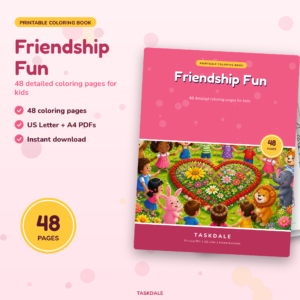
Friendship Fun Coloring Book
Price: $2.99 | Best for: kindness lessons for young kids
Forty-eight scenes of friends doing kind things together: sharing a picnic, building a block tower, rescuing a lost kite and holding hands in a sunny meadow. Each page has a short, kind line at the top. It is not a Bible book, but it pairs well with lessons on loving your neighbor. Color one page after the Good Samaritan and ask your child to name one kind thing to do this week.
Make it a weekly habit
Games work best when they are regular. Pick a time and protect it.
- Sunday afternoon: color and play a game about that morning’s sermon or lesson.
- Wednesday evening: a midweek story and a quick round of bingo.
- Bedtime: color one page in the evening and read the story from a children’s Bible before lights out.
Twenty minutes a week is enough. Over a year, that is more than 40 stories colored, played and remembered. For more ideas on coloring books kids enjoy, see our list of printable coloring books for screen-free days.
Tips for different ages
Ages 3 to 5: keep games very short. Puppets and hide-and-seek work better than puzzles. One verse, a few words long.
Ages 6 to 8: sequence cards, freeze-and-retell and verse puzzles are perfect. They love winning, so make it a gentle competition.
Ages 9 to 10: let them lead. They can narrate the puppet show, write bingo clues or teach a younger sibling. Responsibility makes them take it seriously.
Grown-ups can color too
Children copy what they see. When a parent sits at the table and colors their own verse page during story time, kids notice. It shows them that Scripture is not just for children, and that Mom or Dad values this time too.
It is also simply restful for you. Ten quiet minutes coloring a verse while the kids work on their story pages can be a calm pocket in a busy week.
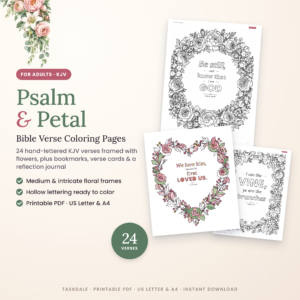
Psalm and Petal Bible Verse Coloring Pages
Price: $4.49 | Best for: parents coloring beside their kids
Twenty-four KJV verses in large hollow hand-lettering with floral frames, including John 3:16, Matthew 5:14 and Psalm 118:24. Pages are labeled Medium or Intricate, and the set includes verse bookmarks, verse cards and a Reflection Journal. Color a verse while your child colors their story page, then swap and read each other’s verse aloud.
Frequently asked questions
How can I make Bible stories fun for kids?
Turn coloring pages into games: put story scenes in order, make paper puppets, rebuild memory verses from cut-up words, or play Bible bingo with pictures from past stories.
What Bible stories are best for young children?
The birth of Jesus, the wise men, feeding the 5,000, Jesus calming the storm, the lost sheep, Zacchaeus and Easter morning are clear, hopeful and easy to act out.
How do I help my child memorize Bible verses?
Use short verses, say them together several times, and make a puzzle by cutting the verse into words to rebuild. Repeat the same verse for a week.
What age are Bible coloring games for?
Most of these games suit ages 4 to 10. Adjust by making games shorter for younger kids and letting older kids lead.
How often should we do Bible coloring activities?
Once or twice a week is plenty. A regular 20-minute slot works better than an occasional long session.
Your next step
Pick one story this week, color four simple scenes from it with your child, and play the sequence game before bed. For 40 story pages ready for games, plus a maze, word search and story tracker, start with the Ark and Star Bible Story Coloring Book for Kids.