Paper is the quiet half of every coloring page. The same marker can look rich and smooth on one sheet and blotchy on another. The same pencil can layer five times on good paper and only twice on cheap copy paper. Pick the right weight and your tools suddenly behave.
This coloring paper guide is for anyone who prints pages at home, whether that is a parent stocking up for rainy days, an adult who colors after work, or a crafter making cards. You will learn how paper weight is measured, which weight suits pencils, crayons, markers, gel pens and paint, and what your home printer can really handle.
At the end you will have a short shopping list. Two or three packs of paper, not ten.
Quick picks: printable pages to try on different papers
| Product | Best for | Price | Link |
|---|---|---|---|
| Friendship Fun Coloring Book | Kids with crayons on everyday paper | $2.99 | View |
| Marquee Me Personalized Name Coloring Pages | Cards, gift tags and door hangers on cardstock | $4.99 | View |
| Easy Mandala Coloring Book | Testing pencils, markers and paint | $3.49 | View |
| Swish & Shade Digital Coloring Pages for Kids | No paper at all, on a tablet | $4.99 | View |
How paper weight is measured, and why it confuses everyone
In most of the world, paper weight is listed in grams per square meter, or gsm. Higher number, thicker paper. Simple.
In the US, paper is listed in pounds, and here is the catch: different paper types are weighed at different sheet sizes. So 80 lb text paper is much thinner than 80 lb cover stock. That is why a 65 lb cardstock feels heavier than 32 lb printer paper even though the numbers look close. When in doubt, look for the gsm figure on the pack. Most brands print both.
| US label | Approx. gsm | What it feels like |
|---|---|---|
| 20 lb bond | 75 | Everyday copy paper |
| 24 lb bond | 90 | A little crisper, less see-through |
| 32 lb bond | 120 | Premium printer paper, smooth and solid |
| 65 lb cover | 176 | Light cardstock, like a greeting card insert |
| 80 lb cover | 216 | Sturdy cardstock, like a postcard |
| 110 lb index | 199 | Stiff, smooth card often used for recipe cards |
| 140 lb watercolor | 300 | Thick art paper made to take water |
Write the gsm figure you like on a sticky note inside your printer lid. Next time you are in a store aisle staring at 40 packs, you will know exactly which one to grab.
The best weight for colored pencils
Colored pencils care more about texture than weight. Paper with a little tooth, the tiny bumps on its surface, grabs pigment and lets you build layer on layer. Very smooth paper fills up fast and starts to feel slippery after two coats.
For most pencil work, 24 to 32 lb bond (90 to 120 gsm) is ideal. It is cheap enough to print freely, thick enough that firm pressure does not dent through to the next sheet, and it runs through every home printer. If you love heavy layering and burnishing, where you press hard with a light color to blend everything smooth, step up to 65 lb cardstock. It takes the pressure without curling.
A quick test: color a small square with four layers, light to dark. If the fourth layer still adds color, the paper has enough tooth. If it slides around and smears, try a paper with a less polished finish.
Crayons and young kids: keep it cheap
Crayons are the easy case. Wax sits on top of almost any paper and never bleeds. Standard 20 lb copy paper is perfectly fine, and that matters when a four-year-old colors one corner of a page and asks for a fresh one.
The only time to step up is when you want the finished page to last. A picture headed for Grandma’s fridge or a birthday card holds up better on 65 lb cardstock. For everyday rainy afternoons, save your good paper and print freely. Big friendly scenes with simple shapes suit crayons best.
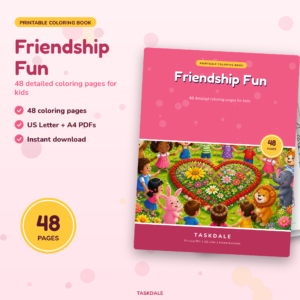
Friendship Fun Coloring Book
Price: $2.99 | Best for: kids who color with crayons
This printable book has 48 scenes of friends playing and helping each other, from a picnic under a tree to a snowy mitten walk, each with a short kind message at the top. The US Letter and A4 PDFs print with sharp, dark lines and only the cover uses color, so pages are easy on ink. Print a handful on plain copy paper and save cardstock for the one your child wants to give away.
The best weight for markers
Markers put liquid on paper, so weight matters a lot here. Thin paper lets ink bleed through, ghost onto the back, or pill up into little fuzzy balls when you go over the same spot twice.
Water-based markers
For classic felt tips and brush pens, 65 lb cover cardstock is the sweet spot. Colors stay bright, the surface does not pill, and the sheet will not buckle. On 32 lb paper they work fine with a light touch, but expect a shadow on the back.
Alcohol markers
Alcohol ink travels through paper fibers fast. It will bleed through almost anything a home printer can take, including heavy cardstock. Use 80 lb cover or heavier for less spread, and always keep a scrap sheet underneath. A smooth, bright white surface helps the ink blend evenly.
One more marker tip: if you print on an inkjet, let the page dry for ten minutes before you color. Fresh inkjet lines can smudge when a wet marker crosses them. Our guide to the best markers for adult coloring books goes deeper on specific marker types and how each one treats paper.
Gel pens and fineliners
Gel pens and fineliners like a smooth surface. Tooth that helps pencils makes a gel pen skip and a fineliner catch. Bright white 32 lb printer paper is a great match, and so is smooth 65 lb cardstock.
Gel ink sits on top of the paper and takes a little while to dry, especially metallic and glitter colors. Color from the top of the page down, or from left to right if you are right-handed, so your hand never drags through wet ink. A sheet of scrap paper under your wrist works too.
Paint on printed pages: watercolor, watercolor pencils and gouache
Paint is where most printed pages fail. Water makes thin paper buckle into waves, and it can make some printer ink run. Here is how to get it right.
Check your printer first
Laser printers fuse toner to the paper with heat, so the lines stay put under water. Many inkjet inks are water-soluble, which means a wet brush can turn your crisp black outline into a gray smear. If you have an inkjet, test a corner with a damp brush before painting a whole page.
Pick a paper your printer can feed
True watercolor paper is around 300 gsm (140 lb) and too stiff for most home printers. Mixed media paper or heavy cardstock around 200 to 250 gsm is a workable middle ground if your printer has a straight-through or manual feed slot. Check the weight limit in your printer manual before you buy.
Use less water
Watercolor pencils are the friendliest way to paint on printed pages. Color as normal, then go over each area with a barely damp brush. You get the soft painted look with a fraction of the water. Gouache, used thick, also works better on cardstock than runny watercolor.
Or trace it
For a page you want to paint properly, print it on regular paper, tape it to a sunny window or a light pad, and trace the lines onto real watercolor paper in pencil. More work, but the result can be framed. Our post on water coloring book pages has more ideas for paint-friendly pages.
Tame the buckle
Even on cardstock, a painted page can ripple as it dries. Tape all four edges to a board or a clean cutting mat with painter’s tape before you start, and leave it taped until it is bone dry. Peel the tape off slowly, pulling away from the paint, and the page will lie much flatter.
Cardstock projects: cards, tags and keepsakes
Some coloring pages are not meant for a folder. They become birthday cards, gift tags, bookmarks or a sign for a bedroom door. These need cardstock, both so they stand up and so they survive little hands.
For folded cards, 65 lb cover stock folds cleanly without cracking. For tags, bookmarks and door hangers, 80 lb or 110 lb index holds its shape better. Score the fold first with the back of a butter knife and a ruler, and the crease will come out sharp.
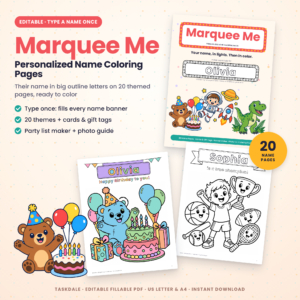
Marquee Me Personalized Name Coloring Pages
Price: $4.99 | Best for: parents making cards and party favors
Type a child’s name once in this fillable PDF and it appears in big outline letters on 20 themed coloring pages, from dinosaurs to space and ballet. It also has eight foldable greeting cards, eight gift tags, two door hangers and four bookmarks, in US Letter and A4. Print the name pages on copy paper and the cards and tags on 65 to 80 lb cardstock.
When to skip paper altogether
Sometimes the best paper is no paper. On a long car ride, in a waiting room or on a plane, a tablet beats a stack of sheets and a bag of markers. Digital coloring also lets kids try paint-style effects, like soft brush textures, without a single buckled page or wet table.
It is not a full replacement. Holding a pencil builds hand strength in a way a fingertip does not, and many kids enjoy the feel of paper. But as a travel option, it is a relief for parents.

Swish & Shade Digital Coloring Pages for Kids
Price: $4.99 | Best for: travel days and mess-free coloring
Swish & Shade has 60 digital coloring pages in four sets: toddler, kids, detailed and a phone-shaped travel set. Pages come as transparent PNG line art plus a hyperlinked PDF for GoodNotes, Notability and Xodo, and it works offline once downloaded. Load it onto a tablet before a trip and let kids try brush textures with no paper to buckle.
Signs you picked the wrong paper
Your page will tell you when the paper is wrong. You just need to know what to look for.
- Little fuzzy balls on the surface. The paper is too soft for your markers. Move up to cardstock or go lighter with each stroke.
- Dots of color on the table. Bleed-through. Use heavier paper and a scrap sheet, or switch from alcohol to water-based markers.
- Pencil that stops adding color. The tooth is full. Try a paper with a slightly rougher finish, or press more lightly in the early layers.
- Waves and ripples after painting. Too much water for the weight. Use watercolor pencils, less water, or tape the page down.
- A page that jams halfway through the printer. Too heavy for the main tray. Try the manual feed slot, or drop one weight.
- Gray, washed-out lines. Usually the print setting, not the paper. Switch from draft to best quality.
None of these mean you did anything wrong. They are just clues. Fix the paper and the same tools will feel brand new.
A small paper drawer that covers everything
You do not need ten kinds of paper. For a family or a single colorist, three packs cover almost every job:
- A ream of 24 lb bond. Crayons, quick pencil pages, kids’ practice sheets.
- A pack of 32 lb premium printer paper. Pencils with layering, gel pens, fineliners, pages you want to keep.
- A pack of 65 lb cardstock. Markers, cards, framing and light paint work.
Add a small pad of watercolor paper only if you start painting often. Label each stack with a sticky note so nobody prints a crayon page on your good cardstock. It happens. Usually on a Saturday morning.
Frequently asked questions
What weight paper is best for coloring pages?
For most people, 24 to 32 lb printer paper (90 to 120 gsm) is best for pencils and crayons, and 65 lb cover cardstock (about 176 gsm) is best for markers. Use heavier stock for paint or for pages you plan to frame.
Is 65 lb cardstock good for markers?
Yes, for water-based markers it is excellent. It stops pilling and keeps colors bright. Alcohol markers can still bleed through, so use 80 lb or heavier and put a scrap sheet underneath.
Can I use watercolor on printer paper?
Only very lightly. Regular printer paper buckles with water. Watercolor pencils with a damp brush on cardstock work much better, and laser-printed lines hold up better to water than most inkjet lines.
What is the difference between gsm and lb paper weight?
Gsm measures the weight of one square meter of paper, so it compares any paper type fairly. US pound weights depend on the paper category, which is why 80 lb text paper is thinner than 65 lb cover stock.
Can my home printer handle cardstock?
Most printers handle 65 lb cardstock. Heavier stock depends on your model, so check the maximum paper weight in the manual and use the rear or manual feed tray when there is one.
Your next step
Print the same page on your everyday paper and on one sheet of 65 lb cardstock, then color half of each with your favorite pencils and half with markers. Put them side by side and you will see your answer straight away. A bold mandala makes a good test page, so grab the Easy Mandala Coloring Book and start there.