Colored pencils are only the start. Run a silver gel pen along the edge of a leaf and the page catches the light. Brush a little watercolor over a forest sky and it suddenly has weather. Add a few sequins to a party dress and a six-year-old will carry that page around the house all afternoon.
This guide is for crafty adults, parents and teachers who want creative coloring book projects using gel pens, paint and embellishments. You will learn which paper handles which tool, step-by-step projects for each medium, mixed-media ideas for kids, how to protect finished work, and the common mistakes that turn a lovely page into a soggy one.
Quick picks: coloring books that suit mixed media
| Product | Best for | Price | Link |
|---|---|---|---|
| Ancient Forests Coloring Book | Watercolor and gel pen detail for adults | $2.99 | View |
| Easy Mandala Coloring Book | Metallic and glitter gel pen practice | $3.49 | View |
| Friendship Fun Coloring Book | Kids’ collage and sticker projects | $2.99 | View |
| Indoor Activities Coloring Book Adventure | Rainy-day 3D and collage crafts | $2.99 | View |
Start with the paper, not the pens
Here is the biggest secret of mixed-media coloring: the paper decides what you can do. Thin store-bought pages buckle under paint and tear under glue. That is one big advantage of printable coloring books. You choose the paper before you print, so the page is ready for whatever you plan to put on it.
| Paper | Rough weight | Good for | Avoid |
|---|---|---|---|
| Copy paper | 20 to 24 lb (75 to 90 gsm) | Pencils, crayons, light gel pen | Paint, heavy glue, alcohol markers |
| Cardstock | 65 to 80 lb (175 to 215 gsm) | Gel pens, markers, glitter glue, light collage | Wet watercolor washes |
| Mixed-media paper | About 90 to 100 lb (around 160 to 180 gsm, heavier sizing) | Watercolor pencils, light paint, gel pens, embellishments | Very heavy acrylic layers |
| Watercolor paper | 90 lb and up (190 gsm and up) | Real watercolor washes | Printers that cannot feed it |
Check your printer’s manual for the heaviest paper it takes, and feed thick sheets one at a time through the rear or manual tray. If your printer refuses, print on regular paper and take that page to a copy shop to run onto heavier stock. Laser and copier toner also holds up better under water than some inkjet inks, so test a corner before you paint.
Gel pen projects: shine, sparkle and fine detail
Gel pens are the easiest way to make a coloring page look special. They come in metallic, glitter, pastel and neon sets, and they add something pencils cannot: shine. A page colored entirely in gel pen can look a bit loud, though. The best results usually come from mixing tools.
Project 1: metallic accents on a pencil base
- Color the whole page in colored pencil first, with soft shading.
- Pick one metallic gel pen, gold or silver.
- Trace only the edges of a few shapes: petal tips, the rim of a circle, the veins of a leaf.
- Let it dry for a minute before your hand moves over it.
That single pass of metallic turns a nice page into one that looks finished and a little bit precious.
Project 2: dots and patterns
Fill a large plain area (a background or a big petal) with tiny gel pen dots, lines or swirls. White gel pen dots on a dark blue sky make stars in seconds. White gel pen is also the best way to add highlights, like a gleam on an eye or a shine on a wet leaf.
Mandalas are ideal for practice, because the shapes repeat. You can try a new technique on one ring and keep the next ring simple.
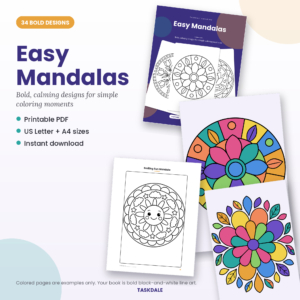
Easy Mandala Coloring Book
Price: $3.49 | Best for: gel pen beginners of any age
These 34 bold mandalas, including a petal sun, a starburst, a heart bloom and butterfly wings, have thick outlines and open spaces that suit gel pens well. Each design is its own page in US Letter and A4, and you can reprint a favorite for personal use. That means you can test metallics on one copy and glitter on another. Print the starburst on cardstock and try gold edges on every other ray.
Painting your coloring pages
Paint opens up soft skies, misty backgrounds and glowing light that pencils struggle to reach. You do not need to be a painter. A few simple approaches work on printed line art.
Watercolor pencils
The gentlest way in. Color the page with watercolor pencils as you normally would, then go over the area with a damp (not wet) brush. The pencil melts into soft paint. You stay in control, and the outlines stay sharp.
Watercolor washes for backgrounds
Print on mixed-media or watercolor paper. Wet the sky area lightly with clean water, then drop in diluted blue at the top and a touch of pink or yellow near the horizon. Let it spread on its own. Once it is fully dry, color the trees, animals and details in pencil or marker on top. Backgrounds painted this way look calm and airy.
Acrylic paint pens
Paint pens give opaque, flat color, like a marker that covers anything. They are great for small solid areas and for adding white or light details over darker color. Use them on cardstock or heavier.
Detailed nature scenes are lovely for paint because there is so much variety: sky, water, stone, moss and bark all ask for different treatments.
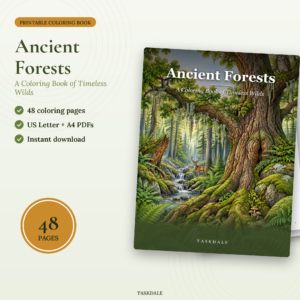
Ancient Forests Coloring Book
Price: $2.99 | Best for: adults who like detailed nature
Ancient Forests has 48 full-page forest scenes drawn as clean line art: The Heart of the Old Grove, Fern Cathedral, Owl in the Ancient Oak, Deer at the Woodland Spring and The Snowbound Old Grove among them. Layered trees, roots and hidden wildlife make each page a long, absorbing project, with a forest in every season and a few by moonlight. Print Deer at the Woodland Spring on mixed-media paper and paint the water first.
Keep the palette small when you start. A cheap student set of 12 watercolors is plenty, and three colors (a blue, a yellow and a warm red) will mix almost everything a forest page needs. The first time a pale wash of blue settles softly behind a dark line of trees, it feels like a small win.
Paint first, color second is the simple rule. Wet media goes down and dries, then dry media goes on top. Working the other way round can smear wax and pencil.
Embellishments that add texture
Embellishments are anything you stick on: glitter, sequins, rhinestones, washi tape, fabric, ribbon, pressed flowers, paper scraps. Used lightly, they make a page feel like a little piece of art. Used heavily, they can hide the drawing you spent an hour coloring. Aim for one or two kinds per page.
- Glitter glue: trace along a few lines, such as snowflakes, stars or a crown. Lay the page flat to dry for a few hours.
- Self-adhesive rhinestones: place them at the center of flowers or as dew drops on leaves.
- Washi tape: cut small strips for borders, scarves, ribbons on presents and stripes on a tent.
- Fabric scraps: glue a tiny square of real fabric onto a quilt, a skirt or a cushion in the picture.
- Pressed flowers and leaves: glue a real fern frond or petal into a nature scene. It looks magical in a frame.
Use a glue stick for paper and fabric, and a clear craft glue for sequins and gems. White school glue can wrinkle thin paper, so save it for cardstock. For more on choosing markers and paper that hold up to this kind of work, our guide to the best adult coloring book markers and paper is worth a look.
Mixed-media projects for kids
Children love mixed media because it feels like a real art project, not just coloring. It also keeps busy hands busy for longer. A page that would take 10 minutes with crayons can fill an hour with scissors, glue and a tray of bits.
Collage clothing
Color the faces and background, then cut clothes from scraps of wrapping paper, old magazines or fabric and glue them onto the characters. A dress made from a gift-wrap scrap with tiny stars on it is very pleasing to a seven-year-old.
Cotton-wool clouds and sandpaper paths
Glue a few stretched cotton balls onto the sky for fluffy clouds. Cut a strip of fine sandpaper for a path or a beach. Kids love the feel of it, and it turns the page into something you can touch.
Sticker scenes
Give a child a page and a sheet of small stickers (stars, hearts, bugs) and let them add to the scene. Butterflies over a picnic. Stars over a sleepover.
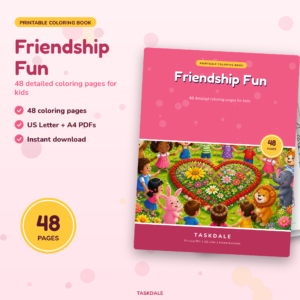
Friendship Fun Coloring Book
Price: $2.99 | Best for: kids aged 4 to 9 who love crafts
This book has 48 scenes of friends playing together, such as a picnic, a treehouse, a hot air balloon ride and an umbrella puddle splash, each with one big picture and a short kind message. Patterned clothes and big open shapes make ideal spots for fabric scraps and stickers. It comes as US Letter and A4 PDFs. Print the hot air balloon ride on cardstock and cover the balloon in paper scraps.
Set up a “bits tray” with an old muffin tin: one cup for sequins, one for paper scraps, one for cotton balls, one for stickers. Kids can see everything at once and tidy up is much faster.
Rainy-day 3D projects
When the weather keeps everyone indoors for a whole weekend, try making a coloring page stand up. These take a bit more time and are perfect for kids aged 6 and up with an adult helping.
Layered diorama
- Print the same page three times on cardstock.
- Color all three the same way.
- Keep the first page whole as the background.
- From the second, cut out the middle-ground pieces (furniture, trees). From the third, cut the front pieces (people, pets).
- Stick small foam squares or folded paper springs behind the cut-outs and layer them on the background.
The scene pops forward in three layers, like a tiny theater. It looks impressive on a shelf.
Pop-up card
Fold a piece of cardstock in half, cut two short slits in the fold and push the tab inward. Glue a colored cut-out to the tab. When the card opens, the figure stands up.
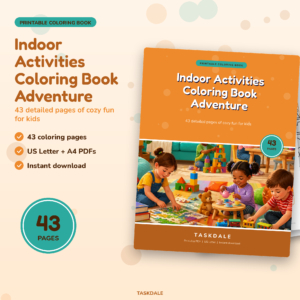
Indoor Activities Coloring Book Adventure
Price: $2.99 | Best for: rainy weekends at home
This book has 43 detailed indoor scenes, from a cozy playroom and board game night to a castle blanket fort, a puppet show and a window garden. Busy rooms full of rugs, shelves and toys give lots of shapes to cut out for dioramas and pop-ups. It prints on US Letter or A4. Print the blanket fort page three times and build it as a layered diorama.
Finishing and protecting your work
Mixed-media pages need a little care at the end so they last.
- Flatten painted pages. Once fully dry, place them between two clean sheets of paper under a pile of heavy books overnight.
- Seal pencil work if you want. A workable fixative spray from a craft shop stops pencil and pastel from smudging. Spray outdoors or by an open window.
- Frame with space. Pages with sequins or fabric need a frame with a deeper mat or a shadow box so the glass does not press on them.
- Store flat. Keep finished pieces in a flat folder or box, with tissue paper between embellished pages so they do not snag each other.
If you enjoy freeform creativity like this, you might also like reverse coloring, where you add the lines yourself over colored backgrounds.
Mistakes to avoid
- Painting on copy paper. It will buckle and may tear. Use mixed-media or watercolor paper.
- Gel pen smears. Gel ink stays wet longer than you think. Work left to right if you are right-handed, or rest your hand on a scrap sheet.
- Too many embellishments. Two kinds per page is usually plenty. Let the coloring show.
- Testing on the final page. Always try a new pen, paint or glue on a spare print first.
- Glitter everywhere. Work on a tray or a baking sheet. You will find glitter in the carpet anyway, but less of it.
Frequently asked questions
Can you use watercolor on coloring book pages?
Yes, if the page is printed on mixed-media or watercolor paper. Thin copy paper buckles. Watercolor pencils with a damp brush are the easiest place to start.
What paper is best for gel pens?
Smooth cardstock around 65 to 80 lb (175 to 215 gsm). It lets gel ink sit on top and dry evenly without bleeding.
How do I stop gel pens from smudging?
Give each stroke a minute to dry, keep a scrap sheet under your hand, and work away from your writing hand.
What embellishments work on coloring pages?
Glitter glue, self-adhesive gems, washi tape, fabric scraps, stickers and pressed flowers. Use a glue stick for paper and fabric, and clear craft glue for gems.
Are mixed-media coloring projects good for kids?
Yes. Collage, stickers and cotton-wool clouds keep kids busy far longer than crayons alone. An adult should handle sharp scissors and spray products.
Your next step
Choose one tool you already own, a gold gel pen, a watercolor pencil or a sheet of stickers, and print one page on the right paper for it. Try it on a spare copy first, then on the real one. If you want a book built for long, layered projects, start with Ancient Forests and paint the woodland spring.