Kids color the animals they want to hug. A kitten with huge eyes gets finished. A scowling lion with a thousand whiskers gets one stripe of orange and a sigh. That is the whole secret behind good cute animal coloring pictures for kids to print and color: soft shapes, a friendly face, and enough space for a crayon to move.
This guide is for parents, grandparents, nannies and teachers who need a stack of animal pages that hold a child’s attention. You will learn what makes a picture look cute, how to choose pages for a toddler versus an eight-year-old, a few games that stretch one page into half an hour, and how to print without wasting ink. Along the way we show four printable animal books from Taskdale and who each one suits.
Quick picks: printable animal coloring books
| Product | Best for | Price | Link |
|---|---|---|---|
| Little Explorers Preschool Coloring Book | Ages 2 to 5, puppies, kittens and bunnies | $3.49 | View |
| Ocean Life Coloring Book | Bold sea animals for early colorists | $3.49 | View |
| Orbit Pals Printable Coloring Book | Funny space animals for ages 7 and up | $3.99 | View |
| Gearhead Zoo Printable Coloring Book | Robot animals for kids who like gadgets | $3.99 | View |
What makes an animal picture look cute
Cute is not an accident. Artists use the same handful of tricks again and again, and once you know them you can spot a good page in a second.
- A big head. Cute animals have heads that are almost as big as their bodies, like a baby.
- Large, low eyes. Eyes set halfway down the face, with a white shine dot, read as young and friendly.
- Round shapes. Circles and soft ovals instead of sharp points. A round tummy, round paws, round ears.
- Short legs and a small nose. Stubby legs make an animal look like a toy.
- A clear expression. A smile, a yawn, a surprised O. Kids connect with feelings faster than with detail.
Those same tricks happen to make a page easier to color. Round, large areas suit a crayon held in a fist. Fewer sharp corners means fewer slips outside the line, and fewer tears from a four-year-old who wanted it perfect.
Matching the picture to the age
A page that delights a seven-year-old can frustrate a three-year-old in under a minute. Use this as a rough guide.
Toddlers, ages 2 to 3
One animal, outline as thick as a marker, nothing in the background. A bunny, a duck, a puppy. They will scribble across the whole thing, and that is how it should be. What they are learning is how to grip and how to move the crayon on purpose.
Preschoolers, ages 4 to 5
One animal plus one simple prop: a ball, a flower, a pond. They start choosing colors on purpose, and some will try to stay inside the lines. Praise the try, not the tidiness.
Early schoolers, ages 6 to 8
Now they want a scene and a story. Two animals doing something together. A turtle and a fish in a reef. A cat chasing a butterfly. Patterns on clothes or shells keep them busy for longer.
Ages 8 and up
Older kids still love cute, but they want a twist. A capybara on a comet. A clockwork rhino. Humor and an odd idea are what make a page worth their time at this age.
The cutest pages for the smallest hands
Very young children need a book made for them, not a grown-up book with the hard pages taken out. Lines must be thick, shapes must be open, and the animals must look like friends.
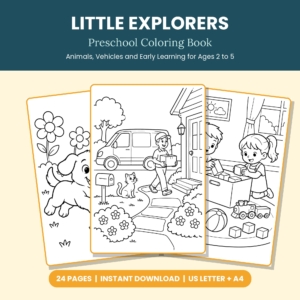
Little Explorers Preschool Coloring Book
Price: $3.49 | Best for: toddlers and preschoolers aged 2 to 5
This book has 24 simple pages in three themes: friendly animals such as a garden puppy, a curious kitten and a bunny picnic, busy vehicles, and early learning pages for counting, shapes and feelings. You get US Letter and A4 PDFs plus every page as a 300 DPI PNG for printing one at a time. Start with the kitten page and a fat crayon, and keep the session to ten minutes.
The early learning pages are a nice bonus. Counting Ducks and Big and Small Animals turn coloring into a quick chat about numbers and sizes, without anyone calling it a lesson. For more ideas at this age, our preschool coloring pages guide covers big shapes and easy wins.
Under the sea: cute ocean animals
Sea animals are naturally round and smiley. A dolphin always looks pleased with itself. An octopus has eight wiggly arms that are fun to color in eight different shades. For a lot of kids, an ocean page is the first one they finish by themselves.
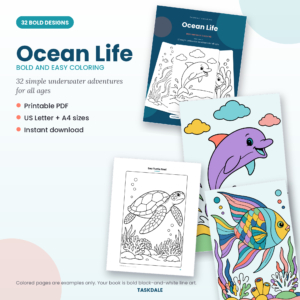
Ocean Life Coloring Book
Price: $3.49 | Best for: kids who love dolphins and turtles
This book has 32 bold, easy underwater scenes, including a friendly dolphin, a sea turtle on the reef, a smiling octopus, a humpback whale and a curious seahorse. Thick outlines and big shapes keep frustration low. It comes as US Letter and A4 PDFs with a clickable contents page and a color test page, so let your child test crayons on the test page before picking an animal.
A fun twist for ocean pages: tell your child the sea can be any color at all. Purple water, orange whales. Kids who usually worry about “wrong” colors relax instantly when you give them permission.
Cute with a twist: space and robot animals
By seven or eight, many kids decide puppies are for babies. They still love animals. They just want them doing something ridiculous. That is where funny themed books come in.
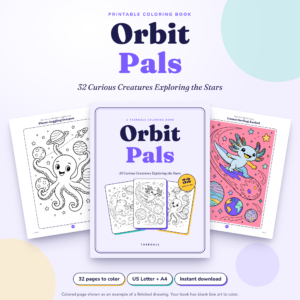
Orbit Pals Printable Coloring Book
Price: $3.99 | Best for: kids aged seven and up
Orbit Pals has 32 full-page drawings of animals in outer space: an axolotl surfing a comet, a capybara in a moon bath and an octopus juggling planets. You get US Letter and A4 PDFs, single-page PNG files and a short user guide. Younger kids can color the big animal and leave the stars, while older ones fill every crater.
Space pages solve the wrong-color worry too. Nobody knows what color a moon bath should be. Every choice is right.
Ten-minute games that stretch one picture
One printed page can fill a whole afternoon if you add a game. These need no prep beyond a pencil.
- Name it first. Before any color goes down, the animal gets a name and an age. Pip the kitten, aged four. Children color a character with far more care than a picture.
- Mood colors. Ask what mood the animal is in today. Happy? Use bright yellow and pink. Sleepy? Soft blues and grays.
- Twin pages. Print two copies of the same animal. One child colors it as it really looks, the other colors it as wild as possible. Pin them side by side.
- Add a friend. Once the animal is colored, the child draws a tiny friend in the corner. A ladybug, a mouse, a cloud with a face.
- Story strip. Color three animal pages, lay them in a row and make up a story that links them.
Games like these are why a stack of ten printables can last a week. The page is just the start.
Robot animals for the gadget fans
Some children light up for anything with wheels, gears or buttons. Give them a lion built from clockwork and they will sit still longer than you thought possible.
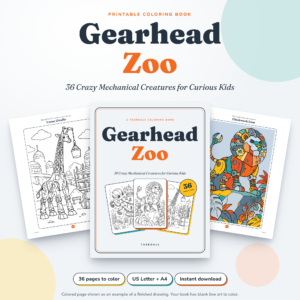
Gearhead Zoo Printable Coloring Book
Price: $3.99 | Best for: kids who love gears and gadgets
Gearhead Zoo has 36 full-page drawings of animals built from gears, springs and wheels, such as a clockwork lion and a rhino with a toaster for a body. There are lots of small bolts and panels, so it suits kids from about seven. You get US Letter and A4 PDFs plus single-page PNGs, and silver or gold gel pens look great on the gears.
A tip for younger siblings who want to join in: let them color the big body panels while the older child does the bolts. Teamwork, and nobody gets left out.
Printing animal pictures at home
A few small settings make a big difference to how a printed page looks and how long the ink lasts.
- Choose your paper size. Pick the US Letter file in North America and A4 almost everywhere else. Mixing them up crops the page.
- Print at Actual size. Not Fit to page, which shrinks lines and leaves big margins.
- Use draft or grayscale mode. Coloring pages are black and white, so there is no need to use color ink. Draft mode saves toner too.
- Print a batch. Ten pages on Sunday night means no hunting for the laptop when a child is bored on Wednesday.
- Thicker paper for markers. Washable markers soak through thin copier paper. A 28 lb or 100 gsm sheet holds up better.
Keep printed pages in a clear folder by the crayon box. A child who can reach the pages herself colors twice as often as one who has to ask.
Turning finished animals into cards and gifts
A colored kitten is lovely on its own. Folded into a card, it becomes a present, and kids glow when someone they love opens it.
Birthday and thank-you cards
Print the page at 50% scale so two animals fit on one sheet. Your child colors one, you cut it out, and it gets glued to the front of a folded piece of card. Inside, they write or dictate one line. “Happy birthday from Pip the kitten and me.” Grandparents keep these for years.
Bookmarks and gift tags
Small animals, like a seahorse or a duck, fit neatly on a strip of card. Punch a hole at the top, thread a ribbon, and you have a bookmark for a teacher or a tag for a present.
A wall zoo
Pick one wall, or one door, and call it the zoo. Every finished animal gets taped up with its name underneath. By the end of a month a five-year-old has a whole menagerie, and she will give you a tour whether you ask or not.
Free pictures versus a printable book
Free animal pictures are easy to find online, and for a single rainy afternoon they are perfect. The catch shows up after a few weeks. Free pages come in mixed styles and sizes, many sit behind ads and pop-ups, and the cute ones are often traced from the same few drawings.
A printable book gives you a matching set in one download, sized for your paper, with a contents page so you can find the dolphin again in five seconds. It also means you can reprint a favorite as often as you like at home. If your child colors one page a week, free pages will do. If she colors one a day, a book saves you hours of searching. For more animal sets by theme, see our guide to animal coloring pages for safari, farm, ocean and woodland.
Common mistakes with kids’ animal pages
- Too much detail too soon. A four-year-old given a page full of fur lines will give up. Go simpler than you think.
- Correcting colors. “Cats aren’t green” ends the fun. Let the green cat live.
- Handing over the whole stack. Twenty pages at once overwhelms. Offer a choice of two.
- Sessions that run too long. Stop while they still want more, and they will ask for another tomorrow.
- Tiny crayons for tiny hands. Thin pencils are hard to grip under age four. Chunky crayons or triangle crayons are easier.
Frequently asked questions
What animals are easiest for kids to color?
Animals with big round shapes, like bunnies, ducks, turtles, whales and pigs. They have few small parts and large areas to fill.
What age can kids start coloring animal pictures?
Around 18 months to 2 years with chunky crayons and very simple outlines. Expect scribbles at first.
Are printable coloring pages safe to reprint?
Yes, for personal and household use. Check each book’s terms if you want to print copies for a whole class.
What paper is best for printing coloring pictures?
Standard copier paper works for crayons and pencils. Use heavier paper for markers or paint sticks.
Can kids color these animal pictures on a tablet?
Yes. Books that include single-page PNG files can be opened in a drawing app and colored with a finger or stylus. Paper is still better for building grip and control in young children.
How do I keep kids interested in coloring?
Short sessions, a choice of two pages, and a game like naming the animal before coloring. Display finished work where they can see it.
Your next step
Print one cute animal page tonight and let your child name it before picking a single crayon. If the little one is under five, the Little Explorers Preschool Coloring Book has the kitten, the puppy and the bunny picnic ready to go. Tape the first finished animal somewhere everyone will see it, and let the wall zoo begin.