Best Fillable Daily Planner: 4 Printable PDFs Compared
The best fillable daily planner is the one whose page matches how you actually plan. Calm Day suits people who also track mood, meals and water. Clear Day suits time blockers who want a choice of layouts. BrightDay and Daily Rainbow suit anyone who wants a full week of colour-coded pages in one file. All four let you type in the PDF or print and write by hand.
Choosing between them can feel harder than it should, because the pages look similar at first glance. The differences sit in the detail: how the day is divided, which trackers are included, which paper sizes are offered, and whether the planner is undated. We'll go through each, so you can pick one and start using it today.
Key facts at a glance
- A fillable daily planner is a PDF with typeable fields, so you can fill it in on screen or print it and use a pen.
- Calm Day comes in US Letter and A4 only, while BrightDay and Daily Rainbow add A5, and Clear Day adds A5 and Half Letter.
- Calm Day and Clear Day are described as undated, so you can start on any day of the year.
- Clear Day offers four different layouts in one download, which is more variety than the other three.
- Every planner here is an instant download with a user guide, so you can print the same pages again whenever you need them.
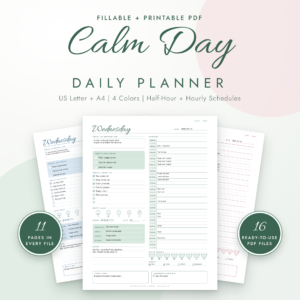 Calm Day Daily Planner | Printable & Fillable PDF with Hourly and Half-Hour Schedule, Mood, Meal & Water Tracker, US Letter & A4
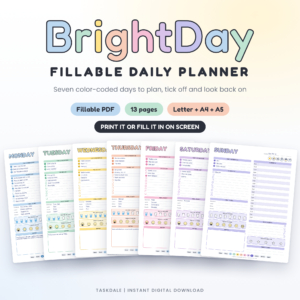 BrightDay Fillable Daily Planner | Printable Daily Schedule, To-Do List, Habit Tracker and Weekly Review PDF
Table of Contents
Toggle
- What should you look for in a fillable daily planner?
- How do the four fillable daily planners compare?
- Which fillable daily planner suits which person?
- How do you use a fillable daily planner PDF?
- What mistakes should you avoid when choosing a fillable daily planner?
- What affects the price of a fillable daily planner?
- Which fillable daily planner should you pick?
- Common questions
What should you look for in a fillable daily planner?
Look for six things: how the day page is laid out, how the fillable fields behave, which paper sizes are offered, whether it is dated, which trackers are included, and how well it prints. Each one changes how the planner feels after the first week, which is when most people either settle in or give up.
Day page layout
A daily planner page is a single sheet that holds one day's priorities, tasks and schedule. The question is how much structure you want. Calm Day gives three main goals, a to-do list and a half-hour or hourly schedule. Daily Rainbow offers a top 3 priority list, a to-do list and an hourly schedule. Clear Day gives you four separate layouts, including a focus day with a priority matrix.
If you like a full page that prompts you to think about the day, pick a structured layout. If you only want a list and a few time slots, a simpler page will be easier to keep up.
Fillable fields
A fillable field is a spot in the PDF where you can click and type, or tick a box. BrightDay is the clearest on this point: you type straight into the lines and click to tick tasks, water cups, moods and stars. Daily Rainbow also lets you type straight into the lines.
Ticking a box on screen is quicker than writing, but only if you are happy working at a computer. If you plan to print every page, the fields matter less than the layout.
Paper size
Paper size decides whether the planner fits your desk, bag or binder. US Letter and A4 are standard sheets. A5 and Half Letter are about half that size, which suits a smaller binder or a planner you carry around.
Calm Day offers US Letter and A4. BrightDay and Daily Rainbow offer US Letter, A4 and A5. Clear Day offers US Letter, A4, A5 and Half Letter, the widest range here. If you live in the UK, A4 and A5 are the sizes that match the paper and binders you already own.
Dated or undated pages
An undated planner is one with no printed dates, so you write the date yourself and can start any day. Calm Day and Clear Day are both described as undated. The listings for BrightDay and Daily Rainbow don't say either way, so check the product page before you buy if the date matters to you.
Undated pages forgive a missed week. You skip ahead without leaving blank, guilt-inducing days behind.
Trackers and review pages
Trackers are small boxes for recording habits, water, meals or mood. Calm Day has mood, meal, water and habit trackers on the daily page. Daily Rainbow puts meal diary, water, mood and a star rating on each day, plus a habit tracker and weekly review. BrightDay adds a habit tracker, a weekly review and a notes page. Clear Day instead gives an evening reflection page.
Choose trackers you will really fill in. A tracker you ignore just adds clutter to the page.
Printing and licence
Ink use matters if you print often. Clear Day includes a Mono Ink Saver colour option and leaves room for hole punching, which helps if you file pages in a binder. Calm Day comes with a personal use licence, meaning it is for your own use rather than for reselling or sharing. The other listings don't state licence terms, so read the product page if you need to know.
How do the four fillable daily planners compare?
The four planners differ mainly in layout variety, paper sizes and tracker coverage. This table shows those differences using only the details in each listing.
| Planner | Layouts and pages | Sizes | Trackers and extras | Best for |
|---|---|---|---|---|
| Calm Day Daily Planner | Printable & Fillable PDF with Hourly and Half-Hour Schedule, Mood, Meal & Water Tracker, US Letter & A4 | Undated daily page with 3 goals, to-do list, half-hour or hourly schedule; 16 PDF files of 11 pages each | US Letter, A4 | Mood, meal, water, habit; 4 colours; Word user guide | Whole-day wellbeing tracking |
| BrightDay Fillable Daily Planner | Printable Daily Schedule, To-Do List, Habit Tracker and Weekly Review PDF | Seven colour-coded day pages, week overview, notes page | US Letter, A4, A5 | Habit tracker, weekly review, tick boxes for tasks, water, moods, stars | Planning a week in one file |
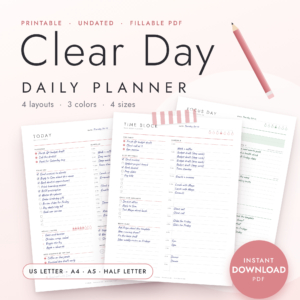 Clear Day Daily Planner Printable | Fillable Daily Schedule, To-Do List & Time Block Pages (US Letter, A4, A5, Half Letter) | Four undated layouts: full day, half-hour time block, focus day with priority matrix, evening reflection | US Letter, A4, A5, Half Letter | Ink friendly; hole punch room; Blush Pink, Sage Green, Mono Ink Saver | Time blocking and small binders |
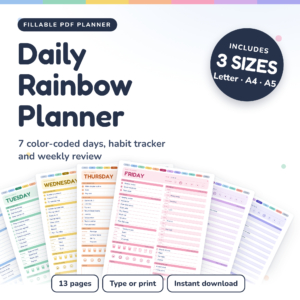 Daily Rainbow Planner | Fillable Daily Planner PDF, Printable 7-Day Schedule, To-Do List and Habit Tracker (Letter, A4, A5) | Seven colour-coded day pages, weekly overview | US Letter, A4, A5 | Top 3, hourly schedule, meal diary, water, mood, star rating, habit tracker, weekly review; Word user guide | Detailed daily and weekly routines |
Which fillable daily planner suits which person?
Each planner suits a different habit. Match yours to the closest description below.
Calm Day suits you if you want one page to hold the whole day, including how you felt and what you ate and drank. The 16 files of 11 pages each give you plenty of choice in colour and size, and the undated pages mean no wasted days. It only comes in US Letter and A4, so it is not the pick for a pocket-sized binder.
BrightDay suits you if you plan by the week. Seven colour-coded day pages, a week overview and a weekly review sit in one PDF, and the clickable tick boxes make it quick to use on screen.
Clear Day suits you if your day is built around blocks of time or if you want to separate priorities from busywork. The focus day with a priority matrix is the only layout of its kind on this page. It also has the most sizes, so it is the easiest to fit into a half-size binder.
Daily Rainbow suits you if you want the most detail on every daily page. Each day carries a top 3, to-do list, hourly schedule, meal diary, water and mood trackers and a star rating. That is a lot to fill in, so it works best if you enjoy the routine of it.
How do you use a fillable daily planner PDF?
Using a fillable daily planner PDF takes five steps, and most of the effort goes into the first setup rather than the daily habit.
- Download the file and open it in a PDF reader that supports form fields.
- Choose the size and colour that match your paper or screen, and read the user guide once.
- Decide whether you will type, print or mix the two. Typing works well for to-do lists, while handwriting suits goals and reflections.
- Save a fresh copy of each filled page, so you always keep a clean master file.
- Each evening, spend five minutes reviewing the day and setting the top priorities for tomorrow.
If you print, a hole punch and a simple binder keep finished pages in order. Clear Day's hole-punch room means nothing gets cut off.
What mistakes should you avoid when choosing a fillable daily planner?
The most common mistake is choosing the planner with the most features rather than the one you will use daily. Here are the others.
- Picking by looks alone. A pretty colour won't help if the page layout doesn't match how you plan.
- Ignoring paper size. An A5 planner printed on A4 paper, or the reverse, wastes time and ink.
- Assuming every listing is undated. Only Calm Day and Clear Day state it. Check the others.
- Overloading the trackers. Tracking mood, meals, water and habits all at once is a lot. Start with one or two.
- Skipping the user guide. Every planner here comes with one, and it explains the clickable fields.
- Forgetting the licence. Calm Day is for personal use. If you need to share a planner with a team, read the terms first.
What affects the price of a fillable daily planner?
The price of a fillable daily planner depends on how much you get in the download rather than how it looks. Four things move the cost.
- Number of files. Calm Day's 16 files of 11 pages each is a larger bundle than a single PDF.
- Paper sizes included. More sizes in one download usually means more for your money.
- Layout variety. Clear Day's four layouts give you more options than a single daily page.
- Licence terms. A personal use licence is the norm for printables, and wider rights usually cost more.
Because the files are digital, you print the pages yourself, so your real running cost is paper and ink. The Mono Ink Saver option in Clear Day is aimed at keeping that down. The live product cards show current prices.
Which fillable daily planner should you pick?
Pick by how you plan, then by paper size. If you track wellbeing alongside tasks, choose Calm Day. If you plan by the week, choose BrightDay. If you time block or want a small binder, choose Clear Day. If you want the most detail on every day, choose Daily Rainbow.
A quick checklist before you buy:
- Do I want to type, print, or both?
- Which paper size do I own?
- Do I need undated pages?
- Which two trackers will I actually fill in?
You can browse all 4 options below and compare them against your answers.
Common questions
Can I mix typing and handwriting in the same planner?
Yes. Each planner here lets you type into the PDF or print and write by hand, so you can type a to-do list on screen and print the page for handwritten notes. Save a copy of your typed version first so nothing is lost.
Which planner works best in a small ring binder?
Clear Day is the best fit because it offers A5 and Half Letter sizes and leaves room for hole punching. BrightDay and Daily Rainbow also come in A5, which suits a smaller binder, but their listings don't mention hole-punch space.
Do I need Word to read the user guide?
Calm Day and Daily Rainbow include a Word user guide, so you will need a programme that opens Word files. BrightDay and Clear Day list a user guide too, though the format isn't stated. Check the product page if format matters.
Can I reuse the same planner every year?
Undated planners can be reused, since you simply write in new dates. Calm Day and Clear Day are described as undated, so you can print fresh pages whenever you need them. The other two don't state this, so check before relying on it.
Is a fillable daily planner better than a paper one?
It depends on how you work. A fillable PDF is better if you reprint pages, switch sizes, or like typing and ticking boxes on screen. A bound paper planner suits you if you never use a computer for planning. Try one printed week before you decide.