You do not need to spend a cent to start teaching a preschooler shapes, letters and numbers with coloring. A pencil, a mug to trace round and a pack of printer paper will carry you through the first few weeks. Free pages are a fine place to begin. The trick is knowing where good ones come from, how to spot the duds, and when it is worth paying for a tidy set instead.
This guide is for parents, grandparents and childminders hunting for free coloring pages for kids that teach shapes, letters, and numbers. You will get honest places to look, a quick test for any free page, step-by-step ways to make your own in minutes, and a clear look at when a low-cost printable set from Taskdale saves you time.
Quick picks if you outgrow free pages
| Product | Best for | Price | Link |
|---|---|---|---|
| Crayon Campus Preschool Learning Coloring Worksheets | Shapes, numbers 1 to 20, colors and more | $4.99 | View |
| Letter Parade Alphabet Coloring Book A to Z | A to Z with tracing and a toddler edition | $3.99 | View |
| Hop to Ten Color by Number for Kids | Number recognition 1 to 10 | $4.49 | View |
| Little Explorers Preschool Coloring Book | Gentle first pages for ages 2 to 5 | $3.49 | View |
Where free learning pages really come from
Free coloring pages are everywhere, but they are not all made the same way or for the same reason. Knowing the source tells you a lot about the quality you can expect.
Your local library
Many libraries run story times with a coloring sheet to take home, and children’s librarians are often happy to photocopy a page or two. Ask at the desk. Libraries also lend activity books you can borrow for three weeks and trace from by hand.
Teacher-sharing websites
Teachers often post single worksheets they made for their own class, and some share them free. Quality varies a lot. Some are brilliant. Others have blurry clip art or fonts that print as boxes. Expect to sift.
Free samples from paid sets
Many sellers offer one or two pages free so you can test the style. These are usually clean and well made, because they are meant to show off the full set. The catch: you get a taster, not a full alphabet.
Ad-supported coloring sites
Big coloring websites give away thousands of pages and pay for it with adverts. They are great for themed pictures, like a fire truck or a unicorn. Learning pages are rarer, and you may click through several pop-ups to reach the download button.
Your own hands
The most reliable free source is you. A simple shape, letter or number page takes five minutes to draw, and you can pitch it at exactly your child’s level. More on that below.
For a wider list of places to print pages tonight, our guide to free coloring book PDFs walks through the good and the frustrating.
A 30-second test for any free page
Before you print, look at the page for half a minute and ask five questions. If the answer to two or more is no, keep looking.
- Is the skill obvious? A child should be able to tell, with your help, what the page wants. Count the balls. Color the triangles.
- Are the lines thick and dark? Thin gray lines vanish on a home printer.
- Are the spaces big enough? For ages 3 to 5, nothing smaller than a coin.
- Is the letter or number shaped the way your child will learn it? Some fonts use a curly “a” or a “4” with an open top. Mismatches confuse beginners.
- Will it print without a watermark or a giant website name across the middle?
A page that passes is worth keeping. Save it in a folder on your computer named by skill: Shapes, Letters, Numbers. Next week you will thank yourself.
Make your own shape pages
Shapes are the easiest pages to make at home, and a homemade page can be just as good as a printed one for a three-year-old.
You will need
- Plain paper and a thick black marker
- A mug or jar lid (circle), a book or box (square and rectangle), a ruler (triangle)
- Crayons
Steps
- Trace one big circle in the middle of the page with the mug. Go over it twice so the line is thick.
- Draw four or five smaller circles around it, plus two squares and a triangle as “tricksters”.
- Write “Color every circle” at the top. Read it aloud to your child.
- Let them hunt. Each correct circle gets a color. The tricksters stay white.
That is a real matching task, made in five minutes, costing nothing but paper. Change the target shape each day and you have a week of practice. A four-year-old who finds every triangle on Thursday gets to feel very clever, and that feeling is the point.
For a two-year-old, skip the hunt and keep it to one giant shape per page. They will scribble across it, and that is fine. If you would rather have a few ready pages for this age, the Little Explorers book has a Shape Playground page and a Counting Ducks page tucked among chunky animals and diggers, which suits toddlers who are not ready for worksheets yet.
Make your own letter pages
Letter pages take a little more care, because the letter shape matters. Use the same style your child will see at school: simple, round letters without curls or tails.
- Draw a big bubble letter. Write the letter lightly in pencil, then draw an outline around it about a finger’s width out. Go over the outline in marker and erase the pencil.
- Add a picture. For S, a sun is easy. A circle with lines. For B, a ball. Keep it simple.
- Add tracing. Write the letter three times along the bottom with a yellow highlighter. Your child traces over it with a pencil.
- Say the sound. While they color, say “sss, sun” together.
Twenty-six letters is a lot of drawing, though. Most parents manage the first eight or nine with enthusiasm and then run out of steam somewhere around K. That is fine. It is also the moment a ready-made alphabet book starts to make sense.
A printed alphabet picks up where your homemade pages stopped, and keeps the same simple routine of color, say the sound, trace.
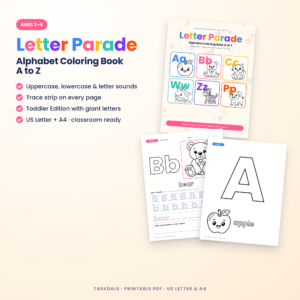
Letter Parade Alphabet Coloring Book A to Z
Price: $3.99 | Best for: parents doing letter of the week
Twenty-six letter pages, each with a big uppercase and lowercase letter, a picture that starts with that sound, the word and three trace rows on handwriting lines. A Toddler Edition with one giant letter per page is included for ages 2 to 4. You also get letter match pages, letter hunts and an alphabet chart in US Letter and A4.
Make your own number pages
Numbers are easy to make and easy to adjust as your child grows.
- Count and color: write a big 4 at the top. Draw six small circles below. Ask your child to color only four.
- Dice pages: draw three empty squares. Roll a die, then draw and color that many dots in a square.
- Number trail: write 1 to 10 in random spots on the page, with a small shape around each. Your child colors them in order.
- Homemade color by number: draw a simple house. Write 1 in the roof, 2 in the walls, 3 in the door. Add a key at the bottom: 1 red, 2 yellow, 3 blue.
That last one is a hit with four- and five-year-olds. Our article on color by number pages for preschool math has more ways to stretch it as their counting grows.
Homemade color by number is fun, but drawing 50 of them is not. A ready set gives you a slow climb from 1 to 5 up to simple sums.
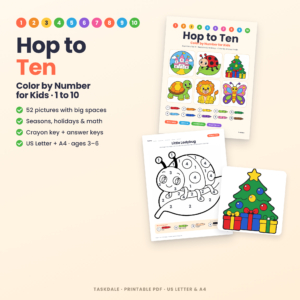
Hop to Ten Color by Number for Kids
Price: $4.49 | Best for: ages 3 to 6 learning numerals
Fifty-two color-by-number pictures that use only the numbers 1 to 10, with big spaces and a simple crayon key. The book moves from 1 to 5, to 6 to 10, to mixed numbers, then easy addition and take-away. Full-color finished pictures at the back make checking simple.
When free pages stop being enough
Free pages are brilliant for a start. Over time, a few problems tend to show up. You spend twenty minutes hunting for a decent number 7 page. The alphabet you found online is missing Q and X. One page uses a different “a” from the next. There is no order, so you are not sure your child has covered all the basics. And every evening, you are the one drawing.
None of this means free pages failed. They did their job: they showed you that your child enjoys learning this way. A parent who has drawn twelve homemade pages also knows exactly what a good page looks like, which makes it easy to judge a paid set before buying.
When the hunting starts to take longer than the coloring, a tidy, low-cost set pays for itself in saved time. You get every letter, every number, a clear order from easy to harder, and answer keys. If you want one set that covers most early skills, this is the closest thing to a ready-made preschool year in a single download.
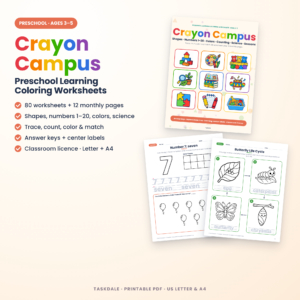
Crayon Campus Preschool Learning Coloring Worksheets
Price: $4.99 | Best for: ages 3 to 5, one set for many skills
Eighty one-skill worksheets covering shapes (circle to diamond), numbers 1 to 20 with ten frames, counting, colors, matching and simple science, plus 12 seasonal pages. Answer keys and a skills checklist are included. Print the 96-page US Letter or A4 PDF in black and white, and start with the circle page, which pairs well with the mug trick above.
Mistakes that make learning pages backfire
Turning every page into a test
If a three-year-old colors a square when you asked for circles, smile and ask, “Which one is the circle?” Then move on. Quizzing every mark drains the fun fast, and a child who feels tested will start saying no to coloring altogether.
Picking pages that are too wordy
Some free worksheets carry three lines of instructions meant for teachers. A preschooler cannot read them, and you end up explaining for longer than they color. Pick pages with one short line you can read out in five seconds.
Jumping ahead too fast
It is tempting to move from 1 to 5 straight to 1 to 20 once a child counts to five. Give each step a week or two. A child who feels sure of 1 to 5 tackles 6 to 10 with confidence instead of guessing.
Forgetting the real world
The page is the start, not the finish. After a triangle page, hunt for triangles at the shops. After a letter B page, look for B on cereal boxes. That link between paper and life is what makes the learning stick, and it costs nothing at all.
A two-week plan mixing free and paid
You do not have to choose one or the other. Plenty of families use homemade pages on busy days and a printed set when they want structure. Here is a plan for a four-year-old, about 15 minutes a day.
| Day | Week 1 | Week 2 |
|---|---|---|
| Mon | Homemade circle hunt | Printed triangle page |
| Tue | Homemade letter S | Printed letter M |
| Wed | Count and color 3 | Color by number, 1 to 5 |
| Thu | Free library sheet | Homemade dice page |
| Fri | Free choice coloring | Gallery day: show off the week |
By the end of two weeks you know which style your child enjoys more. Some love your wobbly homemade pages because you made them. Others prefer the neat printed ones. Either answer is useful.
Frequently asked questions
Where can I find free shape coloring pages?
Try your library, teacher-sharing sites and free samples from paid sets. Or make your own by tracing a mug, a book and a ruler onto paper.
Are free alphabet coloring pages any good?
Some are excellent. Check that the letter shapes match what your child will learn at school and that lines print dark. Full A to Z sets are harder to find free.
What age should kids start learning shapes with coloring?
Around age 2 to 3 for simple circles and squares. By 4, most children can find and color a named shape among others.
How do I make a color by number page at home?
Draw a simple picture, write a number in each space and add a key at the bottom matching each number to a crayon. Keep to 1 to 5 for beginners.
Can I print free coloring pages for my whole class?
Check the terms on each page. Some free pages allow classroom use and some are for home only. Paid sets usually spell it out; the sets above include a license for one teacher’s own class.
Is it worth paying for learning coloring pages?
It is worth it when you want a full set in a clear order, with answer keys, and you are tired of hunting. Free pages work well for a taste or a busy day.
Your next step
Tonight, grab a mug and draw one circle hunt page. Try it tomorrow morning and watch how your child reacts. If they ask for more, print the shape section of Crayon Campus and let the drawing be someone else’s job for a while.