A young paleontology fan does not just want to color a Stegosaurus. They want to know how we know it had plates, who dug it up, and whether there might be one under the school playground. Free dinosaur coloring pages with facts feed that curiosity, and with a bit of setup they become the start of a real little science habit.
This guide is for parents, grandparents, homeschoolers and teachers of curious kids aged about 5 to 11. You will learn where free fact pages come from and how to check them, the kinds of facts that hook young scientists, a simple “field journal” routine, and ways to bring real paleontology into a coloring session. You will also see three Taskdale sets that suit fact-hungry kids, and one tip that makes every page feel like a museum visit.
Quick picks for fact-loving young scientists
| Product | Best for | Price | Link |
|---|---|---|---|
| Roar to Z Dinosaur Coloring Book A to Z with Names and Facts | 78 checked facts, a timeline and a Junior Paleontologist certificate | $4.49 | View |
| Gallop Gallery Horse Breeds Coloring Book for Kids and Adults | Fact fans who love living animals too | $4.99 | View |
| Swish & Shade Digital Coloring Pages for Kids | Tablet coloring on the way to a museum | $4.99 | View |
What a young paleontology fan really wants
Dinosaur kids are collectors. They collect names, numbers and strange details, and then they share them, loudly, with anyone in range. A coloring page that comes with a fact gives them a new thing to collect every time they pick up a crayon.
The best facts for this age answer one of five questions:
- When did it live? Triassic, Jurassic or Cretaceous, and roughly how many million years ago.
- Where was it found? Which country or continent its fossils come from.
- How big was it? Compared with something familiar, like a car, a school bus or a house cat.
- What did it eat? Plants, meat, fish, or a bit of everything.
- How do we know? The clue in the fossils: teeth shape, footprints, eggs, skin impressions.
That last question is where young fans turn into young scientists. “How do we know?” is the most important question in paleontology, and it is never too early to start asking it.
Where free dinosaur fact pages come from
Free coloring pages with facts are a bit rarer than plain pages, but they are out there.
- Natural history museum websites. Many share free activity sheets and fact pages for families. These are the most reliable source.
- Public library activity packs. Libraries often run dinosaur-themed reading programs with printable sheets.
- Teacher resource sites. Worksheets that pair a dinosaur to color with a short reading passage. Quality varies, and some need a free login.
- General coloring sites. Some add a line or two of facts under the picture. Check these carefully, because errors are common.
A free page plus a fact you look up yourself on a museum site works just as well. Write the fact at the bottom of the page in pen before your child starts coloring.
How to check a dinosaur fact in two minutes
Dinosaur facts travel. A child will repeat a fact at school, at dinner and to the cashier at the supermarket. Getting it right first time is worth two minutes.
- Look for a museum or university source. These are written by people who work with the fossils.
- Be wary of exact numbers. “About 12 meters” is honest. “Exactly 12.3 meters” usually is not.
- Check the time period. If a page says T. rex and Stegosaurus lived together, it is wrong. Stegosaurus lived in the Late Jurassic, T. rex near the end of the Cretaceous.
- Watch the “not a dinosaur” trap. Pteranodon flew and Mosasaurus swam. Both were reptiles, but neither was a dinosaur.
- Check the date of the page. Ideas change. Old pages often show Velociraptor without feathers or T. rex standing upright.
Teach older kids to do this themselves. Checking a fact is a real scientist’s habit, and it is one they will use long after the dinosaur phase ends.
A dinosaur book where every fact is already checked
Looking up facts for one page is fun. Doing it for 26 gets tiring. A book where the facts are written, rounded and checked saves that work and gives a young fan something to quiz you with.
Roar to Z gives every A to Z dinosaur three short facts covering when and where it lived, how big it was and one fun fact, 78 facts in total. The ages and sizes are rounded and checked against museum and scientific sources. It also has a timeline, a size chart comparing lengths with a school bus and a child, 26 cut-out fact cards and a blank card for a dinosaur of their own.
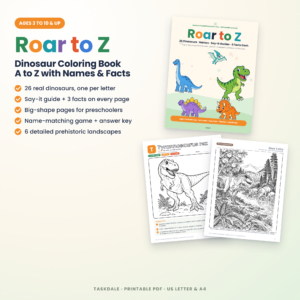
Roar to Z Dinosaur Coloring Book
Price: $4.49 | Best for: Young paleontologists aged 5 to 10
A printable PDF in US Letter and A4 with 26 A to Z dinosaur pages, each with a say-it guide, name meaning and three facts, plus a When did they live timeline, a How big were they size chart, fact cards, a Dino Passport to track finished pages and a Junior Paleontologist certificate. Print the fact cards on cardstock first, and use them as a nightly quiz at bedtime.
Start a paleontologist’s field journal
Real paleontologists keep field notebooks. Your young fan can too, and it turns a stack of coloring pages into a record of everything they have learned.
What goes in it
- The colored page, folded or trimmed to fit.
- The dinosaur’s name, written by the child.
- One fact in their own words. “It was as long as a bus” counts.
- One question they still have. “Why were its arms so small?”
- The date, like a real scientist.
How to set it up
Any notebook works, but a ring binder lets you add pages easily. Put a simple timeline across the inside cover with three sections: Triassic, Jurassic, Cretaceous. Each time a new dinosaur is added, the child marks it on the timeline. After a month, they can see at a glance which animals lived together and which never met.
The question line is the secret ingredient. Looking up the answers together on a museum website becomes a weekend ritual, and the look on a seven-year-old’s face when they find the answer to their own question is pure pride.
Fun facts that hook young fans
A few safe, true facts that reliably make kids gasp:
- T. rex and Triceratops lived at the same time, in the same part of North America.
- Some dinosaurs were tiny. Fruitadens was roughly the size of a cat.
- Birds are living dinosaurs. The pigeon outside your window is a distant relative of T. rex.
- Maiasaura means “good mother lizard”, named after nesting sites with eggs and babies found in Montana.
- Many dinosaurs had feathers. Velociraptor did, based on fossil evidence from its arm bones.
- Nobody knows what color most dinosaurs were. Scientists have only made careful guesses for a few small feathered ones.
The bird fact is the champion. Expect your child to point at every pigeon for a week and announce “dinosaur!”
How a fossil forms, in five kid-sized steps
Young fans often ask how a dinosaur turned into stone. Here is a simple version to read aloud while they color.
- A dinosaur dies near a river, lake or sea.
- Mud or sand covers the body quickly, before animals or weather can scatter the bones.
- Over a very long time, more layers pile on top and press down.
- Water seeping through the ground slowly swaps bits of bone for minerals, turning it into rock-hard fossil.
- Millions of years later, wind, rain or a digger wears the rock away, and someone spots a bone poking out.
Point out that most animals never become fossils. The ones we find are the lucky few that were buried fast. That idea often sparks a whole new round of questions, which is exactly what you want.
The fact jar
Keep a clean jam jar on the kitchen shelf. Each time your child learns a new fact from a coloring page, they write it on a slip of paper, fold it and drop it in. On Sunday, pull out three slips at random and read them aloud. Whoever remembers which dinosaur each fact belongs to gets to choose next week’s page. The jar fills up surprisingly fast, and seeing it grow is its own small reward.
Bring real paleontology to the coloring table
Make a fossil
Press a toy dinosaur foot or a shell into a flattened ball of salt dough or modeling clay. Lift it away and let the print dry. That is how footprints and impressions are preserved, more or less. Color a page of the same dinosaur while the dough hardens.
Run a dig
Bury a few clean chicken bones or pasta shapes in a tub of sand. Hand over a paintbrush and a spoon. Real diggers work slowly, so make a rule: brush, do not scoop.
Visit a museum
If a natural history museum is within reach, plan one trip around the pages your child has colored. Finding the real skeleton of a dinosaur you colored last week is a thrill. Bring the field journal and add a page that day.
For long car journeys to a museum, a tablet with digital coloring keeps hands busy and crayons off the car floor.

Swish and Shade Digital Coloring Pages for Kids
Price: $4.99 | Best for: Families on the road to a museum
60 mess-free digital coloring pages for kids as transparent PNG line art plus a hyperlinked PDF for GoodNotes, Notability and Xodo, split into toddler, kids, detailed and phone-sized travel sets. It works offline once downloaded. Load it the night before the trip so the drive is calm and everyone arrives ready to explore.
A weekly fact routine
A simple rhythm keeps the learning going without turning it into homework.
| Day | What happens | Time |
|---|---|---|
| Monday | Color a new dinosaur, read its facts | 15 minutes |
| Wednesday | Add it to the field journal and timeline | 10 minutes |
| Friday | Fact card quiz at dinner | 5 minutes |
| Weekend | Look up the answer to one journal question | 15 minutes |
Homeschool families can count this as science. Our guide on how to plan a homeschool year shows how a small weekly routine like this fits into a bigger plan.
When the interest spreads beyond dinosaurs
Kids who love dinosaur facts often discover they love animal facts in general. That is a good sign: the habit of asking “how big, where from, how do we know” is the real gift. Horses are a common next obsession, especially for children who ride or watch horses at shows.
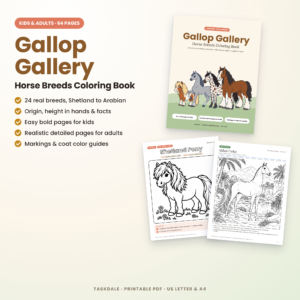
Gallop Gallery Horse Breeds Coloring Book
Price: $4.99 | Best for: Fact fans moving on to real animals
24 real horse breeds, each with an easy page with bold outlines and a realistic page for older kids and adults. Every breed lists its origin and height in hands, with 2 facts on the kids’ page and 3 deeper facts on the adult page, plus guides to markings and coat colors. Printable PDF in US Letter and A4. Start a new section in the field journal for horses and use the same fact routine.
For more ready-to-print books that hold a child’s attention on screen-free days, see our pick of printable coloring books for kids.
Mistakes that blunt a young scientist’s curiosity
- Answering every question instantly. Sometimes say, “Let’s find out.” The search is half the fun.
- Treating facts as a test. Quiz for fun, never for marks.
- Dismissing odd questions. “Did dinosaurs have belly buttons?” is a real question with a real, interesting answer. Look it up.
- Using outdated pages. Upright T. rex and scaly Velociraptor teach old ideas.
- Too many facts at once. One to three per page is plenty. Ten blurs together.
Frequently asked questions
Where can I find free dinosaur coloring pages with facts?
Natural history museum websites, library activity packs and teacher resource sites. You can also add a checked fact by hand to any free page.
What age are dinosaur fact pages good for?
About 5 to 11. Younger children enjoy hearing facts read aloud; older kids like reading and checking them.
How do paleontologists know what dinosaurs looked like?
From bones, teeth, footprints, eggs, skin impressions and, for a few, traces of feathers and pigment. Close living relatives, like birds, help too.
Are birds really dinosaurs?
Yes. Scientists class birds as living dinosaurs, descended from small feathered meat eaters.
How can I make coloring more educational?
Add one checked fact per page, keep a field journal with a question line, and look up the answers together.
What is a Junior Paleontologist certificate?
A printable award for a child who completes a set of dinosaur activities. Roar to Z includes one for finishing the book.
Your next step
Find a ring binder tonight and draw a three-part timeline inside the cover. Tomorrow, color one dinosaur, write one fact and one question, and add it as the first field journal page. When your young scientist wants all 26 with checked facts, the Roar to Z Dinosaur Coloring Book is ready to print.