Best Goal Planner Printable: Four PDFs Compared
The best goal planner printable depends on how much guidance you want. The Becoming Blueprint suits first-time goal setters who want to be walked through, Tallybloom suits people who want habits and goals tracked together, FocusFrame suits a one-page weekly routine, and the Everyday Focus Planner Set suits anyone who wants several paper sizes.
Choosing can feel harder than it should, because every listing promises goals, habits and reviews. This guide shows what actually differs between the four, so you can pick once and start.
Key facts at a glance
- The Becoming Blueprint has 50 guided pages and is the only one here with a life balance wheel, a vision board and a 90-day roadmap.
- Tallybloom has 46 undated pages and covers 30, 66 and 100-day challenges.
- FocusFrame has 10 pages and puts a whole week, including top 3 goals with progress bars, on one page.
- The Everyday Focus Planner Set has 8 undated pages and comes in four sizes: US Letter, A4, A5 and Half Letter.
- All four are undated, so you can begin on any day rather than waiting for January.
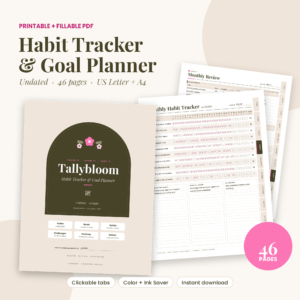 Printable Habit Tracker & Goal Planner PDF | Tallybloom Fillable Undated Planner with 30, 66 & 100-Day Challenges & Routine Builder | US Letter & A4
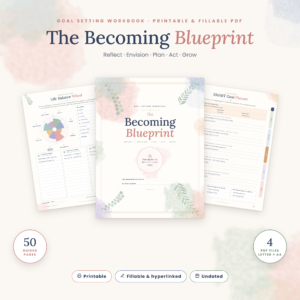 Goal Setting Workbook Printable & Fillable PDF | The Becoming Blueprint 50-Page Goal Planner with SMART Goals, Habit Tracker, Vision Board & Life Balance Wheel
Table of Contents Toggle
- What makes the best goal planner printable?
- How do these four goal planner printables compare?
- Which goal planner printable suits which person?
- How do you use a goal planner printable?
- What mistakes should you avoid with a goal planner printable?
- What affects the price of a goal planner printable?
- Which goal planner printable should you choose?
- Common questions
What makes the best goal planner printable?
The best goal planner printable is one that turns a goal into weekly actions you will genuinely check. Six factors decide that, and they matter more than how attractive the pages look.
Guidance versus blank space
A guided workbook asks you questions before it asks for goals. The Becoming Blueprint does this: you score your life balance, work out your values, choose top goals, then map each with SMART planners. A planner with blank trackers, such as the Everyday Focus Planner Set, assumes you already know your goals. If you have never written goals down, choose guidance.
Page count and depth
A larger page count means more tools but also more to keep up with. Tallybloom's 46 pages and The Becoming Blueprint's 50 pages cover yearly planning through to daily ticks. FocusFrame's 10 pages and the Everyday Focus Planner Set's 8 pages are lighter and quicker to maintain. Be honest about how much admin you will tolerate on a busy Tuesday.
Fillable or print-and-write
A fillable PDF is a file you can type into on a computer before or instead of printing. Tallybloom, The Becoming Blueprint and FocusFrame are fillable, with clickable tabs or hyperlinks in the first two. The Everyday Focus Planner Set supplies both printable-only PDFs and fillable PDFs. If you think better with a pen, print. If you want tidy text and easy edits, type.
Undated pages
Undated pages carry no calendar year, so a missed week leaves no blank gap and you can start today. All four products here are undated. That suits anyone who has abandoned a dated planner in March.
Paper size and week start
US Letter and A4 are the standard sizes. The Everyday Focus Planner Set adds A5 and Half Letter, which suit a ring binder or a smaller desk, and gives Sunday-start and Monday-start files for each size. FocusFrame also offers Monday and Sunday starts. Check your printer takes the size before you buy.
Tracking tools that match your goals
Habit goals need a habit tracker. Longer projects need a roadmap. Tallybloom offers monthly trackers for 5, 10, 15 or 20 habits plus 30, 66 and 100-day challenge pages. The Becoming Blueprint adds progress and savings trackers, which helps if a goal involves money.
How do these four goal planner printables compare?
The four differ mainly in depth and format. The Becoming Blueprint and Tallybloom are full systems, while FocusFrame and the Everyday Focus Planner Set are lighter tools.
| Product | Pages | Formats and sizes | Best known for |
|---|---|---|---|
| Printable Habit Tracker & Goal Planner PDF | Tallybloom Fillable Undated Planner with 30, 66 & 100-Day Challenges & Routine Builder | US Letter & A4 | 46 | Fillable PDF, US Letter and A4, Colour and Ink Saver | Habit trackers, challenges, routine builder |
| Goal Setting Workbook Printable & Fillable PDF | The Becoming Blueprint 50-Page Goal Planner with SMART Goals, Habit Tracker, Vision Board & Life Balance Wheel | 50 | Printable and fillable, hyperlinked PDFs, US Letter and A4 | Guided goal setting with a 90-day roadmap |
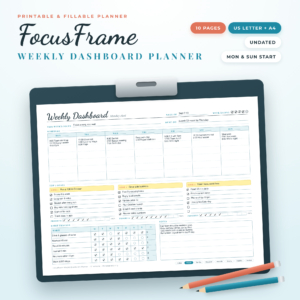 Printable Weekly Planner Dashboard | FocusFrame Undated Weekly Dashboard with Habit Tracker, Goal Planner & To-Do List | Fillable PDF, US Letter & A4 | 10 | Fillable PDF, US Letter and A4, black and white or Coastal colour, Monday or Sunday start | One-page weekly view with top 3 goals |
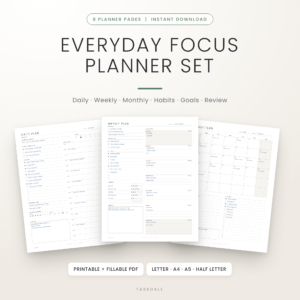 Everyday Focus Planner Set | 8 | Printable and fillable PDFs, US Letter, A4, A5 and Half Letter, Sunday or Monday start | Size choice and basic daily to monthly pages |
All four include a user guide, and the Everyday Focus Planner Set also states a personal-use licence.
Which goal planner printable suits which person?
Each of these printables suits a different starting point, and matching yours saves a wasted print run.
The Becoming Blueprint suits you if goals feel vague. The early pages work on values and life balance before you commit to anything, which stops you chasing goals you do not actually care about. It is the most reflective option here.
Tallybloom suits you if your goals are mostly habits: walking daily, drinking more water, writing each morning. The 66-day challenge page is useful because it gives a habit a longer runway than the common 30-day attempt. Mood and energy check-ins also help you spot why a habit slips.
FocusFrame suits you if you dislike flicking between pages. Schedule, top 3 goals with progress bars, habits and notes sit on one sheet. It also includes a weekly review, a monthly dashboard and a 31-day habit tracker, so it is not a single page only.
The Everyday Focus Planner Set suits you if you want a simple kit in a particular size, such as A5 for a small binder. It covers daily, weekly and monthly pages plus a habit tracker, goal planner, weekly review and two note styles, lined and dot grid. It leaves the thinking to you.
How do you use a goal planner printable?
A goal planner printable works when you set it up once and review it weekly. Follow these steps with any of the four.
- Print a single trial page first and check margins, size and ink use. If a Colour and Ink Saver version is offered, as with Tallybloom, try that for everyday pages.
- Pick no more than three goals to start. The Becoming Blueprint asks you to choose top goals for this reason.
- Break each goal into one weekly action you can finish in under an hour.
- Put the weekly pages where you will see them, such as on the desk or fridge.
- Tick or fill in daily, even briefly. A half-filled tracker is better than a blank one.
- Hold a ten-minute review each week using the review page, then adjust the next week's actions.
If you work on screen, type into the fillable versions and save a dated copy of the file each week. Store spare printed pages flat and away from damp so they feed through the printer cleanly.
What mistakes should you avoid with a goal planner printable?
The commonest mistake is printing every page at once. A 50-page workbook printed in full looks daunting and wastes ink on pages you may never use.
- Setting too many goals. Three is manageable. Ten becomes a list you ignore.
- Writing outcomes, not actions. "Get fitter" cannot be ticked. "Walk for 20 minutes on three mornings" can.
- Skipping the review. The weekly review is where a plan gets corrected. Without it, a missed week becomes an abandoned planner.
- Choosing the wrong paper size. Check that A4 or US Letter suits your printer and binder before printing at volume.
- Picking a system that is too big. If you will not maintain 46 pages, FocusFrame's single weekly sheet is the more honest choice.
What affects the price of a goal planner printable?
The price of a goal planner printable mainly reflects how many pages it has, how many formats and sizes are included, and how much guidance comes with it. A larger guided workbook generally costs more than a short set of blank pages.
Extras such as a user guide, fillable fields, hyperlinked navigation and multiple start-day files add value to a listing. Since these are digital downloads, you also avoid postage, but you do pay for your own paper and ink. A set with an ink saver version can cut that running cost. Check the live product cards for current prices rather than relying on any figure quoted elsewhere.
Which goal planner printable should you choose?
Choose by the problem you are trying to solve. If you do not yet know your goals, start with The Becoming Blueprint. If your goals are habits, choose Tallybloom. If your week feels scattered, choose FocusFrame. If you mainly need a particular paper size, choose the Everyday Focus Planner Set.
You can browse all 4 options below, but the rule stays the same: pick the lightest system you will still use in week four.
Common questions
Can I reuse a goal planner printable?
Yes, because you can print the files again. All four are undated, so you can reprint pages whenever you start a new week or goal. The Everyday Focus Planner Set states a personal-use licence, which covers your own use but not reselling the files.
Do I need a printer?
Not always. Tallybloom, The Becoming Blueprint and FocusFrame are fillable, so you can type into the PDFs on a computer. The Everyday Focus Planner Set also includes fillable files. Printing only matters if you prefer writing by hand.
What is the difference between a goal planner and a habit tracker?
A goal planner sets a target and the steps to reach it, while a habit tracker records a repeated action each day. Tallybloom, The Becoming Blueprint and FocusFrame include both, which links daily habits to the larger goal.
Does a Monday or Sunday start matter?
It matters only if your week has a natural starting day. FocusFrame and the Everyday Focus Planner Set offer both. If you plan on Sunday evening, choose a Sunday start so your weekly review and the new week sit on the same page.
How do I decide between the larger and smaller planners?
Choose the larger ones if you want a full system with reviews and trackers, and the smaller ones if you want less upkeep. A good test is whether you will open it at least once a day. If not, pick FocusFrame or the Everyday Focus Planner Set and add more later.