The best grief journal is the one you can open on a bad day and actually fill in. For most people on this page, that means Carrying Love for a gentle, structured start, Tender Tides for a fuller workbook that can also be used with a counsellor, and Unknot when grief sits alongside other difficult emotions.
Grief can make even simple choices feel heavy, so we've kept this guide practical. You'll find what to look for, how the three options differ, and a plain rule for choosing. 3 options are shown below, and all of them are printable or fillable, which means you can start the same day.
Key facts at a glance
- A grief journal is a set of prompts, worksheets and trackers that helps you put loss into words, rather than a blank notebook.
- Tender Tides is the longest at 77 pages, Carrying Love has 71 pages, and Unknot offers 670 guided questions across 16 emotions.
- Tender Tides and Carrying Love are both written for teens and adults, and both come as fillable PDFs you can complete on screen or print.
- Only Tender Tides includes an 8-session guide for counsellors.
- Carrying Love is the only one with a 31-day grief tracker.
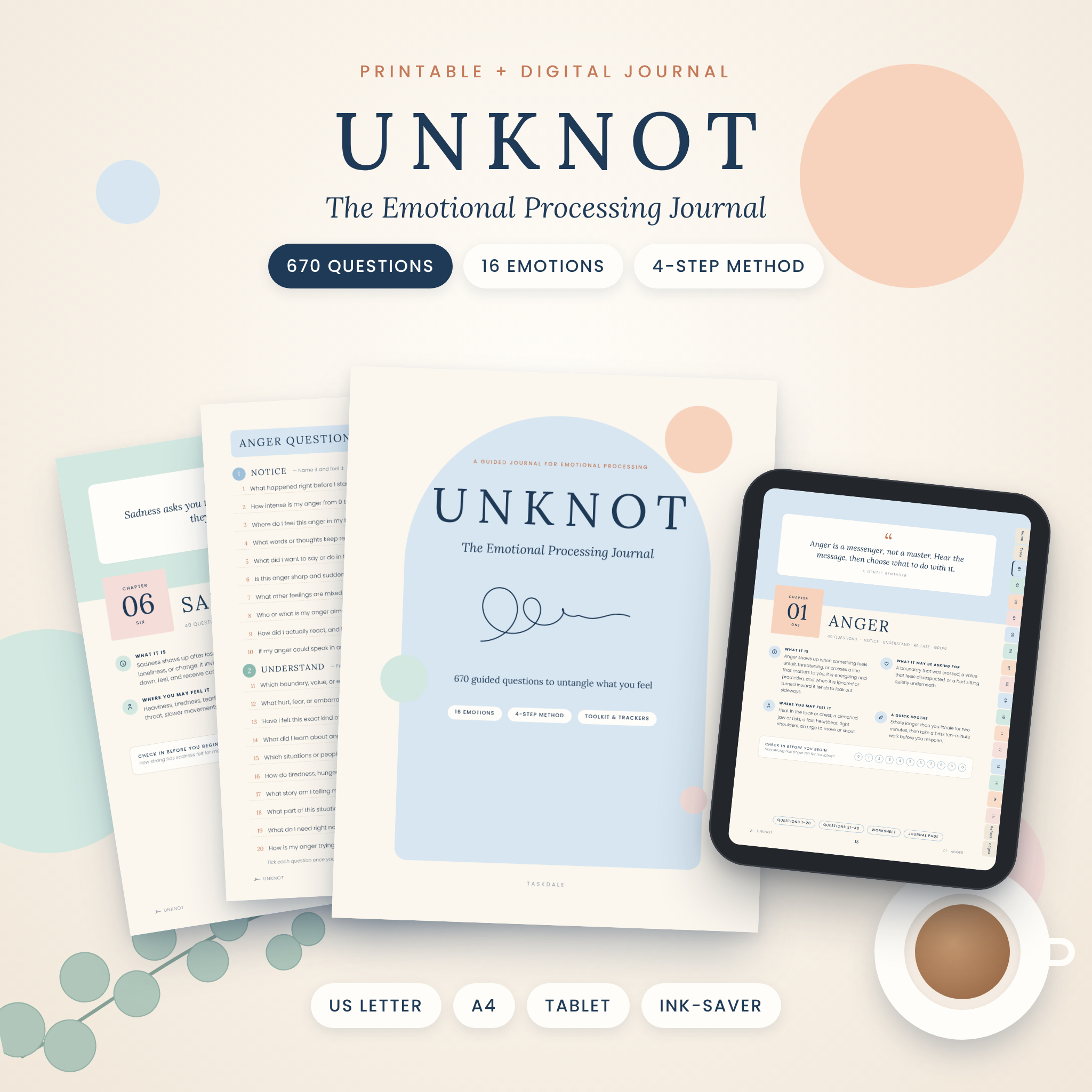 Emotional Processing Journal, Printable & Digital Feelings Journal with 670 Guided Questions, Feelings Wheel, Worksheets & Mood Tracker | Unknot
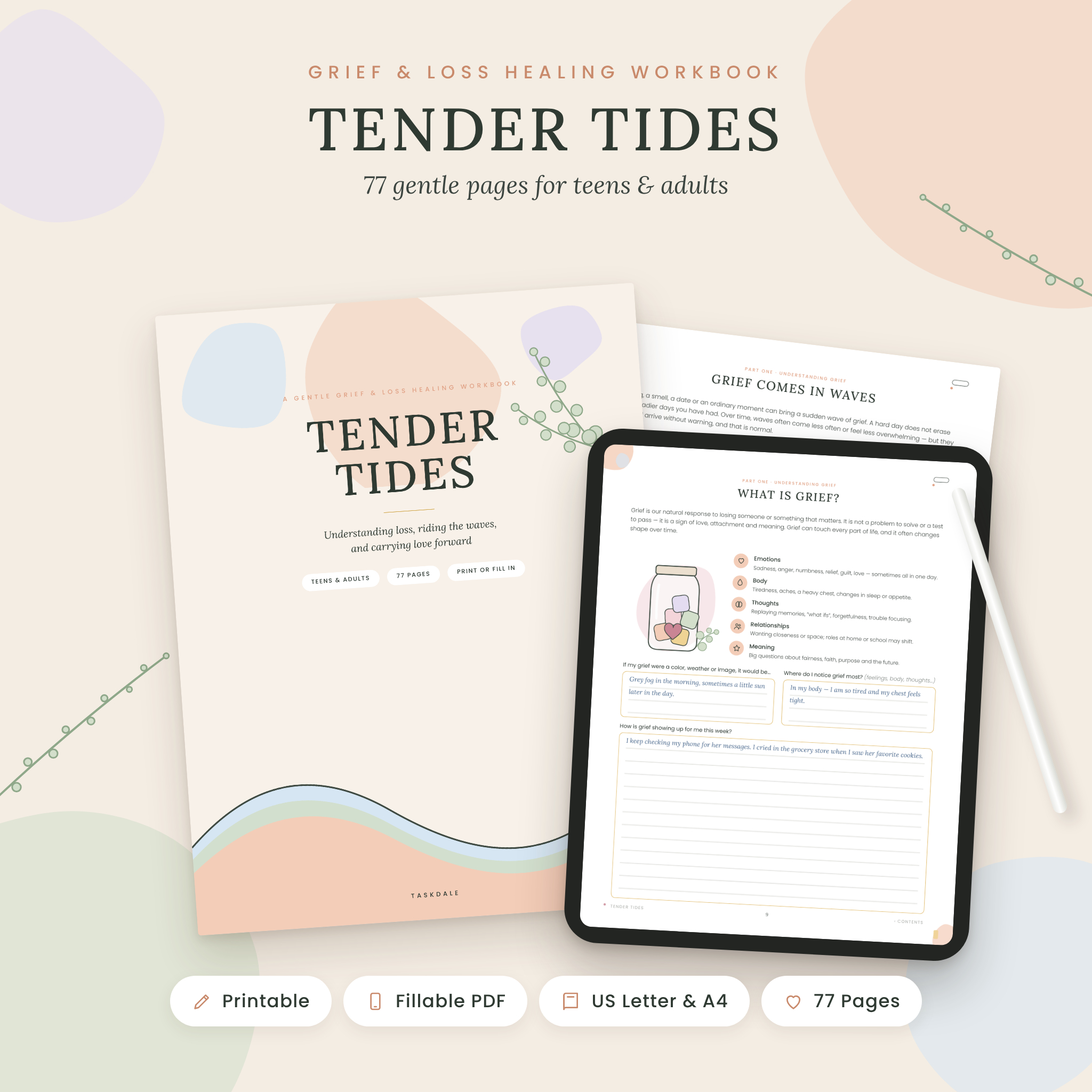
Table of Contents
- What should you look for in a grief journal?
- How do the grief journals on this page compare?
- Which grief journal suits which person?
- How do you use a printable grief journal?
- What mistakes should you avoid?
- What affects the price of a grief journal?
- Which grief journal should you choose?
- Common questions
What should you look for in a grief journal?
A good grief journal has gentle structure, prompts you can answer in a few lines, a way to track how you're feeling, and a format that suits how you like to write. Those four things matter more than design or length, because grief tends to shorten your attention and your energy.
Guided prompts rather than a blank page
A guided grief journal is one that asks you specific questions instead of leaving you to start from nothing. That matters because many people find a blank page harder, not easier, when they're grieving. A prompt such as a letter page, a memory page or a "what I wish I'd said" page gives you a way in. All three products here are guided, but they guide in different ways. Tender Tides has 60 journal prompts. Carrying Love has letter pages and cheque-ins. Unknot has 670 questions, which is far more than most people will use.
Coping tools you can reach for in the moment
Coping tools are short, practical pages or cards to use when a wave of emotion arrives, as opposed to reflective pages you save for a calmer hour. Look for them, because journalling alone doesn't always help in a hard moment. Tender Tides includes 24 cut-out cards. Carrying Love has coping and affirmation cards. Unknot has 36 ways to cope and a feelings wheel and body map to help you name what you're feeling.
Trackers that show patterns over time
A grief tracker is a simple page where you record your mood or how a day went, so you can see change that's too slow to notice from the inside. Carrying Love has a 31-day grief tracker, which suits people who want a month-long view. Unknot has mood, question and daily trackers. Tender Tides includes trackers as one of its nine parts.
Format: printable, fillable or tablet-friendly
Format decides whether you'll use the journal at all. Printable means you print the pages and write by hand. Fillable means you type straight into the PDF. All three offer US Letter and A4 sizes. Carrying Love adds low-ink versions, Unknot has an Ink-Saver edition and hyperlinked tablet editions, and Tender Tides has a clickable contents page so you can jump to the part you need.
Who it's written for, and whether a professional can use it
Cheque the age range and whether you might share it. Tender Tides and Carrying Love are both written for teens and adults. Tender Tides adds an 8-session guide for counsellors, so it's the natural choice if you're seeing a bereavement counsellor or therapist. Unknot is broader than grief, covering 16 emotions, which helps if loss has brought up anger, loneliness or guilt too.
How do the grief journals on this page compare?
The three differ mainly in scope and structure. Two are grief-specific workbooks of around 70 to 80 pages, and one is a much larger emotional processing journal that includes grief as a chapter.
| Product | Best for | Length and structure | Extras | Formats |
|---|---|---|---|---|
| Emotional Processing Journal, Printable & Digital Feelings Journal with 670 Guided Questions, Feelings Wheel, Worksheets & Mood Tracker | Unknot | Grief mixed with other emotions | 670 questions across 16 emotions, 4-step method in every chapter | Feelings wheel, body map, 36 ways to cope, 72 question cards, trackers | US Letter, A4, Ink-Saver, hyperlinked tablet editions, user guide |
| Grief Workbook for Teens & Adults | Tender Tides Printable & Fillable Grief Journal with Loss & Bereavement Worksheets, Coping Skills & Counsellor Session Guide | Grief work alongside a counsellor | 77 pages in 9 colour-coded parts, 60 journal prompts | 24 cut-out cards, 8-session counsellor guide | Printable and fillable PDF, US Letter and A4, clickable contents |
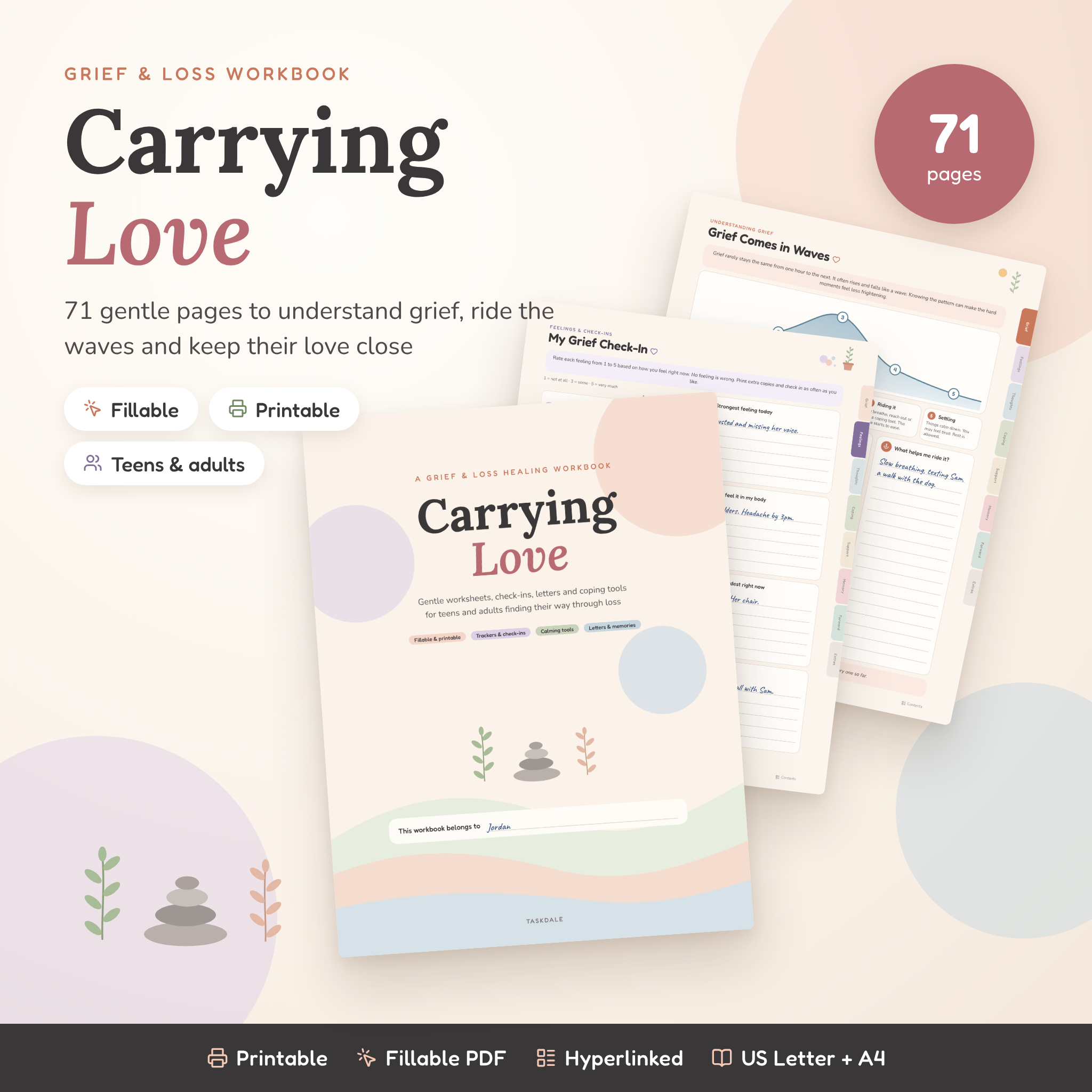 Carrying Love Grief Workbook | Printable & Fillable Grief and Loss Journal for Teens & Adults, 71 Bereavement Worksheets with Coping Skills, Trackers & Letters | A gentle first grief journal | 71 pages in 8 colour-coded sections | Cheque-ins, 31-day grief tracker, letter pages, coping and affirmation cards | Fill on screen or print, US Letter and A4, low-ink versions, user guide |
The practical difference is how much you'll face at once. Carrying Love is the smallest and most contained. Tender Tides adds more parts and a counsellor guide. Unknot gives the most material, which is a strength if you want depth and a burden if you don't.
Which grief journal suits which person?
Each journal suits a different situation, and the right one depends on how recent your loss is, whether you have support, and how much you want to write.
Carrying Love suits you if the loss is recent or you've never journalled before. Its 71 pages are organised into 8 sections with clickable tabs, and it deals directly with guilt and unanswered questions, which are common in early grief. The 31-day tracker gives the month a shape.
Tender Tides suits you if you want a fuller workbook or you're working with a professional. The 8-session counsellor guide means a counsellor can use it as a framework, and the nine colour-coded parts cover feelings, coping skills, support and memories. It also suits a teenager and parent working through the pages in turn.
Unknot suits you if grief isn't the only thing you're carrying. Its 4-step method (Notice, Understand, Release, Grow) repeats in every chapter, so you learn one routine and use it for anger, loneliness, rejection or grief. It's the better choice for someone who journals regularly and wants to keep using the book after the hardest months.
How do you use a printable grief journal?
Using a printable grief journal means setting up a small, low-pressure routine, not working through it page by page. Short, regular sessions tend to work better than occasional long ones.
- Choose your format first. Print the low-ink or Ink-Saver version if you're printing at home, or fill the PDF on screen if writing by hand feels like too much.
- Read the user guide or contents page once. Both Carrying Love and Unknot include a step-by-step guide, and Tender Tides has a clickable contents page.
- Start with the easiest page, such as a tracker or cheque-in, not the hardest.
- Set a short time limit, say ten to fifteen minutes, and stop when it's up.
- Keep the printed pages in a folder or binder so they stay together and private.
- Return to earlier pages after a few weeks to see what has shifted.
If you're using a journal with a counsellor, bring the pages you're willing to share rather than the whole thing.
What mistakes should you avoid?
The most common mistakes are choosing too much material, treating the journal as a task to finish, and using it in place of support you need. Each one can make a helpful tool feel like another pressure.
- Buying the largest option by default. Unknot's 670 questions are a resource to dip into, not a course to complete. If that sounds tiring, choose a smaller workbook.
- Starting with the hardest prompts. Letters and guilt pages can be powerful, but they're better after a few easier sessions.
- Expecting a straight line. Grief comes in waves, and a tracker may show good and bad weeks side by side. That's normal.
- Using a journal instead of help. A journal can support you, but it isn't a substitute for a GP, counsellor or bereavement service if you're struggling to cope.
- Leaving printed pages where others can read them. If privacy matters, keep them somewhere safe or use the fillable version.
What affects the price of a grief journal?
The price of a grief journal depends mainly on how much material it includes, which formats come with it, and whether it has professional extras. The live product cards show current prices, so we haven't quoted any here.
Content volume is the biggest factor. A journal with hundreds of prompts, question cards and several tracker types costs more to produce than a shorter workbook. Format range matters too: extra editions such as low-ink versions or tablet-friendly files add value. Professional features, such as Tender Tides' counsellor session guide, are aimed at a narrower audience and can raise the price.
Printing costs are separate and yours to control. Low-ink and Ink-Saver editions cut the cost of printing at home, and you can print only the sections you'll use.
Which grief journal should you choose?
Choose by the situation you're in, not by the longest feature list. A simple rule covers most cases.
- Choose Carrying Love if you want a gentle, contained grief journal for a recent loss or a first attempt at journalling.
- Choose Tender Tides if you're seeing a counsellor, want the widest grief-specific coverage, or are supporting a teenager.
- Choose Unknot if grief is one of several emotions you want to work through, and you're comfortable with a large book.
If you're unsure, start with the smaller grief workbook. You can always add a broader journal later.
Common questions
Is a printable grief journal as effective as a paper notebook?
A printable journal gives you the same hand-written experience once printed, with prompts already set out. Many people prefer it because the structure removes the pressure of a blank page. If you'd rather type, the fillable PDFs let you work on screen instead.
Can a teenager use these grief journals?
Tender Tides and Carrying Love are both written for teens and adults, so a teenager can use either. The gentle wording suits younger readers. A parent or counsellor may want to look through the pages first, and Tender Tides' counsellor guide can help structure that conversation.
How long should I spend on grief journalling each day?
There's no required length. Ten to fifteen minutes is a manageable start, and a few lines on a tracker page counts. Skipping days is fine. Consistency matters less than finding a pace that doesn't leave you feeling worse afterwards.
What if journalling makes me feel worse?
Stop and put the journal down. Some prompts, especially letters and questions about guilt, can bring up strong feelings. Return to a lighter page or a coping card instead. If distress continues, speak to your GP or a bereavement support service.
Do I need a printer to use these?
No. Carrying Love can be filled in on screen, Tender Tides is a fillable PDF, and Unknot has hyperlinked tablet editions. If you do print, pick a low-ink or Ink-Saver edition and print only the sections you need.