Best Homeschool Printable: Four Picks Compared
The best homeschool printable is the one that fits your child's age and the specific job you need done, whether that is teaching money skills, building focus or keeping lessons and records in order. Of the four here, two money workbooks suit ages 7 to 12, the Executive Functioning Workbook for Kids suits ages 5 to 10, and the Rainbow Days planner is for the parent doing the teaching.
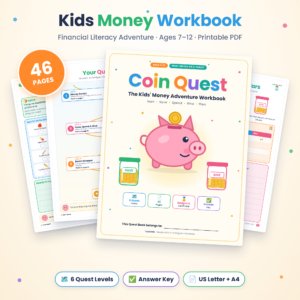 Kids Money Workbook Printable | Coin Quest Financial Literacy for Kids Ages 7–12 with Budgeting, Saving, Needs vs Wants Worksheets & Answer Key
 Penny Pathfinders Kids Money Workbook | Financial Literacy Printable for Ages 7–12 | Budgeting, Saving & Needs vs Wants Worksheets | Homeschool Unit Study with Answer Key
Key facts at a glance
- The Kids Money Workbook Printable and Penny Pathfinders Kids Money Workbook both cover earning, saving, spending, giving and budgeting for ages 7 to 12.
- The Executive Functioning Workbook for Kids is written for ages 5 to 10 and runs to 38 pages.
- The Rainbow Days Homeschool Weekly Planner & Command Centre has 22 undated pages, so you can start on any date.
- All four come as US Letter and A4 files, so they print on standard paper in most countries.
- You can browse all 4 options in the grid on this page and open any of them for the full listing.
What should you look for in the best homeschool printable?
A good homeschool printable has a stated age range, an answer key or adult guide, print-friendly files and enough pages to last a realistic stretch of time. Each of these is easy to check on a product page before you buy.
A clearly stated age range
A printable with a narrow, honest age range will pitch its reading level and activities correctly. The money workbooks aim at 7 to 12 and the focus workbook at 5 to 10, which is a different spread of ability from the same family.
Where a range is wide, look for built-in stretch. Penny Pathfinders includes Level Up challenges for ages 10 to 12, so older children are not working through the same tasks as a seven-year-old.
An answer key and adult guidance
An answer key saves you from working out every worksheet yourself, and a grown-up guide tells you how to run the material. Both money workbooks include a full answer key, and Kids Money Workbook Printable adds a grown-up guide and a 6-week plan.
The Executive Functioning Workbook for Kids includes a grown-up toolkit with posters. Penny Pathfinders comes with a printable user guide.
Paper size and ink options
US Letter and A4 are different shapes, and printing the wrong one can crop margins. Every product here includes both sizes, so you pick the one that matches your paper.
If you print often, ink matters. Kids Money Workbook Printable and the Rainbow Days planner both include Ink Saver versions alongside full colour, which suits a home printer.
Currency and local relevance
A money workbook is only useful if the coins in it look like the ones your child handles. Kids Money Workbook Printable works with any currency and uses dollars by default. Penny Pathfinders comes in dollar, pound and any-currency editions.
Tracking and record-keeping features
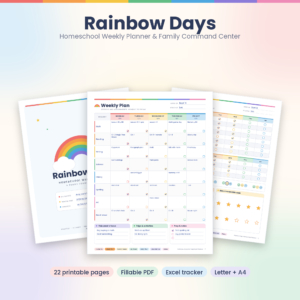
Some printables teach, and some keep you organised. The Rainbow Days planner has a 180-Day Attendance page, an Hours Log and a Reading Log, plus a spreadsheet that counts attendance, totals hours and works out grades for up to four children.
If your area asks you to keep records, those features matter more than any amount of colour.
How do the four homeschool printables compare?
The four products split into two money workbooks, one skills workbook and one planner. The table sets out what differs in the supplied details.
| Product | Best for | Ages | Format and size | Standout features |
|---|---|---|---|---|
| Kids Money Workbook Printable | A structured money course with a clear finish | 7 to 12 | 46 pages, US Letter and A4, Ink-Saver versions | Six levels, checkpoint badges, answer key, grown-up guide, 6-week plan |
| Penny Pathfinders Kids Money Workbook | A homeschool unit study with games and play money | 7 to 12 | 52 pages, US Letter and A4, three currency editions | Clickable trail map, 33 activities, store game, Level Up challenges, user guide |
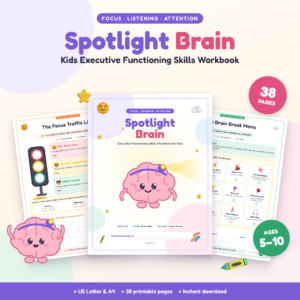
| Executive Functioning Workbook for Kids | Focus, listening and routine building | 5 to 10 | 38 pages, US Letter and A4 PDFs, instant download | Traffic-light check-ins, brain break cards, reward chart, grown-up toolkit |
| Rainbow Days Homeschool Weekly Planner & Command Centre | Planning lessons and keeping records | Parent use, with pages for children | 22 undated pages, fillable and printable PDF, colour and Ink Saver | Attendance, hours and reading logs, spreadsheet for up to 4 kids |
Which homeschool printable suits which family?
Each product suits a different situation, and the choice is mostly about what problem you are solving this term.
Kids Money Workbook Printable suits a family that wants a clear start and finish. Its six levels, checkpoint badges and certificate give a child visible progress, and the 6-week plan tells you how to pace it.
Penny Pathfinders Kids Money Workbook suits a family that wants a full unit study. With 52 pages, a trail map, a store game and play money, it gives hands-on practise, and the Level Up challenges help if your children span several ages.
It also suits families who need pounds rather than dollars, because a pound edition is included.
Executive Functioning Workbook for Kids suits a younger child who struggles to settle, listen or follow routines. It is described as ADHD-friendly, with brain breaks, star breathing and morning and evening routines.
It is a skills workbook, not a subject, so it works alongside any curriculum. Children aged 5 to 10 are the intended audience.
Rainbow Days Homeschool Weekly Planner & Command Centre suits the parent who needs the week to hang together. Because the pages are undated, you can start mid-term without wasting weeks.
If you teach up to four children, the grading and attendance spreadsheet is the feature that earns its place.
How do you use a homeschool printable properly?
A homeschool printable works best when you print a small batch, set a fixed time to use it and review progress weekly. Printing the whole file at once usually leads to a pile of paper that nobody opens.
- Check your paper size and choose the US Letter or A4 file to match.
- Choose full colour for a child who responds to visuals, or the Ink Saver version for everyday use where one is included.
- Read the grown-up guide or user guide first, which takes a few minutes and shows you the intended order.
- Print one level, trail or week at a time and keep it in a folder or binder.
- Set a regular slot, such as 20 minutes after breakfast, and stick to it for the first fortnight.
- Mark work with the answer key, then talk through any wrong answers instead of just correcting them.
- Finish each stage with the reward chart, badge or certificate where one is included.
For the planner, fill in the Weekly Plan on Sunday evening and log attendance and hours daily. Doing that in small amounts takes far less effort than catching up at term end.
What mistakes should you avoid when buying a homeschool printable?
The most common mistake is buying for the wrong age, followed by buying more than you can use. Each one is simple to avoid.
- Buying on theme alone. A colourful money workbook is no use to a five-year-old who cannot yet read the instructions. Check the age range first.
- Ignoring currency. A child who counts pounds at the shop will struggle with dollar coins. Choose a pound or any-currency edition where it matters.
- Printing everything at once. A 52-page workbook in full colour uses a lot of ink. Print by level or trail.
- Skipping the adult guide. The answer key and plan are there to save you time, and they only help if you read them.
- Expecting a workbook to replace a routine. The Executive Functioning Workbook for Kids works through daily habits, so it needs regular check-ins to have any effect.
- Buying a planner and not using it daily. An unused attendance log is worse than none if you are required to keep records.
What affects the price of a homeschool printable?
The price of a homeschool printable mostly reflects the amount of material, the number of included extras and how many versions of the file you receive. The cheaper options are usually shorter or narrower in scope, and the premium ones bundle more.
Page count is the first factor. A 52-page workbook with 33 activities, trackers and play money costs more to produce than a 22-page planner.
Extras come next, such as answer keys, guides, posters, certificates and spreadsheets. Editions matter as well, so a product offering three currency versions has more in the download.
Because these are digital files, you pay once and print as often as you need for your own household. Your running cost is paper and ink, which is why the Ink Saver files matter over a long term.
Which homeschool printable should you choose first?
Start from the problem you want solved this month. If your child needs to learn about money, choose Kids Money Workbook Printable for a clear six-level course, or Penny Pathfinders Kids Money Workbook for a fuller unit study with games and a pound edition.
If your child struggles with focus or routines, choose the Executive Functioning Workbook for Kids. If the paperwork is what weighs on you, choose the Rainbow Days planner.
Common questions
Can I use the money workbooks with children of different ages?
Yes, within the 7 to 12 range. Penny Pathfinders includes Level Up challenges for ages 10 to 12, which gives older children extra stretch, while Kids Money Workbook Printable's six levels let a younger child work through more slowly.
Do I need a colour printer for these homeschool printables?
No. Kids Money Workbook Printable and the Rainbow Days planner both include Ink Saver versions. The other two are designed in colour, but you can print them in greyscale if you prefer, though the visual cues may be less clear.
Will these files print on A4 paper in the UK?
Yes. All four products include both US Letter and A4 versions. Choose the A4 file when printing in the UK, and set your printer to actual size so the margins stay intact.
Is the Executive Functioning Workbook only for children with ADHD?
No. It is described as ADHD-friendly, but it covers focus, listening and routines that many children aged 5 to 10 find useful. The brain breaks, traffic-light check-ins and routines suit any child who finds settling difficult.
How many children can the Rainbow Days planner track?
The included spreadsheet counts attendance, totals hours and works out grades for up to four children. If you teach more than four, you would need a second copy or a separate system for the extra children.