A mountain lake is the perfect color by number picture. The sky fades from pale blue to deep blue in three numbered bands. The water mirrors it. The pines are four greens. When you finish, you realize you just shaded a landscape like a painter, one numbered patch at a time.
That is why paint by number coloring games with landscape and nature artwork are so popular. This guide covers the scenes worth starting with, what numbered landscapes quietly teach you about light and shade, palettes for each season, a weekend plan for a big scene, and ideas for framing a set. We also suggest printable books on Taskdale for guided nature pages and for free coloring once you are ready.
Quick picks for nature lovers
| Product | Best for | Price | Link |
|---|---|---|---|
| Hue & Harmony Color by Number for Adults | Numbered lakes, meadows, gardens and coasts | $4.99 | View |
| Pond Life Coloring Book | Detailed wetland scenes to color freely | $3.49 | View |
| Hop to Ten Color by Number for Kids | Simple seasonal nature pages for young children | $4.49 | View |
| Swish & Shade Digital Coloring Pages for Kids | Mess-free tablet coloring on the go | $4.99 | View |
Why nature scenes suit color by number so well
Nature is made of gradients. A sky is never one blue, a hill is never one green, a sunset is a slow slide from gold to rose to violet. Those smooth changes are hard to color freehand. Color by number breaks them into clear zones, so you get the effect of blending without having to blend.
Nature also forgives. If a leaf is a shade off, it still looks like a leaf. If a cloud edge wobbles, clouds wobble. Compare that with a portrait, where one wrong shade on a nose looks odd. Landscapes give you room to relax.
And they feel good to finish. A completed garden cottage or autumn path looks like real art on the wall. Visitors ask where you bought it. That small flush of pride never gets old.
Landscape scenes worth starting with
Some subjects are kinder to beginners than others. Here is a rough order from easiest to most demanding.
Single subjects in nature
A sunflower, a tulip vase, a hummingbird, an owl. Few colors, big shapes, quick wins. Good for your first evening.
Coastal scenes
A sailboat on calm water, a cliffside lighthouse. The sea and sky give you large areas, while the boat or lighthouse adds a little detail.
Lakes and mountains
Layers of sky, peaks, trees and reflections. More numbers, but very satisfying as the depth appears.
Gardens and paths
A garden cottage, an autumn path, a wildflower meadow. Lots of small flowers and leaves. Best for a medium or advanced session.
Water gardens and reefs
Koi ponds, Japanese gardens, coral reefs. These are rich, colorful and full of small areas. Save them for a weekend.
A book that sorts nature designs by level lets you climb this ladder one page at a time.

Hue & Harmony Color by Number for Adults
Price: $4.99 | Best for: Adults who love guided nature scenes
Hue & Harmony has 30 designs in Easy, Medium and Advanced, with plenty of nature: a sunflower, a cliffside lighthouse, a sailboat, a mountain lake, a koi pond, an autumn path, a garden cottage, a coral reef, a Japanese garden and a wildflower meadow. Each page has a named color key, and a Finished Gallery shows every completed design. Start with the lighthouse, then try the mountain lake.
What numbered landscapes teach you about shading
Here is a quiet bonus. Every landscape you color by number is a free lesson in how artists handle light. Once you notice it, you start seeing it everywhere.
- Skies go lighter toward the horizon. Look at how the numbers step from dark blue at the top to pale blue near the hills.
- Distant things are paler and bluer. Far mountains get softer, greyer numbers than the trees in front.
- Water borrows the sky. The lake uses the same blues as the sky above it, often a step darker.
- Light has a side. Trees and rocks get a lighter green or grey on one side and a darker one on the other.
- Warm colors come forward. An orange path or a red barn pops out of a cool green field.
After five or six landscapes, try coloring a free nature page and use these rules yourself. You will be surprised how much you have picked up.
Palettes for every season
Color by number pages come with their own palette, but it helps to know the feel of each season if you ever want to recolor a design or move on to free coloring.
| Season | Core colors | Accent |
|---|---|---|
| Spring | Fresh green, pale yellow, soft pink, sky blue | Lavender |
| Summer | Deep green, bright blue, sunflower yellow | Coral |
| Autumn | Rust, mustard, olive, warm brown | Burgundy |
| Winter | Blue-grey, slate, white paper, pine green | Holly red |
A fun experiment: print the same landscape twice. Color one with the key, and recolor the second using an autumn palette. Same mountains, different season. Hang them side by side.
Using real photos to bring a page alive
Keep a few nature photos on your phone or pinned beside you while you color: a lake at dusk, a beech wood in October, a cliff path in July. You will not copy them exactly, but they help you notice things the color key is hinting at.
Look at how a real lake darkens near the shore where trees reflect in it. Look at how far hills turn almost lilac on a hazy day. Then glance back at your numbered page and you will see the designer used the same trick. It makes the coloring feel less like filling in and more like painting.
A walk helps too. Color a woodland page on the evening after a walk in the woods, and you will find yourself choosing to press a little harder on the shadowed side of the trunks. Small observations, real improvement.
From guided pages to free nature coloring
Color by number is a wonderful training ground. Many people find that after a dozen guided landscapes, they want to try a detailed nature page without numbers and choose every color themselves. That step feels big, but you are better prepared than you think.
Start with a scene full of natural subjects, where small color choices do not matter much. Frogs, reeds, lily pads, dragonflies. Use the shading rules from above: lighter on one side, darker underneath, water that borrows the sky.
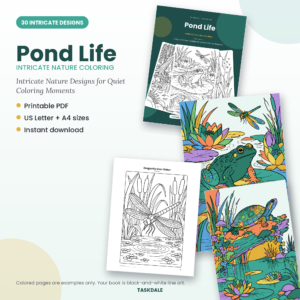
Pond Life Coloring Book
Price: $3.49 | Best for: Nature lovers ready for free coloring
Pond Life has 30 intricate nature pages: a lily pad frog, a heron in reeds, a dragonfly over water, a turtle on a log, a kingfisher, a willow reflection and a rainy pond. Each page opens with a short, gentle line to set the mood, and it prints on US Letter or A4. Try the Turtle on a Log page first, using the palette from a finished color by number lake.
If you enjoy wildlife pages, our guide to bird coloring pages has more nature subjects to try.
A weekend plan for an advanced landscape
Big scenes like a coral reef or a wildflower meadow can feel daunting. Split them across a weekend and they become a pleasure.
- Friday evening (20 minutes): print the page and the swatch chart. Match pencils. Sharpen everything.
- Saturday morning (1 hour): color all the background numbers first, usually sky or water.
- Saturday afternoon (1 hour): the middle ground. Hills, trees, rocks.
- Sunday morning (1 hour): the foreground and the small, bright details like flowers or fish.
- Sunday afternoon (20 minutes): compare with the finished preview, touch up any missed spaces and sign the page.
Working back to front keeps the page clean, because you never rest your hand on finished foreground details. And there is something lovely about seeing a whole landscape take shape across two days.
A ten-minute nature break on busy days
Not every day has room for an hour of coloring. Ten minutes does. Keep a medium landscape on a clipboard by the kettle and color one number while the water boils and the tea brews.
Ten minutes on a Tuesday is enough to fill every 6 on the page, perhaps the pale green of a far meadow. By Friday, the meadow is done and the hills are taking shape. The page becomes a small window onto somewhere calm, and you visit it a few minutes at a time. On a stressful week, those tiny visits matter more than you might expect.
Paper, pencils and printing for nature pages
- Print at actual size. Small numbered areas get even smaller if the page shrinks to fit.
- Use smooth paper. Thicker, smooth paper takes layers of pencil better than thin copy paper.
- Keep pencils sharp. Advanced nature pages have tiny areas between leaves and petals.
- Try fine-tip markers for water. They give flat, even blues that look like still water.
- Use a white gel pen for sparkle. A few dots on water or dew on leaves after you finish.
Paper pages or tablet games?
Tap-to-fill paint by number apps offer plenty of landscape pictures and are handy on the go. They are fast, though, and the fun can be over in minutes. Paper pages take longer and leave you with something to hang. Some people like both: an app on the commute, a printed landscape on the weekend.
You can also color a printable PDF on a tablet with a stylus in an app like GoodNotes or Procreate. It sits halfway between the two: slower than tapping, tidier than paper. For a look at free digital options, see our roundup of online coloring games.
Children who want to join in on a tablet need bigger shapes and no ads. A pack of kid-friendly digital pages keeps them busy in the car while you plan the next landscape.

Swish & Shade Digital Coloring Pages for Kids
Price: $4.99 | Best for: Kids coloring on tablets and phones
Swish & Shade has 60 mess-free digital coloring pages in four sets: toddler, kids, detailed and a travel set shaped for phones. Every page is black line art on a transparent PNG, and the collection also comes as a hyperlinked PDF for GoodNotes, Notability and Xodo. Load the travel set on a phone before a long drive.
Nature pages for children
Kids love nature subjects too, but they need much bigger spaces and fewer numbers. Seasonal pictures work well: a tulip and a chick in spring, an ice cream and a sandcastle in summer, a hedgehog and a squirrel in autumn, a snowman in winter. Color by number with numbers 1 to 10 also builds early counting.
A nice family idea: an adult colors a numbered landscape while a child colors a simple nature page beside them. Then hang both together. The child is always thrilled to be part of the gallery.
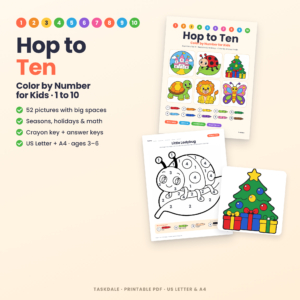
Hop to Ten Color by Number for Kids
Price: $4.49 | Best for: Young children aged 3 to 6
Hop to Ten has 52 color by number pictures using the numbers 1 to 10, with big spaces and a crayon key. Its Seasons and Holidays section includes spring tulips and a chick, summer ice cream and a sandcastle, an autumn hedgehog and squirrel, and a winter snowman and penguin. Full-color answer keys let children check their own work.
Framing and displaying a landscape set
Finished nature pages look wonderful together. A few simple ideas:
- Four seasons wall: frame four landscapes, one per season, in matching frames.
- Coastal row: a lighthouse, a sailboat and a reef in a line above a desk.
- Gift frames: a finished garden cottage makes a thoughtful present for a gardener.
- Clipboard gallery: hang the page you are working on from a clipboard on the wall. It changes every week.
Simple white mounts make colored pencil look rich. Inexpensive frames from a home store are fine.
Common mistakes on landscape pages
- Coloring the foreground first. Your hand smudges it while you work on the sky.
- Heavy pressure on skies. Light, even layers look smoother over big areas.
- Mixing up similar greens. Label your pencils with the key numbers on a strip of tape.
- Skipping the preview. Glance at the finished image now and then to stay on track.
- Starting with a reef. Begin with a lighthouse or a sunflower and build up.
Flower scenes have their own quirks, like tiny petals and lots of pinks. Our guide to flower coloring pages covers those.
Frequently asked questions
What is the easiest landscape for color by number?
A coastal scene like a lighthouse or a sailboat. Large sky and sea areas with a single simple subject make it quick and satisfying.
Do color by number landscapes help you learn shading?
Yes. The numbered zones show how skies lighten toward the horizon, how distant hills get paler and how light falls on one side of trees.
What pencils work best for nature scenes?
Soft colored pencils with several greens and blues. Keep them sharp for small leaves and petals.
Are there paint by number games with nature pictures?
Many apps include landscapes and wildlife, often with ads or subscriptions. Printable books give you nature scenes to color on paper with no screen.
How long does an advanced landscape take?
Around three to five hours, which suits a weekend split into short sessions.
Can I recolor a landscape in my own palette?
Yes. Print a second copy and try a seasonal palette. It is a great way to move toward free coloring.
Which greens do I need for nature color by number pages?
At least four: a pale spring green, a mid leaf green, a deep pine green and an olive. Most nature keys use some mix of these.
Your next step
This weekend, print one coastal scene and one mountain lake, and color the sky of each before Sunday lunch. For 30 guided designs full of lakes, meadows, gardens and coasts, start with Hue & Harmony Color by Number for Adults.