Ask a 5-year-old to “tell me a story” and you often get a shrug. Hand her a castle page and a purple crayon, then ask who lives in the tower, and the story pours out. Busy hands free up the imagination. That is the whole idea behind these activities.
This guide is for parents, grandparents, homeschoolers and early-years teachers who want coloring time to do a little more. You will find eight simple activities that turn princess pages into storytelling practice, ideas for adapting them for pre-writers and confident writers, a five-day plan and a few mistakes that can shut a story down. None of it needs special training. Just pages, crayons and a willingness to listen.
Quick picks for story-rich coloring
| Product | Best for | Price | Link |
|---|---|---|---|
| Turret & Tiara Princess and Castle Coloring Book | A story starter question under every picture | $4.49 | View |
| Pretend Play Coloring Book | Knight, dragon and dress-up scenes for hero swaps | $2.99 | View |
| Indoor Activities Coloring Book Adventure | Puppet show and storytime scenes | $2.99 | View |
| Friendship Fun Coloring Book | Kind stories about friends helping each other | $2.99 | View |
Why coloring and storytelling go together
Storytelling on the spot is hard for young children. They have to invent characters, a place and a problem, and say it all in order, while an adult waits. Many freeze. Coloring takes the pressure off. The picture already gives them a place and a character, and the crayon gives their hands something to do while their mind wanders.
Think of a 6-year-old coloring a castle by a lake. You ask, “Who rows the little boat?” She keeps coloring and says, “The princess’s grandma. She goes fishing every morning.” That is a character, a setting and a daily routine in one breath. She has started a story without noticing.
Over weeks, these small conversations build real skills: using new words, putting events in order, describing feelings and explaining why things happen. Those are the same skills kids need for reading and writing at school.
Activity 1: Answer the story starter
The easiest way in is a page with a question already printed on it. “Who lives in this castle?” “What is hiding behind the little round door?” A question gives the child a target. There is no blank page to fear.
How to run it: read the question aloud before your child starts coloring. Do not ask for an answer yet. Let them color for a few minutes and think. Then ask again. You will usually get a much richer answer the second time.
For pre-writers, you write their answer on the lines while they watch. Say each word as you write it. Seeing their own words become writing is a powerful moment for a 4-year-old.
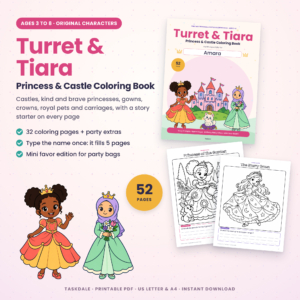
Turret and Tiara Princess and Castle Coloring Book
Price: $4.49 | Best for: story time and early writing, ages 3 to 8
Turret & Tiara has 32 original princess and castle pages, each with its own story starter question and two or three writing lines. It also includes a My Royal Fairy Tale writing page and design-your-own gown, crown and castle pages. You get US Letter and A4 PDFs, and its terms cover one teacher’s own class as well as home use. Start with the castle pages, which have the most open questions.
Activity 2: Who, where and what goes wrong
Every good story needs three things: a character, a place and a problem. Kids grasp this quickly when you name the three parts and point to them on a page.
Before coloring, ask:
- Who? “Who is this? What is her name?”
- Where? “Where is she? What does it smell like there?”
- What goes wrong? “Uh oh. Something has gone wrong. What is it?”
The third question is where the magic happens. A princess with a kite on a windy hill becomes interesting the moment the kite gets stuck in a tree. Now there is a problem to solve, and the child’s brain lights up. How will she get it down? Who helps?
Write the three answers on a sticky note and stick it to the page. After a week, you will have a little pile of story plans, and you can ask your child to pick one to tell at dinner.
Activity 3: First, then, finally
Sequencing is one of the most useful early literacy skills. Children need to know that stories have a beginning, a middle and an end. Three coloring pages make that visible.
Choose three pages that could fit together, for example a princess at the castle gate, a princess in the garden and a princess at a tea party. Color them over a few days. Then lay them on the table in a muddle and ask your child to put them in order. “What happened first? Then what? And finally?”
There is no single right order. One child will say the princess went to the garden to pick flowers for the tea party. Another will say she went to the tea party first and then needed fresh air. Both are good sequencing. What matters is that they can explain why.
Clip the three pages together and write “First,” “Then” and “Finally” at the top of each. You have just made a three-page picture book.
Activity 4: Color the feeling
Colors carry mood. Kids know this instinctively, even if they have never thought about it. This activity makes it a game.
Before coloring a castle page, ask how the princess feels today. Happy? Worried? Excited? Grumpy? Then ask what colors would show that feeling. A happy day might be yellow and pink with a bright sun. A worried day might have gray clouds rolling over the towers. An excited day might be every color at once.
Afterward, ask why she feels that way. “She’s worried because her dragon flew away and it’s getting dark.” Now the child is linking feelings to events, which is a big step in storytelling. It also gives children words for their own emotions. That is a lovely side effect.
Activity 5: Swap the hero
Fairy tales often follow the same pattern. Swap one piece and the story becomes fresh and funny. Kids love turning things upside down.
Try these swaps while coloring:
- The princess rescues the knight from the tower.
- The dragon is scared of the princess’s cat.
- The castle is tiny and the princess is a giant.
- The king is the one who has to be home before midnight.
Each swap forces the child to rethink the story. Who does what now? What happens next? This is creative thinking in action, and it is wonderful for kids who have heard the same tales a hundred times.
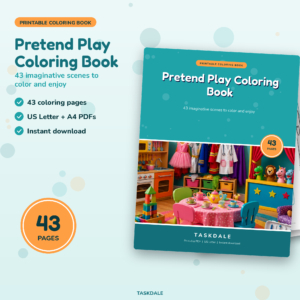
Pretend Play Coloring Book
Price: $2.99 | Best for: kids who love role-play and dress-up
Pretend Play has 43 role-play scenes packed with props, including Knight and Dragon, Princess Dress-Up, Pirate Ship Captain and Space Explorer. Each page is one big scene with lots to talk about, in US Letter and A4 PDFs, licensed for your household. Color the Knight and Dragon page and ask your child to swap the hero: what if the dragon needs rescuing?
Activity 6: Put on a puppet show
Once a page is colored, the characters can come off the paper. Cut out the princess, the dragon, the pony and the king. Tape each one to a craft stick, a straw or a pencil. Now you have puppets.
Turn a cardboard box on its side for a stage, or kneel behind the sofa. Your child tells the story while moving the puppets. A shy child who will not tell a story to your face will often happily tell it through a paper dragon.
Print a second copy of the page first, so the colored original stays whole for the fridge. Puppets get bent and loved. That is fine.
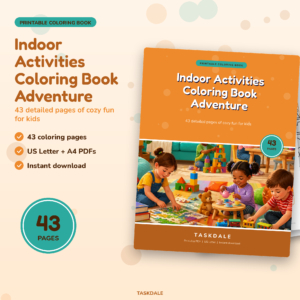
Indoor Activities Coloring Book Adventure
Price: $2.99 | Best for: rainy days and home story time
Indoor Activities has 43 detailed home scenes, including Puppet Show, Storytime Circle, Dress-Up Corner, Castle Blanket Fort and Tea Party. It comes as separate US Letter and A4 PDFs with crisp lines, licensed for your household. Color the Puppet Show page together, then make your own puppets and put on the show it pictures.
Activity 7: Stories where friends help
Not every story needs a villain. Some of the best stories for young children are about friends solving a small problem together. A lost kite. A tower of blocks that falls. A picnic in the rain.
These stories build a different skill: explaining how characters help each other and how they feel afterward. They also tie storytelling to kindness, which many parents value just as much.
Try it with any page that shows two or more characters. Ask, “What problem do they have? How does one help the other? How do they feel at the end?” A princess and her friend fixing a broken carriage wheel is a full story with a warm ending.
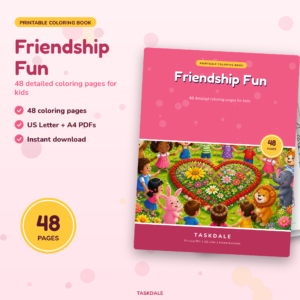
Friendship Fun Coloring Book
Price: $2.99 | Best for: stories about kindness and sharing
Friendship Fun has 48 scenes of friends doing things together, each with a short, kind line at the top, such as Treehouse Helpers, Picnic Sharing and Umbrella Puddle Splash. It comes as US Letter and A4 PDFs, licensed for your household. Read the kind line aloud first, then ask your child to tell the story that led up to it.
Activity 8: Make a royal fairy tale book
This is the big finish. After a week or two of these activities, your child has colored pages, answered questions and told stories. Now they make a whole book.
Choose four to six colored pages that could tell one story. Put them in order. On each page, write one or two sentences, or have your child write them. Add a cover with a title and the author’s name: “The Dragon Who Lost His Hat, by Zara, age 6.” Staple it or tie it with ribbon.
Then comes the best part. Your child reads the book to someone. A grandparent on a video call, a sibling, a teddy bear. The pride on their face is something you will remember. For more on books that mix coloring with prompts and puzzles, see our guide to interactive coloring books with puzzles and prompts.
Adapting the activities by age
Pre-writers, ages 3 to 4
Everything is spoken. You are the scribe. Keep stories very short, one or two sentences. Focus on Activities 1, 4 and 6. Puppets are a big hit at this age.
Early writers, ages 5 to 6
Children can write a word or two, often with invented spelling. Let them. “Th drgn wz sad” is a real sentence written by a real author. Try Activities 2, 3 and 5.
Confident writers, ages 7 to 8
Kids can write full sentences on the story lines and plan longer tales. Activities 5 and 8 work best. Challenge them to include a problem, a helper and a twist.
For a broader look at princess pages by age, see our guide to princess coloring book pages for kids.
A five-day storytelling plan
- Monday: color a castle and answer its story starter. You write the answer.
- Tuesday: color a princess with a hobby. Ask who, where and what goes wrong.
- Wednesday: color a page in “feeling colors” and talk about why she feels that way.
- Thursday: cut out characters and put on a puppet show.
- Friday: pick three pages, put them in order and staple them into a book.
Each day takes 20 to 30 minutes. By Friday, your child has told five stories, made puppets and authored a book. That is a good week by anyone’s measure.
Mistakes that shut a story down
Correcting the story. “Dragons can’t eat ice cream” ends the fun. In stories, dragons can do anything.
Asking too many questions. One or two per page is plenty. Twenty questions feels like a test.
Fixing spelling in the moment. For young writers, getting ideas down matters more than spelling. Praise the idea first.
Rushing the coloring. The quiet coloring time is when thinking happens. Do not hurry it to get to the talking.
Not writing it down. Children forget their stories. A sticky note or a line on the page keeps them, and seeing their words saved tells them their ideas matter.
Frequently asked questions
How does coloring help with storytelling?
Coloring keeps the hands busy and the mind relaxed, which makes it easier for kids to talk. The picture gives them a character and a place, so they only need to imagine what happens.
What age can kids start storytelling with coloring pages?
From about 3. Young children tell short spoken stories while an adult writes them down. By 7 or 8, many write full stories on their own.
What are good story prompts for princess coloring pages?
Who lives in this castle? What is behind the little door? What went wrong today? How did the princess and the dragon become friends?
How do I help a child who says they have no ideas?
Give them a choice instead of an open question. “Is the dragon hungry or lost?” Picking one gets the story moving.
Can teachers use these activities in class?
Yes, with pages licensed for classroom use. Turret & Tiara allows one teacher to print for their own class. Many household books do not, so check the terms first.
Do kids need to write to build storytelling skills?
No. Telling stories out loud builds the same skills of order, character and problem. Writing can come later.
Your next step
Tonight, print one castle page from Turret & Tiara, read the story starter aloud and let your child color in silence for five minutes. Then ask the question again, write down exactly what they say, and stick it on the fridge.