Somewhere around age eight, the cartoon unicorn with the giant smile stops being cool. Your child still loves unicorns. She just wants them to look real: a proper horse’s body, a mane that moves, a horn that catches the light, and a moonlit forest behind it all. Realistic unicorn coloring pages for older kids and fantasy fans fill exactly that gap.
This guide is for tweens, teens and grown-ups who want detailed fantasy pages, and for parents shopping for them. You will get a clear idea of what makes a unicorn page look realistic, how to shade the tricky parts, a full worked example, and three printable books on Taskdale that suit a more patient colorist.
Quick picks for detailed unicorn and fantasy coloring
| Product | Best for | Price | Link |
|---|---|---|---|
| Starmane Meadow Unicorn Coloring Book for Kids | Detailed fantasy unicorns for ages 8 to 12 and up | $4.49 | View |
| Gallop Gallery Horse Breeds Coloring Book | Learning real horse bodies, coats and markings | $4.99 | View |
| Enchanted Forest Coloring Book | Teens and adults who love magical woodland scenes | $3.49 | View |
What makes a unicorn page look realistic
A realistic unicorn is really a realistic horse with one extra feature. That is the secret. Get the horse right and the horn takes care of itself.
So when you look at a page, check four things.
- Body shape. The legs have joints in the right places, the neck is thick and muscled, and the head is long, not round. Cartoon unicorns have stubby legs and a ball for a head.
- Mane and tail with direction. Real hair falls in long strands that follow gravity and wind. A good detailed page gives you separate locks to shade, not one solid blob.
- A setting. Rocks, trees, stars, water. A background tells you where the light comes from, and light is what makes coloring look three-dimensional.
- Small details to slow down for. Hooves with a rim, a few whiskers, a jeweled bridle, flowers at the feet. These reward a colorist who likes to take an evening over one page.
If a page has all four, it will look good even colored with a basic set of 24 pencils. If it has none, no amount of expensive markers will make it look real.
Who detailed unicorn pages suit
Detailed pages are not better than easy ones. They suit a different person on a different day.
Kids aged 8 to 12
This is the age when children start to care about the finished look. They notice when a mane looks flat, and they want to fix it. A detailed unicorn gives them a reason to learn blending and shading, and they feel real pride when it works. If you have a younger sibling in the house too, our guide to easy unicorn coloring pages for preschoolers and toddlers covers the chunky pages they need.
Teens
Teens often like fantasy art with a bit of drama: wings, crystal caves, northern lights. They may also enjoy coloring digitally on a tablet, which is easy with a PDF you can import into a drawing app.
Adult fantasy fans
Plenty of grown-ups color unicorns. No apology needed. A detailed fantasy scene is absorbing in the same way a jigsaw is, and it gives your hands something to do while your mind slows down after work.
Detailed fantasy unicorns in one book
The Starmane Meadow book is sold as a kids’ book, but its third section, Enchanted Realm, is aimed at ages 8 to 12 and up. These are 14 full-page fantasy scenes: a unicorn rearing in an enchanted forest, a winged unicorn under the constellations, a crystal kingdom, a jeweled mane portrait, an ocean gallop, a unicorn with a dragon friend, a crystal cave and a northern lights scene.
The earlier sections hold easier pages and puzzles, which is handy if you are buying for a family with a range of ages. The older child takes the fantasy pages. The little one takes the rest.

Starmane Meadow Unicorn Coloring Book
Price: $4.49 | Best for: families with unicorn fans of different ages
78 pages of original unicorn art in US Letter and A4 PDFs, including 14 detailed Enchanted Realm fantasy unicorns for older kids, plus easier scenes, color by number, dot-to-dot, mazes and a word search with answer keys. The listing recommends card stock for the detailed fantasy pages. Start with the jeweled mane portrait: it is one big subject, so it is a gentle first step into detail.
Learn the horse first, then add the magic
Here is a trick that lifts a fantasy colorist fast. Spend a few evenings coloring real horses. You will learn how light falls on a shoulder, where the coat goes darker on the legs, and which colors make a white horse look white instead of blank.
Real horse coats also make great unicorn palettes. A palomino unicorn, golden with a cream mane, looks warm and sunny. A dapple gray unicorn, with soft round spots, looks like it stepped out of an old legend. A black unicorn with a silver horn looks striking against a night sky.
The Gallop Gallery book is useful here because each of its 24 breeds comes twice: once as an easy page and once as a detailed portrait set in the breed’s home landscape. It also includes guides to face markings, leg markings and coat colors, with the names riders use, such as blaze, stocking, bay and palomino.
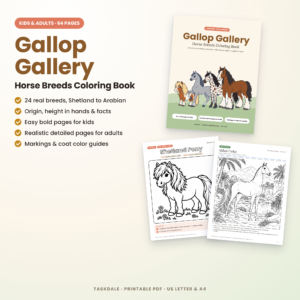
Gallop Gallery Horse Breeds Coloring Book
Price: $4.99 | Best for: horse-crazy tweens, teens and adults
24 real horse breeds, each drawn as an easy kids’ page and a realistic adult portrait, with origin, height in hands and short facts on every page. Coat color and markings guides show how to color horses like a horse person. Print the realistic Friesian or Arabian portrait first and practice shading a flowing mane before you take on a unicorn.
Horse fans who want more ideas for this kind of book can read our post on horse coloring book activities.
How to shade the hard parts
Three parts of a unicorn trip people up: the white coat, the mane and the horn. Here is how to handle each.
A white coat that does not look unfinished
White paper left bare looks like you forgot to color it. So add shadow instead. Use a very light gray, lilac or pale blue under the belly, down the back of each leg and under the jaw. Leave the top of the back and the front of the chest bare. Suddenly the white looks like a lit, rounded body.
A mane with movement
Color each lock from the root outward, pressing harder near the neck and lifting off toward the tips. Use two or three shades of one color, say a deep purple, a mid violet and a pale lavender. Put the darkest shade where locks overlap and the palest on the edges that face the light. Leave a thin unshaded line down the middle of some locks for shine.
A horn that glows
Horns usually have a spiral. Shade one side of each twist darker than the other, always on the same side, and the spiral pops out. For a pearl look, layer pale pink, pale blue and cream lightly over each other. For crystal, use a cool blue with white gel pen highlights at the top of each twist.
A worked example: the winged unicorn under the stars
Let’s walk through one page from start to finish, the way a 12-year-old might tackle it over two evenings.
- Decide where the light is. On a night page, the moon is the light. Put it top left. Every shadow will fall to the right and below.
- Pick five colors. Navy, purple, a pale gray, a soft gold and white gel pen. Fewer colors keeps the page calm.
- Do the sky first. Navy at the top edge, fading into purple near the horizon. Color around the stars so they stay white.
- Shade the body. Pale gray along the belly, under the wings and on the side of each leg away from the moon.
- Feathers next. Each wing feather gets a touch of gray at its base and stays white at the tip. That makes the wing look layered.
- Mane and tail in purple. Darker near the neck, lighter at the ends, with a few white gaps for shine.
- Gold on the horn and hooves. Shade one side of each twist deeper.
- Finish with highlights. A dot of white gel pen in the eye, a line on the horn, and a few sparkles in the sky.
Evening one covers steps 1 to 4. Evening two covers the rest. The result looks far more polished than a page colored in one rushed sitting, and finishing it feels great.
Fantasy backgrounds worth practicing
Once the unicorn looks good, the background is what makes a page feel like a scene from a story. Forests are the classic choice. Moonlit trees, ferns, mushrooms and glowing paths all sit naturally behind a unicorn, and they teach you to layer greens and add soft light.
If your fantasy fan wants to practice those settings on their own, the Enchanted Forest book has 30 detailed woodland scenes with hidden objects to find as you color: a moonlit owl in an oak, a mushroom cottage, a crystal brook, a stag in a hidden glade and a firefly lantern path.

Enchanted Forest Coloring Book
Price: $3.49 | Best for: teens and adults who like fine linework
30 detailed woodland fantasy scenes with hidden objects, in 41-page US Letter and A4 PDFs, with a clickable contents page, a color test page and a palette planner for choosing three to five colors before you start. A Word user guide covers printing and troubleshooting. Try the Firefly Lantern Path page to practice glowing light on dark leaves.
Supplies and paper for detailed pages
Detailed pages need finer tools than a crayon box. You do not need anything fancy, though.
- Colored pencils with sharp points. A set of 24 to 36 is plenty. Keep a sharpener on the table and use it often.
- A white gel pen. This is the cheapest upgrade there is. It adds sparkle to eyes, horns and stars.
- Card stock. Heavier paper takes more layers of pencil without going shiny or tearing. It also stops markers soaking through.
- A scrap sheet under your hand. It stops your palm smudging finished areas.
- Print at actual size. Scaling down makes fine lines too close together.
For tablet colorists, import the PDF page into a drawing app that supports layers and color on a layer below the line art. It is a nice way to try out three palettes before printing the page for real.
Mistakes that make detailed unicorns look flat
Most flat-looking pages come from the same few habits.
- Pressing hard from the start. Heavy first layers leave no room to build depth. Start light and get darker slowly.
- Too many colors. A rainbow mane can look lovely, but a rainbow mane plus a rainbow sky plus rainbow flowers is noise. Pick one star feature.
- No shadow on the white. Covered above. It is the most common one.
- Coloring the background last in a rush. The background affects every color on top of it. Plan it early, even if you color it later.
- Giving up halfway. Detailed pages look messy in the middle. Every colorist hits that stage. Push through one more session and it comes together.
For more ideas on choosing pages that kids actually finish, our guide to coloring pages for kids is worth a look.
Frequently asked questions
What age are realistic unicorn coloring pages for?
Most detailed unicorn pages suit children from about 8 years old, plus teens and adults. Younger kids can try them by coloring the big shapes only, but small spaces usually frustrate children under seven.
How do I make a unicorn look realistic when coloring?
Treat it like a real horse. Decide where the light comes from, shade the side away from the light, color the mane in long strokes with two or three shades of one color, and leave small white gaps for shine.
What should I use to color a white unicorn?
Use pale gray, lilac or light blue only in the shadows: under the belly, behind the legs and under the jaw. Leave the parts facing the light as bare paper.
Are there unicorn coloring pages that are not cartoons?
Yes. Look for pages described as detailed or fantasy rather than cute or easy. The Enchanted Realm section of the Starmane Meadow book has 14 full-page fantasy unicorns with enchanted forests, crystal caves and starry skies.
Can I color these pages on a tablet?
Yes. A printable PDF page can be imported into most tablet drawing apps. Color on a layer underneath the line art so the outlines stay crisp.
Your next step
Pick one detailed page this week, print it on card stock, and color it over two evenings using the eight steps in the worked example above. Start with the light, finish with the gel pen sparkle. For 14 fantasy unicorns ready to go, open the Starmane Meadow Unicorn Coloring Book and head straight to the Enchanted Realm section.