Best Thought Record: 3 CBT Workbooks Compared
The best thought record is the one that matches what you want to change. Break the Loop is the guided starting point for self-sabotage, Unhooked adds pocket coping cards and a 7-Day Challenge for follow-through, and Rooted Worth places thought records inside a wider 67-page self-esteem programme.
A thought record can look simple on paper and still feel awkward in practise, so it helps to know what you are choosing between before you commit. We'll explain what separates these workbooks and who each one suits, so you can pick with confidence.
Key facts at a glance
- A thought record is a worksheet that helps you write down a difficult moment, the thought it triggered, and a more balanced alternative.
- Unhooked runs to 55 pages, Break the Loop to 45 pages, and Rooted Worth to 67 pages.
- All three are printable and fillable PDFs in US Letter and A4, each with a user guide.
- Unhooked and Break the Loop are written for adults and teens, and both can be used on your own or with clients.
- Break the Loop and Rooted Worth each include a scored self-check, so you can see how far you have moved.
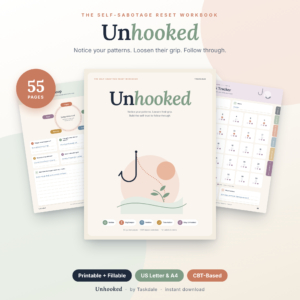 Unhooked: Self-Sabotage Workbook, Printable and Fillable CBT Worksheets PDF for Adults and Teens
Table of Contents Toggle
- What is a thought record and why does the format matter?
- What should you look for in the best thought record?
- How do these thought record workbooks compare?
- Which thought record suits which person?
- How do you fill in a thought record?
- What mistakes should you avoid with a thought record?
- What affects the price of a thought record workbook?
- Which thought record should you choose?
- Common questions
What is a thought record and why does the format matter?
A thought record is a structured worksheet, used in cognitive behavioural therapy (CBT), that walks you from a upsetting situation to the thought behind it and then to a fairer way of seeing it. The idea grows out of Aaron Beck's cognitive therapy, and the column-style layout was popularised by the book Mind Over Mood by Dennis Greenberger and Christine Padesky.
The format matters because a blank page rarely helps when you are upset. A good thought record gives you prompts in a set order, so you spend your energy on the thinking and not on deciding what to write.
That is also where these three workbooks differ. A single worksheet is cheap and quick, but a workbook surrounds the thought record with other tools, so the habit has a chance to stick.
What should you look for in the best thought record?
The best thought record has clear prompts, a way to check your progress, and something that carries the insight into real life. Six factors separate a useful workbook from one you abandon after a week.
How much guidance does it give you?
Guidance is the amount of explanation around each worksheet. Break the Loop is built around five guided parts: Understand, Uncover, Reframe, Act and Sustain. That order walks you through the logic, which helps if you have never filled in a thought record before.
Does it measure progress?
A scored check lets you compare how you feel before and after. Break the Loop has a scored self-check. Unhooked has one too. Rooted Worth uses a scored check-in at the start and end, so you can see real progress across the whole workbook.
Does it help you act on what you write?
Writing a balanced thought is only half the job. Unhooked and Break the Loop both include If-Then plans, which turn an insight into a specific action for the next time the trigger appears. Unhooked adds a Reframe Bank, a 7-Day Challenge and a 30-Day Tracker, and Break the Loop has its own 30-day tracker.
How wide is the scope?
Scope is the range of topics beyond the thought record. Unhooked and Break the Loop focus on self-sabotage. Rooted Worth has eight parts: CBT thought tools, self-compassion, self-sabotage, strengths, core beliefs, boundaries and daily practise. Choose the narrower workbook if your problem is specific, and the wider one if the thoughts keep coming back to your sense of worth.
Can you fill it in on screen and on paper?
All three are fillable and printable PDFs in US Letter and A4. Unhooked and Rooted Worth also have clickable tabs, so you can move between sections on screen. Unhooked colour-codes its five parts as well. If you think better with a pen, print it. If you want privacy and tidiness, type into it.
Will you use it alone or with clients?
Unhooked and Break the Loop are both described as suitable for solo use or with clients. Rooted Worth is presented for personal use, and the details supplied do not mention client work. If you are a coach or practitioner, that difference decides it.
How do these thought record workbooks compare?
Unhooked is the most practical of the three, Break the Loop is the shortest and most guided, and Rooted Worth is the longest and widest. The table sets out what differs.
| Product | Pages | Structure | Extras | Best for |
|---|---|---|---|---|
| Unhooked: Self-Sabotage Workbook, Printable and Fillable CBT Worksheets PDF for Adults and Teens | 55 | 5 colour-coded parts with clickable tabs | 12 pocket coping cards, Reframe Bank, 7-Day Challenge, 30-Day Tracker, user guide | Follow-through on self-sabotage, solo or with clients |
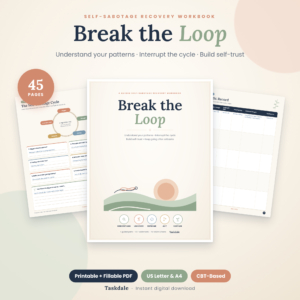 Break the Loop: Self-Sabotage Workbook, Printable and Fillable CBT Worksheets PDF for Adults and Teens | 45 | 5 guided parts: Understand, Uncover, Reframe, Act, Sustain | Scored self-check, If-Then plans, 30-day tracker, step-by-step user guide | A first, guided run at self-sabotage, solo or with clients |
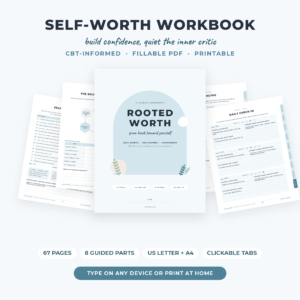 Rooted Worth Self-Worth Workbook | 67-Page CBT Self-Esteem & Confidence Worksheets, Fillable & Printable PDF, US Letter & A4 | 67 | 8 parts with clickable tabs | Scored check-in at start and end, step-by-step user guide | Self-esteem, core beliefs and confidence |
Which thought record suits which person?
Each workbook suits a different starting point, and the right one depends on the pattern you want to break.
Unhooked suits someone who understands their habits but struggles to act differently. The pocket coping cards are the clearest example: you carry a prompt with you for the moment it matters. It also suits practitioners who want something to hand to clients, since it works in sessions or between them.
Break the Loop suits someone new to CBT worksheets. At 45 pages it is the shortest of the three, and the Understand to Sustain sequence reads like a short course. You can finish it without it feeling like a project.
Rooted Worth suits someone whose harsh inner voice shows up everywhere, not only in one habit. Because it covers self-compassion, strengths, core beliefs and boundaries, the thought record sits alongside the deeper beliefs that feed it.
How do you fill in a thought record?
You fill in a thought record by working through the same steps each time, ideally soon after the upsetting moment. Your workbook's own layout will vary, but the sequence is consistent.
- Describe the situation in one or two plain sentences: where you were and what happened.
- Name the emotion and rate its strength, for example out of 100.
- Write down the automatic thought that came with it, in your own words.
- Look at the evidence for and against that thought.
- Write a more balanced alternative thought.
- Re-rate the emotion and note any change.
Start with small irritations, not your hardest memories. Three or four short entries in a week teach you the method better than one long entry on a bad night. If you are working through serious distress, a workbook is a companion to professional support and not a replacement for it.
What mistakes should you avoid with a thought record?
The most common mistake is writing a positive thought you do not believe. A balanced thought has to be credible to you, or the emotion rating will not shift.
Other pitfalls to watch for:
- Skipping the evidence step. Going straight to a cheerful replacement thought turns the exercise into wishful thinking.
- Waiting until you feel perfectly calm. Notes written hours later lose the exact wording of the thought.
- Doing it once and stopping. The value comes from repetition, which is why trackers and challenges matter.
- Treating the score as a grade. A scored check is a snapshot of how you feel that day, not a verdict on you.
- Choosing a workbook that is too big. A 67-page programme can feel heavy if you only want a quick tool.
What affects the price of a thought record workbook?
The price of a thought record workbook mainly reflects its length, its extras and who it is built for. A longer workbook with eight parts costs more to produce than a shorter one with five, and that usually shows in the price.
Extras also count. Unhooked includes 12 pocket coping cards, a Reframe Bank and a 7-Day Challenge alongside its tracker, while Break the Loop keeps to a tighter set of tools. Use with clients can matter as well, since a workbook designed for practitioners tends to offer more than one for personal use.
Because these are digital PDFs, there is nothing to ship, and you can print as many working copies as you need. Check the live product cards for the current price of each.
Which thought record should you choose?
Choose by the problem you have right now, and you are unlikely to go far wrong.
- If you want to understand and stop a specific habit of holding yourself back, start with Break the Loop.
- If you already know the habit and need tools that carry you through the week, choose Unhooked.
- If the root issue is low self-worth and harsh self-criticism, choose Rooted Worth.
- If you work with clients, pick between Unhooked and Break the Loop, as both are described for that use.
You can browse all 3 options below and compare the cards side by side.
Common questions
Is a thought record the same as a journal?
No. A journal is free writing, while a thought record follows a fixed order that separates the situation, the thought, the emotion and a balanced alternative. The structure is what makes it a CBT tool and keeps you from simply repeating a worry on paper.
How long does it take to complete one thought record?
A single entry usually takes about ten to fifteen minutes once you know the steps. The first few can take longer. Short, regular entries tend to work better than occasional long ones, particularly when you pair them with a tracker.
Can teenagers use these workbooks?
Unhooked and Break the Loop are both written for adults and teens. A teenager may find the shorter Break the Loop easier to start with. For anyone under 18 who is struggling, involve a trusted adult or a professional alongside the workbook.
Should I print the workbook or fill it in on screen?
Both work, since each PDF is fillable and printable. Print it if writing by hand helps you slow down. Fill it in on screen if you want clickable tabs, easier edits and no paper lying around. Unhooked and Rooted Worth both offer clickable tabs.
Do I need a therapist to use a thought record workbook?
No, you can use a workbook alone, and Unhooked and Break the Loop are described for solo use. A therapist can help you interpret patterns and keep you on track, though. If your low mood or anxiety is affecting daily life, speak to your GP or a qualified professional.