You did not start a business to read balance sheets. You started it because you bake great bread, fix bikes, design logos or teach piano. The money side came along uninvited. Still, a handful of finance basics decide whether a small business lasts, and none of them need an accounting degree.
This guide covers the business finance basics small owners use every week: the difference between revenue, profit and cash, how to work out a margin and a break-even point, how much to pay yourself, how to set tax aside without panic, and which five numbers deserve a look every month. Each idea comes with a worked example in real dollars, plus a few templates that do the arithmetic once you know what you are looking at.
Quick picks: tools for small business finances
| Product | Best for | Price | Link |
|---|---|---|---|
| Small Business Finance HQ | Break-even, cash flow and tax in one file | $7.99 | View |
| Rosefold Small Business Bookkeeping Printable | Owners who learn best on paper | $19.99 | View |
| Petal & Profit Finance Planner | A live dashboard with tax set-aside | $9.99 | View |
Start here: keep business money in its own account
Every other basic depends on this one. If business sales and personal spending share one checking account, you cannot tell how the business is doing without an afternoon of highlighting statements. Open a separate account, even a free one, and run every business payment through it.
Picture a hairdresser who rents a chair and gets paid into her personal account. In March she feels flush. In April she feels broke. Neither feeling tells her anything, because the rent, the groceries, the color supplies and the kids’ shoes all flow through the same pot. Split the accounts and the fog lifts within a month.
One more rule goes with the separate account: when you take money out for yourself, record it as an owner’s draw or salary, never as a business expense. That keeps your profit figure honest.
Revenue, profit and cash are three different things
These words get used loosely, and the mix-up causes real trouble. Here is what each one means for a small owner.
Revenue
Everything customers paid you, or agreed to pay you, before any costs. A dog walker who bills $4,200 in May has $4,200 of revenue. Nice number. It says nothing about whether she made money.
Profit
Revenue minus the costs of running the business. If the dog walker spent $650 on fuel, insurance, leads and treats, her profit for May is $3,550. This is the number taxes are based on, and the one that tells you if the business works.
Cash
The money actually in the account today. If two clients have not paid their May invoices yet, the dog walker may have only $2,700 in the bank, even though her profit was $3,550. Cash pays the bills. Profit does not, until it arrives.
Many businesses that close are not short of customers. They run out of cash while waiting to be paid, or while buying stock ahead of a busy season. Watching all three numbers, not just revenue, is the single best habit a new owner can build.
Margin: the number behind every price
Margin is the share of each sale you keep after paying for what went into it. To work it out, take the price, subtract the direct cost of making or delivering that item, and divide by the price.
Take a candle maker selling a large candle for $28. Wax, wick, fragrance oil, jar, label and box cost $7.40. Payment fees take another $1.10. Her direct cost is $8.50, so she keeps $19.50 per candle. Divide $19.50 by $28 and her margin is about 70%.
That sounds healthy, and it is. But it is not profit yet. She still pays for her market stall, her website, her insurance and her time. Margin tells you how much each sale contributes to those bills. A product with a 25% margin has to sell almost three times as many units as one with 70% to cover the same costs.
Worth doing tonight: list your three best sellers and work out the margin on each. Owners are often surprised to find their most popular item is the one making the least.
Break-even: how many sales before you make a dollar
Your fixed costs are the bills that arrive whether you sell anything or not: rent, software, insurance, loan payments, phone. Break-even is the number of sales needed to cover them.
The formula is short. Divide your monthly fixed costs by the amount each sale contributes (the price minus the direct cost).
Back to the candle maker. Her fixed costs come to $1,170 a month: $450 for a shared studio, $180 for her website and email tools, $90 for insurance, $250 for market stall fees and $200 for packaging stock she keeps on hand. Each candle contributes $19.50. So $1,170 divided by $19.50 is 60 candles. Candle number 61 is the first one that earns her real money that month.
Knowing that number changes how a month feels. Sold 40 candles by the 15th? You are on track. Sold 22? Time for an email to your list, a weekend market or a bundle offer. It turns a vague worry into a target you can actually chase.
You can do this on a calculator. A template that keeps your pricing and break-even beside your real sales saves you redoing it whenever costs change.
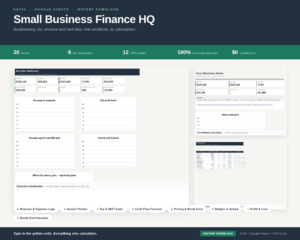
Small Business Finance HQ
Price: $7.99 | Best for: owners who want pricing and forecasts joined up
A 20-sheet workbook for Excel and Google Sheets with revenue and expense logs of 400 rows each, an invoice tracker, monthly and annual profit and loss, a tax center for income tax and VAT, a pricing and break-even sheet, a cash flow forecast with a lowest-point warning, budget vs actual and six dashboards. You type in the yellow cells and the rest calculates. Fill in the pricing and break-even sheet for your top product first, then log this month’s sales.
Cash flow: plan for the dip before it comes
Profit is measured over a month or a year. Cash flow is about timing within those weeks. The two drift apart whenever you pay before you are paid.
A wedding florist feels this sharply. In April she buys flowers, ribbon and vases for six June weddings, and pays her assistant. Couples pay the balance a week before the day. So April and May look terrible in the bank, and June looks wonderful. Across the season she is profitable. In mid-May she might not make rent.
A simple cash flow forecast fixes this. List each week for the next three months. Write in the money you expect in, and when. Write in what must go out, and when. Keep a running balance. The week where that balance dips lowest is the week to plan for: chase a deposit early, delay an equipment purchase, or keep a cushion in savings.
A cushion of one to two months of fixed costs is a sensible goal for most small businesses. It takes time to build. Even half a month of costs set aside turns a cash crunch from an emergency into an inconvenience.
Paying yourself without starving the business
Many owners pay themselves whatever is left at the end of the month. Some months that is plenty, some months nothing, and the household budget never settles. A steadier way is to pick a fixed amount you can reliably take, and adjust it once a quarter.
Here is one simple method. Add up your profit for the last three months, after setting aside tax. Divide by three for a monthly average. Pay yourself about 70% to 80% of that average, and leave the rest in the business as a buffer and for growth.
Say a mobile mechanic made $15,600 of profit over three months after tax set-asides. That is $5,200 a month on average. Paying himself $4,000 a month leaves $1,200 each month to build a cushion and replace tools. If the next quarter is stronger, he raises his pay. If it is weaker, the buffer covers the gap. Either way, his family gets the same amount on the same day, which takes a weight off everyone.
Setting tax aside the calm way
Nobody withholds tax for you when you work for yourself. So the bill arrives in a lump, and if the money is gone, it hurts. The fix is boring and works: move a fixed share of every payment into a separate savings account the day it lands.
The right share depends on where you live, your income and how your business is set up, so ask an accountant or check your tax agency’s guidance for a starting figure. Many sole traders start with 25% to 30% of profit and adjust after their first return. If you pay quarterly estimates, our guide on quarterly estimated taxes walks through the timing.
Some owners prefer to write every number down by hand. Paper slows you down enough to notice things, like a supplier who quietly raised prices, and some people simply remember money better when they write it.

Rosefold Small Business Bookkeeping Printable
Price: $19.99 | Best for: owners who prefer pen and paper
A 59-page business finance planner in US Letter, A4 and A5, with a fillable PDF edition and a clickable index. It covers financial goals, a yearly budget with budget vs actual, sales, expense, receipt and mileage logs, monthly and annual profit and loss pages, cash flow forecasting, pricing and break-even, and quarterly tax planning. Print the budget and break-even pages first and fill them in using last month’s statements, then plan for about 30 minutes a week on the logs.
Five numbers to check every month
You do not need twenty reports. These five, checked on the first working day of each month, tell you nearly everything.
- Revenue for the month, compared with the same month last year if you have it. Seasonal businesses should never compare May with December.
- Profit for the month, and profit margin (profit divided by revenue). A falling margin with rising sales usually means costs are creeping up.
- Cash in the bank, against your fixed costs. Two months of fixed costs in the account is comfortable. Under one month needs attention.
- Money owed to you, and how old it is. Anything past 30 days needs a call, not another email.
- Tax set aside, compared with what you expect to owe. If the pot looks thin, top it up now while the gap is small.
Write all five on one line in a notebook or a dashboard. After six months you will spot patterns no accountant could point out for you, because you will know what was happening behind each number.
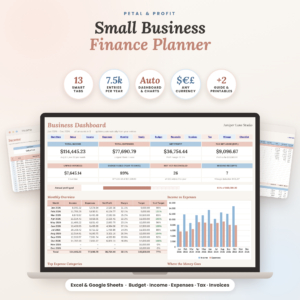
Petal & Profit Finance Planner
Price: $9.99 | Best for: owners who want the five numbers on one screen
A bookkeeping, budget, invoice, tax and mileage workbook for Excel and Google Sheets. Eight live tiles show income, expenses, net profit, profit margin, estimated tax set-aside, unpaid invoices, budget used and missing receipts, so most of the monthly check sits on one screen. It works in any currency with no subscription. Set your categories and tax set-aside rate first, then log the current month to see the tiles fill.
Common money mistakes new owners make
- Pricing from competitors, not costs. If your costs are higher than theirs, matching their price can mean losing money on every sale.
- Forgetting your own time. A $40 product that takes three hours to make pays far less per hour than it looks.
- Buying equipment before demand. A $2,400 machine pays back only if the orders come. Rent, borrow or start smaller first.
- Letting invoices drift. Send them the day the work is done. Late invoices get paid late.
- Doing the books once a year. A weekly half hour beats a frantic March weekend, and you catch errors while you still remember the details.
For a side-by-side look at spreadsheet options, see our roundup of the best bookkeeping spreadsheet for small business. And if you are setting up the rest of your admin too, the best small business templates guide covers planners, trackers and forms beyond money.
Frequently asked questions
What are the most basic financial statements for a small business?
A profit and loss statement, which shows income, costs and profit over a period, and a cash flow view, which shows money moving in and out week by week. Most small owners can run their business on these two.
What is the difference between profit and cash flow?
Profit is income minus costs over a period. Cash flow is the timing of money arriving and leaving. A business can show a profit and still run short of cash if customers pay late.
How do I calculate break-even for my small business?
Add up your monthly fixed costs, then divide by what each sale contributes after its direct costs. The result is the number of sales needed to cover the month.
How much should a small business owner pay themselves?
A steady approach is 70% to 80% of your average monthly profit after tax set-asides, reviewed every quarter. The rest stays in the business as a buffer.
How much of my income should I save for taxes?
It depends on your location and income. Many sole traders start with 25% to 30% of profit and adjust after their first return, but an accountant or your tax agency can give a figure that fits you.
Your next step
Pick your best-selling product or service and work out its margin and your monthly break-even on the back of an envelope tonight. One number, written down, beats a dozen vague worries. When you want it to update itself as costs change, set it up in Small Business Finance HQ and log this month’s sales beside it.