Advanced free printable coloring pages for adults are harder to find than easy ones. Search for free pages and you will mostly get big flowers and simple animals made for children. Detailed work takes an artist many hours to draw, so most of it sits behind a price tag. Still, good free options exist if you know where to look and what to check.
This guide is for the colorist who wants a real challenge: hundreds of tiny spaces, layered scenes, textures to shade and things to find. You will get honest sources for free detailed pages, a quick test that stops you printing a blurry file, a method for drawing your own intricate page from scratch, and a few printable books worth buying when the free well runs dry.
Quick picks: detailed printable sets for experienced colorists
| Product | Best for | Price | Link |
|---|---|---|---|
| Gearhead Zoo Printable Coloring Book | Gears, bolts and pipes in tiny pieces | $3.99 | View |
| Moonlit Wildlife Coloring Book | Night scenes with hidden objects | $3.49 | View |
| Orbit Pals Printable Coloring Book | Star fields, rings and craters | $3.99 | View |
| Cloud Casters Printable Coloring Book | Swirling skies and tiny raindrops | $3.99 | View |
What counts as advanced on a printable page
Advanced is a slippery word. Some sites call any mandala advanced. A better test is to look at the page itself and ask four questions.
- How small are the smallest spaces? On an advanced page, plenty of cells are just a few millimeters wide, small enough that a blunt pencil will not fit.
- How many separate areas are there? A beginner page might have 40. A detailed scene can have several hundred. Try counting the shapes in one square inch and multiply.
- Do objects overlap? When a fox sits in front of ferns that sit in front of trees, you have to decide what is near and far. That is a skill, not just patience.
- Is there texture to describe? Fur, feathers, bark, metal and water each ask for a different stroke.
A page that ticks all four will keep you busy for several evenings. A page that only ticks the first is just small, and small is not the same as satisfying.
Honest sources for free detailed pages
Free advanced pages come from a short list of places. Each has strengths and a catch.
Public domain natural history art
Old scientific books are packed with engraved birds, shells, insects and plants, drawn in fine line work long before color printing was cheap. Online libraries such as the Biodiversity Heritage Library share scans of many of these books. A page of beetles or seashells from a 19th-century plate makes a superb advanced coloring page. The catch: scans are often yellowed and need cleaning up, and some plates are already colored. Look for the black and white ones.
Old architectural and ornament drawings
Pattern books of tiles, ironwork and carved borders are another treasure. A single sheet of Victorian floor tile designs can hold dozens of tiny shapes. Same catch as above: check the scan is clean and the work is truly in the public domain before you share or post it.
Artist samples
Illustrators who draw detailed books sometimes give away a page or two, often for an email sign-up. Quality is high. Quantity is low. Treat these as a taste of a style you might want to buy more of.
Pages you make yourself
This is the most reliable free source of all, and it is covered step by step further down. With a fine pen and twenty minutes you can make a page as detailed as you like.
For gentler free pages to start with, our guide to coloring pages for adults lists simpler free sheets alongside the best paid sets.
The ten-minute test for a detailed download
Detailed pages suffer more from bad files than simple ones. A fuzzy line on a big daisy is fine. A fuzzy line between two tiny cells merges them into one grey smudge. Run this test before you print.
- Zoom to 300 percent on screen. The thinnest lines should still be solid black, not grey dots or jagged steps.
- Check the pixel size. For a US Letter page, an image about 2,550 by 3,300 pixels prints at 300 dots per inch, which is sharp. Half that size will look soft on fine work.
- Look for gaps in lines. Broken outlines are a nuisance on paper and a real problem in coloring apps, where the fill tool leaks into the next area.
- Check the background. A grey or cream tint from scanning will mute every color you add. Some free photo editors can raise the contrast to fix it.
- Print one corner first. Crop a small area and print it on scrap paper. If the tiny spaces survive, print the whole page.
It sounds fussy. It takes ten minutes and saves a sheet of good cardstock, plus the disappointment of finding the problem two hours into coloring.
Make your own intricate page in twenty minutes
Drawing your own advanced page is easier than it sounds. You do not need to draw well. You need a few simple shapes and the patience to fill them.
- Draw one big outline. A leaf, a fish, a teapot, a letter of your name. Trace a cookie cutter if you like. Make it fill most of a sheet of paper.
- Split it into sections. Draw five to eight curved lines across the shape, like the veins of a leaf.
- Fill each section with a different pattern. Tiny circles in one, stripes in the next, scales, zigzags, little triangles, cross-hatching. Keep the lines thin and the shapes small.
- Add a border. A row of small loops or diamonds around the edge frames the page.
- Scan or photograph it. Turn up the contrast, then print several copies. Keep the original safe.
A colorist with a fine 0.3 mm pen can fill a page with several hundred spaces this way in one sitting. It is calming in its own right, and coloring something you drew yourself brings a quiet pride you do not get from a download.
Mechanical detail that rewards patience
When you want detail without drawing it, mechanical subjects are hard to beat. Gears have teeth. Pipes have joints. Panels have rivets. Every small part is a separate space, and metal surfaces let you practice highlights and reflections, which is one of the more advanced skills in coloring.
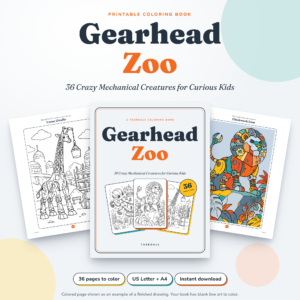
Gearhead Zoo Coloring Book
Price: $3.99 | Best for: colorists who enjoy fiddly mechanical detail
Gearhead Zoo has 36 full-page robot animals built from gears, springs, rockets and wheels, such as Clockwork Lion, Toaster Rhino and Airship Whale. You get US Letter and A4 PDFs, a pack of single PNG pages and a 9-page user guide with print settings. Start with Clockwork Lion and try gold and silver gel pens on the gears.
For a convincing metal look, color each gear in a mid gray, then add a near-white strip along one edge and a dark gray strip along the opposite edge. Leave a tiny gap of bare paper in the middle of the light strip. That gap does the work of a shine.
Night scenes and the art of dark palettes
Coloring a night scene is a real step up. Beginners tend to color everything bright. Advanced colorists learn that a page lit only by the moon needs deep blues, purples and greens, with the brightest colors saved for a few small spots. Getting that balance right is hard. When it works, the page glows.
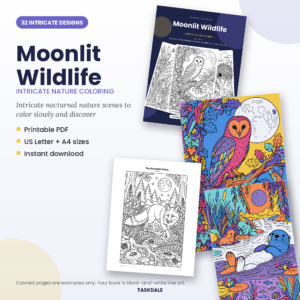
Moonlit Wildlife Coloring Book
Price: $3.49 | Best for: colorists who like moody night scenes
Moonlit Wildlife holds 32 intricate scenes of animals at night, including Barn Owl and Moonlit Oak, Fox Beneath Ferns, Wolf on a Rocky Ridge and Luna Moth Among Moonflowers. Small objects are hidden in the leaves, feathers and stones. It comes as US Letter and A4 PDFs. Begin with the Hedgehog Moon Garden and keep the moon itself almost white.
One method that works well: color the whole background in a light layer of dark blue first, then build up the animals on top. Add moonlight last, as pale yellow or silver on the upper edges only. Everything the moon does not touch stays in shadow.
Star fields, rings and craters
Space scenes are a quiet test of patience. A sky full of tiny stars means coloring around dozens of small shapes, and a planet with rings needs a smooth gradient that wraps round a curve. Both reward slow, light pencil work.
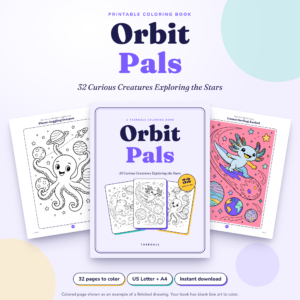
Orbit Pals Coloring Book
Price: $3.99 | Best for: colorists who love space and gradients
Orbit Pals gives you 32 space animal scenes, from Comet-Surfing Axolotl to Planet-Juggling Octopus and Animal Moon Festival. Stars, rings and craters fill the backgrounds. The download includes US Letter and A4 PDFs, single PNG pages for reprints, and an illustrated user guide. Start with the Starry Space Whale and practice coloring around the stars.
For planets, pick three shades of one color and work from dark at the shadow edge to light at the lit edge, following the curve with your strokes. Then add a thin band of a contrasting color across the middle. Gas giants look best with soft, uneven stripes.
Coloring detailed pages on a tablet
Advanced pages can be easier on a tablet. You can zoom into a cell the size of a grain of rice and color it without a magnifier. You can undo. You can try three palettes on the same page without printing three copies.
- Use PNG files when they are offered. Clean PNG line art imports neatly into most drawing apps.
- Put the line art on its own layer. Set it to multiply and color on a layer underneath. Your strokes will never cover the lines.
- Check that lines are closed before using the fill tool. Any gap lets the color spill. Patch gaps with a thin black brush first.
- Turn off pressure smoothing for tiny areas. It can make small strokes overshoot.
Many colorists work digitally on weeknights and on paper at weekends. Both count, and the skills carry over.
A weekly rhythm for big, detailed pages
A detailed page is a project, not a sitting. A simple weekly rhythm keeps it enjoyable instead of daunting.
- Sunday: choose the page, test the print and swatch a palette of ten to twelve colors on scrap paper.
- Monday and Tuesday: background only, in light layers.
- Wednesday: rest. Look at the page for a minute and note what feels off.
- Thursday and Friday: the main subject, with your light source marked in light pencil.
- Saturday: darkest darks, highlights and any hidden objects you have spotted.
That is about six hours across the week, in pieces of an hour or less. The page gets your best attention every time you sit down, and finishing on Saturday feels like a real small win. For more ideas on making coloring part of a calm routine, read our page of mindfulness coloring pages and prompts.
Mistakes that waste a good detailed page
- Printing on thin paper. Detailed pages take many layers. Copy paper pills and tears before you finish. Smooth cardstock is worth it.
- Coloring every tiny cell a new color. Hundreds of colors on one page look like confetti. Group cells into color families.
- Working with a blunt point. Sharpen every few minutes. It is tedious and it shows in the result.
- Forgetting the background. A detailed subject on a white background often looks unfinished. Even a light wash of color pulls the scene together.
- Rushing the last hour. Most damage happens near the end, when you want to be done. Stop, come back tomorrow.
Frequently asked questions
Where can I find free intricate coloring pages for adults?
Public domain scans of old natural history and ornament books, artist sample pages, and pages you draw yourself are the most reliable free sources. Ad-supported sites have some detailed pages but quality varies a lot.
What resolution should a printable coloring page be?
Aim for 300 dots per inch at the printed size. For US Letter, that is roughly 2,550 by 3,300 pixels. PDFs made for printing usually handle this for you.
Can I color public domain illustrations and share them online?
Generally yes, if the original is truly in the public domain. Check the library’s notes for each scan, since rules vary by source and country.
Why do my printed coloring pages look pixelated?
The file is too small for the page size. Find a larger version, use a PDF, or print the page smaller so the pixels pack closer together.
Can I use markers on advanced coloring pages?
Yes, with fine tips around 0.4 mm and heavier paper. Test on a spare print first, because markers can bleed across thin lines into the next cell.
How do I know if I am ready for advanced pages?
If you finish a medium page in under an hour and feel restless afterwards, you are ready. Start with one detailed scene and spread it across a week. For a gentler middle step, our guide to cat coloring pages for adults has both detailed and easy options.
Your next step
This weekend, try the twenty-minute DIY method and draw one pattern-filled leaf. Then, if you want a full set of detailed pages ready to print, download Gearhead Zoo and give Clockwork Lion a full week on the rhythm above.