It is 8:40 on a Wednesday. The inbox is still full, the dishwasher needs emptying and your mind is replaying a conversation from 3 pm. You sit down with one printed page and a tin of pencils, and twenty minutes later the replay has gone quiet. That is art coloring for stress relief in practice. Nothing dramatic. Just a small, steady way to put the day down.
This guide is for adults who want coloring to be a real calming habit rather than a craft kit gathering dust. You will learn how to match a page style to your mood, a simple fifteen-minute session you can do tonight, prompts that keep your attention on the paper, a one-week starter plan, and how to build a practice that lasts past the first week.
Quick picks: pages that suit different kinds of stress
| Product | Best for | Price | Link |
|---|---|---|---|
| Snug Hours: Bold & Easy Cozy Coloring Book for Adults | Tired evenings, no fiddly detail | $5.99 | View |
| Hue & Harmony Color by Number for Adults | When choosing colors feels like one more decision | $4.99 | View |
| Easy Mandala Coloring Book | Rhythm and repetition | $3.49 | View |
| Ink & Glint Manga Coloring Book | Learning shading as a focused hobby | $4.99 | View |
Why coloring quiets a busy mind
Coloring works on stress in a plain, practical way. Your hands make the same small movement again and again. Your eyes stay on one area of paper. Your decisions shrink from “what do I do about work” to “blue or green for this leaf”. That narrowing of attention is the whole point.
It also gives you something rare in adult life: a task you can finish. A page has edges. When the last petal is filled, it is done, and nobody emails you about it afterwards. For someone who spends all day on work that never quite ends, that small finish line feels good.
And it is gentle. You do not need talent, a class or a special room. A kitchen table at 9 pm is enough. If you want to read more on how adults use coloring books to unwind, our guide to coloring books for relaxation and stress relief covers the basics.
There is a creative side too, and it matters more than people expect. Most adult days involve following other people’s plans. On a coloring page, you decide that the cat is lilac and the sky is peach, and nobody can overrule you. That small freedom is part of why a page can lift a gray mood as well as calm a frantic one.
Match the page to the kind of stress you feel
Not all stress is the same, and not all pages help in the same way. A page that soothes one evening can annoy you the next. Here is a simple way to choose.
| How you feel | What tends to help | Why |
|---|---|---|
| Drained, foggy, low energy | Bold, easy pages with big spaces | Quick progress, no strain on tired eyes |
| Overwhelmed by choices | Color by number | Every color decision is already made |
| Restless, racing thoughts | Mandalas and repeating patterns | Repetition gives the mind a steady beat |
| Bored, flat, under-stimulated | Detailed pages or a new skill | Enough challenge to hold full attention |
Keep two or three kinds of page printed and ready. Then on any evening you can pick by feel, without a search.
A fifteen-minute calming session, step by step
You do not need an hour. Fifteen minutes done well beats an hour spent half on your phone. Try this tonight.
- Clear a space the size of a placemat. One page, one pencil tin, one drink. Nothing else on the table.
- Take three slow breaths. In through the nose, out through the mouth. It marks the start, like closing a door.
- Choose three to five colors. Lay them in a row. That is your palette for tonight.
- Start with the biggest shape. Color slowly, with light pressure. Notice the sound of the pencil.
- When a thought drifts in, name it and go back. “Work thing.” Back to the leaf. No arguing with it.
- Stop at fifteen minutes. Even mid-shape. Look at what you did. Put the page somewhere you will see it tomorrow.
That last step matters. Stopping on time teaches your brain that the session is safe and short. You will want to come back.
Low-effort pages for drained evenings
Some nights you want calm with no effort at all. Tiny spaces and complex scenes feel like work on those nights, so reach for pages with thick lines and large, friendly shapes. You get the satisfaction of a finished page in one sitting, and your eyes get a rest from screens.
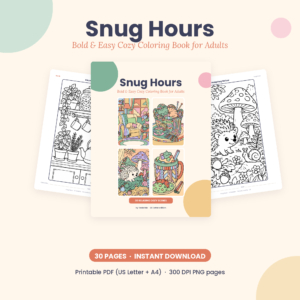
Snug Hours Cozy Coloring Book
Price: $5.99 | Best for: tired adults who want easy calm
Snug Hours has 30 bold and easy cozy scenes: a sleeping cat in a reading nook, a rainy window seat, a fireside puppy, a garden tea party and a snowy log cabin. You get US Letter and A4 PDFs, 300 DPI PNG pages for tablets, a color test page, six palette ideas and a coloring tracker. Start with the rainy window seat on a gray evening.
The tracker in a set like this is handy for a stress-relief habit. Ticking off each page you finish gives you a visible record of evenings you took for yourself. Seeing ten ticks after a hard month is a quiet kind of encouragement.
When choosing colors is the stressful part
Plenty of people sit down to relax and then freeze. Which blue? Does this green clash? Is the whole page going to look wrong? If your days are full of decisions, more decisions are not restful. Color by number takes them away. You match a number to a color and let the picture appear.

Hue and Harmony Color by Number
Price: $4.99 | Best for: adults who find color choices stressful
Hue & Harmony has 30 color by number designs for adults, split into Easy, Medium and Advanced, with flowers, animals, landscapes and mandalas. Each page has a color key with named swatches, and a full-color Finished Gallery shows how each design should look. It prints on US Letter or A4. Begin with an Easy page such as the sunflower or the sailboat.
A small trick: on a stressful evening, do the Easy page even if you could manage an Advanced one. The goal is calm, not a challenge. Save the harder designs for a relaxed Sunday.
Mandalas: rhythm for a racing mind
When thoughts are running in circles, a page that runs in circles can help. Mandalas repeat the same shape around a center, so once you choose a color for one petal, you repeat it six or eight times around the ring. Your hand settles into a rhythm. Your mind tends to follow.
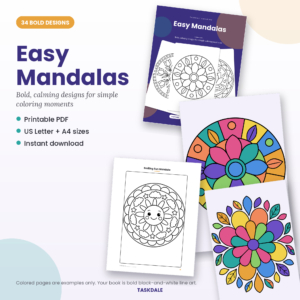
Easy Mandala Coloring Book
Price: $3.49 | Best for: restless minds that like repetition
Easy Mandala has 34 bold mandalas with big shapes and open patterns, such as Petal Sun, Daisy Circle, Heart Bloom and Cloud and Raindrop. Each design is on its own page, in US Letter and A4 PDFs with a clickable contents page. Start in the center of Petal Sun and work outward one ring at a time.
Working from the center outward is worth trying as a deliberate habit. Each ring is a small, complete task. When you finish one, take a breath before you start the next. Over twenty minutes, you will have done six or seven of those tiny resets.
For pages paired with written prompts, see our set of mindfulness coloring pages for adults.
Prompts that keep your attention on the paper
A wandering mind is normal. These short prompts bring it back without forcing anything. Write two or three on a sticky note and keep it beside the page.
- What color is the room around me right now? Use one of them.
- Which shape on this page looks the calmest? Color that one first.
- How hard am I pressing? Can I press half as hard?
- What is one small thing that went fine today? Pick a color for it.
- Where are my shoulders? Drop them. Keep coloring.
- What would this page look like in only two colors?
The shoulder prompt is the one most people need. Fine work creeps tension up into the neck, and you rarely notice until it aches.
Learning a skill as a calm focus
For some people, the calmest state is absorbed learning, not doing nothing. A new skill pulls all your attention in, and there is no room left for worry. Shading is a good skill for this. It is slow, it improves visibly in a week, and every page teaches you something.
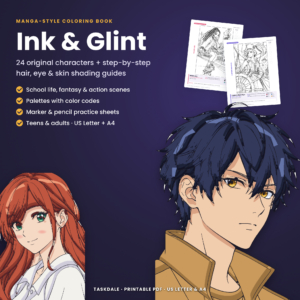
Ink and Glint Manga Coloring Book
Price: $4.99 | Best for: teens and adults learning to shade
Ink & Glint has 24 original anime-style characters in school-life, fantasy and action scenes, each with a short profile. Step-by-step guides show hair, eye and skin shading in four stages, with coded palettes and practice sheets. It comes as a printable PDF in US Letter and A4. Start with a practice sheet before your first full character.
If learning feels like pressure rather than play, put it aside for a while. The skill will keep. Calm comes first.
A one-week starter plan
If you have never kept a coloring habit before, a simple plan for the first seven days takes the guesswork out. Each session is short on purpose.
| Day | Page type | Time | Focus |
|---|---|---|---|
| Monday | Bold and easy | 10 minutes | Just start. One shape counts. |
| Tuesday | Same page | 15 minutes | Light pressure, slow strokes |
| Wednesday | Color by number, Easy | 15 minutes | Enjoy having no choices |
| Thursday | Mandala | 15 minutes | Work from the center out, one ring at a time |
| Friday | Your pick | 20 minutes | Use two prompts from the list above |
| Saturday | Rest or a longer session | Up to 45 minutes | Finish any half-done page |
| Sunday | Look back | 5 minutes | Lay the week’s pages out and pick a favorite |
That Sunday look-back is the part people skip, and it is the part that keeps them going. Five pages on a table, each one a quiet evening you gave yourself. It is a better feeling than most people expect.
Turning coloring into a practice that lasts
Most people start strong and drift away in two weeks. A few small habits make the difference.
- Same time, same place. After dinner at the kitchen table, or with morning coffee before anyone else is up. A fixed slot beats waiting for the mood.
- A ready box. Keep pencils, a sharpener and five printed pages in one shoebox. If setting up takes more than thirty seconds, you will skip it.
- A short minimum. Ten minutes counts. On bad days, one shape counts.
- No judging the result. The page is a record of time spent calmly, not a test.
- Display a favorite. Stick one finished page on the fridge. It reminds you the habit exists.
After a month, many people find they reach for the box on their own on a hard day. That is the moment the practice has taken root.
When coloring is not helping
Coloring suits a lot of people, but not every evening and not everyone. If you notice you are gripping the pencil, rushing to finish, or getting cross about a smudge, the page has turned into another task. Switch to a simpler page or stop for the night.
If fine hand movements are uncomfortable for you, try very large pages, chunky crayons, or coloring on a tablet with a stylus. And if you simply find it boring after a fair try of two weeks, that is useful to know. A walk, a puzzle or a bit of gardening may suit you better, and that is fine.
Frequently asked questions
Does coloring really help with stress?
Many adults find it calming because it narrows attention onto one simple, repetitive task. It is not a cure for anything, but as a regular wind-down habit it suits a lot of people.
How long should I color to feel relaxed?
Ten to twenty minutes is enough for most people. Short and regular works better than long and rare.
What type of coloring page is most relaxing?
It depends on your mood. Bold, easy pages suit tired evenings, mandalas suit restless ones, and color by number suits days full of decisions. For easy options, see our guide to simple coloring books for adults.
Is color by number as relaxing as free coloring?
For many people it is more relaxing, because there are no choices to make. Others miss the freedom. Try one of each and see which leaves you calmer.
Should I use pencils or markers for stress relief?
Pencils are quieter, slower and more forgiving, which suits a calming session. Markers are quicker and brighter, which suits a short burst of fun.
Can I color on a tablet and still get the calming effect?
Yes, though notifications can break your focus. Turn on do not disturb before you start.
Your next step
Tonight, clear a placemat-sized space, pick three colors and try the fifteen-minute session above. If you want pages ready for tired evenings, download Snug Hours, print five, and put them in a box by the table.