Blank walls are cheap to fix if you color the art yourself. Print a black-and-white picture, choose colors that match your sofa or your curtains, and frame it. For the price of a cheap print you get something that fits your room exactly, and that nobody else has.
This guide is for renters, first-home owners, parents decorating a nursery and anyone who likes the idea of art they made with their own hands. You will learn how to choose printable pictures for room decor, match them to your color scheme, print and size them for standard frames, and swap them with the seasons. Room by room, with real examples.
Quick picks: printable art to color for your walls
| Product | Best for | Price | Link |
|---|---|---|---|
| Hue & Harmony Color by Number | Living rooms and hallways | $4.99 | View |
| Cozy Cottage Coloring Book | Kitchens and reading corners | $3.49 | View |
| Letter Parade Alphabet Coloring Book | Nursery and playroom walls | $3.99 | View |
| Peekaboo Patch Halloween Coloring Book | Seasonal door and window decor | $4.99 | View |
Why color-it-yourself art works on a wall
Store-bought prints come in the colors someone else picked. That is fine until you get it home and the “sage green” turns out to clash with your actual sage green cushions. When you color the print yourself, you choose every shade. The art fits the room because you made it fit.
It is also kind to a tight budget. A set of three framed pieces for a hallway can cost a fair bit from a home store. Three printed pages, an evening of coloring and three simple frames from a discount shop often come to less than one bought print. And when you get bored in six months, you print a new page and swap it.
Here is a rough budget for a three-piece hallway set: three sheets of heavier paper (under $1), three basic 11 x 14 frames with mats from a discount store ($8 to $12 each), and pencils you probably already own. That comes to roughly $25 to $37 for three framed pieces in your exact colors. Swap the pages next year and the frames keep working.
There is a quieter reward too. Every time you walk past, you remember the rainy Sunday you spent on that lighthouse. Bought art rarely does that.
Pick your palette before you pick a page
This one step makes the difference between “kid’s coloring page in a frame” and “wait, where did you buy that?” Choose your colors from the room first, then color with only those.
- Look around the room. Pick out three colors you already have: the wall, the main fabric, one accent (a rug, a lamp, a plant pot).
- Add one neutral. Cream, warm gray or a soft brown ties it all together.
- Allow one surprise. A small touch of a brighter shade, used in two or three spots only, adds life.
A worked example: a living room with cream walls, a dusty-blue sofa and a terracotta rug. Your palette becomes cream, dusty blue, terracotta, warm gray, and a little mustard yellow as the surprise. Color a flower bouquet using only those five pencils and it will look as if it was painted for that wall.
Test each color on scrap paper first and hold it up against the sofa or the curtain in daylight. Pencils often look darker in the tin than on paper.
Sizes, paper and printing for wall art
Getting the size right saves a trip back to the shop. Most printable coloring books come as US Letter (8.5 x 11 inches) or A4 (210 x 297 mm). Neither is a standard frame size in the US, so plan around it.
- 11 x 14 frame with a mat: the easiest choice. Buy a mat with an 8 x 10 or 8.5 x 11 opening and the page sits neatly inside.
- 8 x 10 frame: trim the page by a quarter inch on each side. Check that the picture is not too close to the edge first.
- A4 frames: easy to find in the UK, Europe and many other countries, and an A4 file fits perfectly.
- Bigger statement pieces: a copy shop can enlarge a page onto 11 x 17 paper. Bold-line art holds up best when it is made bigger.
Planning a gallery wall with mixed sizes? Cut a sheet of kraft or newspaper to the size of each frame, tape the paper shapes to the wall with painter’s tape, and live with the layout for a day or two. Move them until the gaps look even, usually 2 to 3 inches. Then hang the real frames where the paper was. It feels fussy, but it saves you from patching six nail holes.
Print wall pieces on smooth, heavier paper, around 65 lb cardstock or 100 lb text paper (around 150 to 175 gsm). It takes colored pencil well and stays flat behind glass. Set the printer to “best” quality and 100% scale.
Living room and hallway: framed color-by-number pieces
For the main rooms of the house, you want art that looks finished and calm from across the room. Color-by-number pages are a clever shortcut here. The color plan is already balanced, so even a beginner ends up with a piece that looks deliberate.
You can still make it yours. Swap the key colors for your room palette (the “5” that should be red becomes your terracotta), and keep the light and dark balance the same. The picture will look planned, just in your colors.
Hang three in a row above a sofa or along a hallway. Matching frames, the same mat color and about 2 to 3 inches between frames is all it takes.

Hue and Harmony Color by Number
Price: $4.99 | Best for: adults decorating main rooms
Hue & Harmony has 30 original designs in Easy, Medium and Advanced levels: flowers, animals, landscapes and mandalas such as a sunflower, a mountain lake, a koi pond and a hilltop village. Every page has numbered areas, a named color key and a level badge, and a Finished Gallery shows each one completed. It prints on US Letter or A4. For a hallway set, pick three designs from the same level so the detail matches.
If clean shapes suit your style better than scenes, our guide to geometric coloring books for adults has patterns that look sharp in modern rooms.
Kitchen and reading nook: cozy home scenes
Kitchens and reading corners suit warmer, softer art. A tea table by a window, a cottage garden gate, a vegetable patch. These pictures feel at home next to a kettle or a stack of library books.
Keep the frames small here, 5 x 7 to 8 x 10, and lean them on a shelf instead of hanging them. A leaning frame is easy to swap and leaves no nail holes, which is a relief for renters.
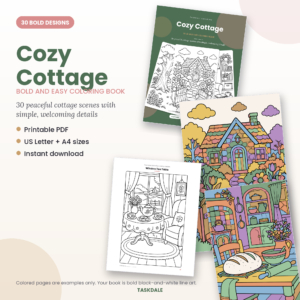
Cozy Cottage Coloring Book
Price: $3.49 | Best for: kitchens and cozy corners
Cozy Cottage has 30 bold, easy scenes of home and garden life: a cottage garden gate, a window tea table, cottage kitchen baking, a rainy cottage window and a fireplace evening. Thick outlines and large shapes keep each page relaxed. It includes US Letter and A4 files and a clickable contents page. Color the window tea table in your kitchen colors and lean it on the shelf above the counter.
A small styling trick: put the framed page next to a real object that echoes it. A teapot beside the tea table picture, a jar of wooden spoons beside the baking scene. The art suddenly feels like part of the room.
Nursery and playroom: an alphabet wall
An alphabet wall is one of the most loved nursery projects, and it can cost very little. Print all 26 letters, color them in the room’s palette, and hang them in a long line or a grid of rows. For a baby’s room, a parent or grandparent colors them. For a four-year-old, the child colors their own and feels very proud.
A grid of 26 pieces looks busy, so here is a calmer layout: frame only the letters of the child’s name, and keep the rest in a folder to swap in as they learn. A five-letter name fits nicely above a crib or a small bed.
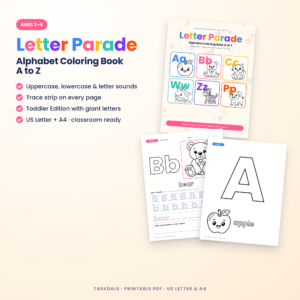
Letter Parade Alphabet Coloring Book
Price: $3.99 | Best for: nursery and playroom walls
Each page shows a big uppercase and lowercase letter to color, a friendly picture for the letter’s sound, the word and three trace rows. A separate Toddler Edition gives every letter one huge hollow shape with extra-thick outlines, which looks clean on a wall. It prints on US Letter or A4 and includes an alphabet chart. Use the Toddler Edition pages for the wall and the main book for practice at the table.
Older kids and teens want something different. A ten-year-old might color a set of animal pages in bold primaries and pin them to a corkboard. A fifteen-year-old might prefer a single mandala colored in black, gray and one neon shade, hung above a desk. Let them choose the palette. A teen who picks and colors their own wall art tends to keep the room tidier around it, at least for a week or two.
Use clip frames or clipboards for kids’ rooms. They are light, safe above a bed, and easy to change when your child’s favorite letter (or color) changes next week.
Seasonal swaps: door hangers, windows and holiday decor
Not every piece needs to stay up all year. Seasonal art keeps a room feeling fresh, and it is a lovely job to share with kids. Swap a framed spring flower for a pumpkin in October, and a pumpkin for a wreath in December.
Halloween is a favorite for this, especially with younger children. Friendly ghosts and smiling pumpkins colored at the kitchen table make perfect window and door decor, and they are much gentler than the scary store-bought kind for a child who startles easily.
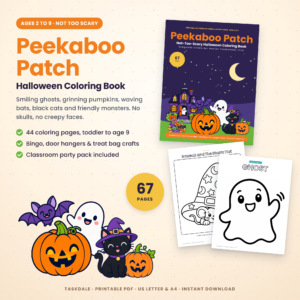
Peekaboo Patch Halloween Coloring Book
Price: $4.99 | Best for: families with little ones
Peekaboo Patch has 67 pages of friendly Halloween art: 12 extra-easy toddler pages, 32 named character pages with smiling ghosts, pumpkins, bats and black cats, puzzles, picture bingo, two door hangers and a treat bag cover. A separate Classroom Party Pack comes too, all in US Letter and A4. Every character is original and not too scary. Print the door hangers on cardstock first and hang them the same afternoon.
Keep a “seasons” folder near your frames. When the season changes, slide the new page in and the old one goes back in the folder for next year.
Does it have to be fully colored?
No, and some of the best-looking pieces are not. Black-and-white line art can be striking on its own, especially in a modern room with white walls and black frames. A few other looks are worth trying:
- One-color accent. Leave the page black and white, and color only one element. A single red door on a cottage. One gold sun in a mandala.
- Monochrome shading. Use one color in light, medium and dark. All blues, or all greens. Calm and grown-up.
- Watercolor wash. Print on watercolor paper (if your printer feeds it) and add loose washes of paint over the lines.
Partial coloring is also a gift to busy people. A one-accent piece takes 20 minutes instead of three evenings, so you can make a whole set of four in a single afternoon and still have time for tea.
For softer, simpler designs that look lovely half-colored, see our list of simple coloring books for adults.
Common mistakes with printable wall art
- Coloring before choosing the frame. Pick the frame and mat first so you know how much of the page will show.
- Using every color in the box. Five colors look intentional. Twenty-four look like a coloring page.
- Thin printer paper behind glass. It ripples over time. Use heavier paper.
- Hanging in direct sun. Markers and some pencils fade. A wall that gets afternoon light needs UV-filtering glass or a different spot.
- Skipping the test print. One page first, then the real one. Faint lines are easy to miss on screen.
Frequently asked questions
What size frame fits a printable coloring page?
An 11 x 14 frame with a mat cut for 8.5 x 11 works best in the US. A4 frames fit A4 pages exactly.
What paper is best for printable wall art?
Smooth, heavier paper such as 65 lb cardstock or 100 lb text (about 150 to 175 gsm). It takes pencil well and stays flat in a frame.
How do I make coloring pages look like real art?
Limit yourself to four or five colors taken from the room, use a mat and a plain frame, and hang pieces in matching sets.
Can I enlarge a printable coloring page for a bigger frame?
Yes, a copy shop can print it on 11 x 17 paper. Bold, simple line art enlarges better than fine detail.
Will colored pencil fade on a wall?
Some shades can fade in strong sunlight. Hang art away from direct sun or use UV-filtering glass.
Your next step
Stand in the room you want to decorate and write down three colors you can see. Then print one page, color it with only those shades plus one neutral, and buy one frame. If it is for a living room or hallway, start with an Easy design from the Hue & Harmony color by number book and swap in your room colors.