Engineers do clever, difficult things at work and then describe them in the dullest possible way on paper. Responsible for design of structural elements. Involved in testing. Used AutoCAD. Every line is true, and none of it tells a hiring manager what you actually built, how big it was or whether it worked.
This guide shows you how to use a CV engineer template to put your projects, tools and results front and centre. You will get a layout that suits engineering roles, a simple pattern for writing project entries, examples for civil, mechanical, electrical and software engineers, and a before-and-after rewrite of a real-looking CV section.
It works for graduate engineers writing a first CV and for senior engineers who have not updated theirs since their last promotion.
Quick picks: CV templates that suit engineering roles
| Product | Best for | Price | Link |
|---|---|---|---|
| Marlowe Resume Template | A 2-page CV with tools, certifications and selected projects | $4.79 | View |
| Alder Resume Template with Photo | Neat tool ratings and a key projects section | $4.79 | View |
| Sloane Resume Template | Senior engineers who need a 3-page CV with projects and talks | $4.49 | View |
| Hollis Resume Template | A clean sidebar for software and certifications | $8.99 | View |
What engineering hiring managers check first
An engineering manager reading your CV is usually an engineer too. They are not impressed by big words. They want to know quickly whether you can do the work their team does, at the scale they do it.
In the first 30 seconds they tend to look for five things:
- Your discipline and level. Graduate civil engineer, senior controls engineer, staff software engineer.
- Professional status. Chartered, incorporated, licensed or working towards it, with the body named.
- The type and size of projects. A 40-metre footbridge is not a 4-kilometre motorway scheme. Both are good. They are different.
- The tools you use daily. Design software, analysis packages, programming languages, standards.
- Results. Delivered on time, under budget, safer, faster, cheaper, more reliable.
A good engineering CV answers all five on the first page without making anyone dig.
The layout that works for an engineering CV
Engineering CVs need a little more structure than most, because you are showing both what you did in each job and the specific projects you delivered. Here is an order that works for most disciplines.
- Header. Name, title, professional status (for example CEng MICE), phone, email, town, LinkedIn.
- Profile. Three lines: your discipline, years of experience, the kinds of projects you deliver and one standout result.
- Core tools and skills. Grouped, not a long list. More on this below.
- Experience. Each job with three to six bullets, each bullet tied to a project or result.
- Selected projects. Two to five of your best projects with scope, your role, tools and outcome.
- Education. Degree, university, year and class. Final year project if you are a graduate.
- Certifications and memberships. Safety tickets, software certifications, institution membership.
For most engineers with five or more years, this fits on two pages. Graduates can keep it to one. If you are unsure which is right, our guide on how long a resume should be compares the options.
The Marlowe kit handles this structure well. Its 2-page version adds sections for tools, certifications, awards, key achievements and selected projects on page two.
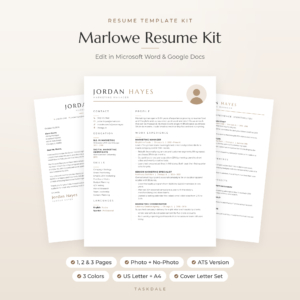
Marlowe Resume Template
Price: $4.79 | Best for: engineers needing a 2-page CV
Marlowe includes 1, 2 and 3 page CVs with and without a photo, an ATS version, a cover letter, references page and thank-you letter, in Sand, Sage and Slate and both US Letter and A4. Page two of the 2-page CV is built for tools, certifications, awards, key achievements and selected projects. Fill the selected projects block first, then write your job bullets to match it.
Writing project entries that show what you built
The heart of an engineering CV is the project entry. Use a simple four-part pattern for each one: the project, your role, the tools and the result.
The pattern
Project and scale. What was it and how big? Your role. What did you personally do? Tools. What did you use? Result. What changed because of your work?
Examples by discipline
- Civil: Designed the drainage for a 220-home housing development using MicroDrainage and Civil 3D, cutting attenuation tank volume by 15 percent through a revised network layout.
- Mechanical: Redesigned a pump bracket in SolidWorks after FEA showed fatigue cracking, extending service life from 9 months to over 3 years across 40 installed units.
- Electrical: Led LV distribution design for a three-storey school extension in Amtech, coordinating with M&E contractors to hit the programme with zero design-related delays.
- Software: Rebuilt the order processing service in Go, reducing average response time from 800 to 120 milliseconds and on-call alerts by half.
- Process: Ran a root cause study on a filling line using Minitab, finding a valve timing issue that lifted yield from 94 to 98 percent.
Each line is one or two sentences, has a number, names the tool and makes the engineer’s own part clear. That last point matters. Saying the team delivered a hospital tells the reader nothing about you. Saying you designed the medical gas system for its 12 theatres does.
When you cannot share details
Some projects sit under confidentiality agreements. In that case describe the type and scale without naming the client: a 30 MW data centre for a global cloud provider, or a safety-critical control system for a European rail operator. You can still give your role, the tools and the outcome.
A tools section that is actually useful
A wall of 40 software names in one paragraph is hard to read and hard to believe. Group your tools so a reader can scan them in a few seconds, and list the ones you use confidently.
- Design: AutoCAD, Revit, Civil 3D
- Analysis: ANSYS, ETABS, MATLAB
- Programming: Python, C++, SQL
- Project tools: MS Project, Primavera P6, Jira
- Standards: Eurocodes, BS 7671, ISO 9001
If the template offers rating dots, use them only for tools, not for soft skills, and be honest. A recruiter will happily ask you to talk through a model you built in a package you rated five out of five.
Alder’s tool and language ratings sit on a right tab, so the dots stay lined up even when one software name is much longer than the next.
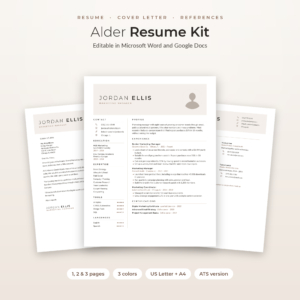
Alder Resume Template with Photo
Price: $4.79 | Best for: engineers listing many tools neatly
Alder includes 1, 2 and 3 page CVs with and without a photo and a one-column ATS version, in Mocha, Sage and Slate and both paper sizes. The 2-page version adds earlier experience, key projects, volunteering, awards and training, and tool ratings stay aligned on a right tab. An Excel Job Application Tracker is included for logging every role you apply for.
Numbers every engineer can use
Engineers often say they have no numbers because their work is technical rather than commercial. In practice, almost every project has something you can measure.
- Size: floor area, length, capacity, number of units, lines of code, users
- Money: project value, savings, budget managed
- Time: programme length, days saved, response time, downtime cut
- Quality: defect rate, yield, test pass rate, uptime
- Safety: incident-free hours, risk items closed, audits passed
- People: team size, number of contractors coordinated, juniors mentored
If you are not sure of an exact figure, use a fair round number and be ready to explain it. Around 2,000 sensors is fine if you can say roughly how you know.
Graduate engineers and senior engineers need different CVs
Graduate and junior engineers
Keep it to one page. Lead with your degree and your final year or group design project, written in the same project pattern as above. Add placements, summer work and any society or competition work, such as Formula Student, Engineers Without Borders or a robotics team. Those count, and engineering managers often recognise them.
Mid-level engineers
Two pages. Move education below experience. Cut your university projects down to one line unless they are directly relevant. Add your professional status and progress towards it.
Senior and principal engineers
Two pages for most applications, three when a role asks for a full project list, publications or conference talks. Show leadership: teams led, design reviews chaired, standards written, juniors brought through to chartership.
Sloane has a 3-page CV with sections for projects and talks, which suits senior engineers with a long project record.
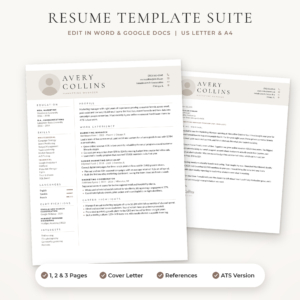
Sloane Resume Template
Price: $4.49 | Best for: senior engineers with long project lists
Sloane includes a 1-page resume with and without a photo, a 2-page resume, a 3-page CV with projects, talks and a references section, plus an ATS version, cover letter and references page. Every file comes in Stone, Sage and Navy and both US Letter and A4, built with real Word styles and no floating text boxes. Use the 3-page CV only when a posting asks for a detailed project record.
Matching your CV to each engineering role
Engineering postings are usually specific. A structural role at a consultancy might ask for Eurocode design in steel and concrete, Tekla and site supervision. A contractor’s role might care more about temporary works, programme and cost control. The same engineer can fit both, but not with the same CV.
Before you apply, copy the posting into a document and highlight every tool, standard and task it mentions. Then check three places on your CV. Does your profile name the type of work they do? Does your tools section include the software they listed, if you really use it? Does your first job show a project that looks like theirs? Swap the order of your selected projects so the closest match comes first.
This takes 15 to 20 minutes per application. It is worth it. A manager hiring for a water treatment project will stop at a CV that opens with a pumping station upgrade, and keep scrolling past one that opens with a car park.
A worked example: rewriting a mechanical engineer’s job entry
Here is a typical entry from a mechanical design engineer with six years of experience.
Before
- Responsible for design of components for agricultural machinery.
- Used SolidWorks and ANSYS.
- Worked with production team.
- Involved in testing.
After
- Designed 60+ structural and drive components for a range of tractor-mounted mowers, from concept to production release in SolidWorks.
- Ran FEA in ANSYS on the main gearbox housing, cutting weight by 11 percent while keeping a safety factor above 2.0.
- Worked with the production team to redesign three weld assemblies for robotic welding, saving around 25 minutes per unit on a line building 1,200 units a year.
- Planned and ran field trials on 8 prototype machines over two harvest seasons, feeding 34 design changes back into production.
Same job. Same engineer. The second version shows scale, tools, the engineer’s own part and real outcomes. Writing it took about 40 minutes, and the small glow of seeing six years of work finally look like six years of work is worth every one of them.
Mistakes that hide good engineering work
- Duties instead of results. Responsible for says what you were meant to do, not what you did.
- Jargon soup. HR staff often screen CVs first. Write so a non-engineer can follow the main point, then add the technical detail.
- Every tool you have ever opened. List what you could use tomorrow without a refresher.
- Hiding your professional status. If you are chartered or licensed, put it next to your name.
- Graphics-heavy designs. Many engineering employers use screening software. Keep a single-column version ready, and see our ATS resume template guide for what it needs.
- No referees lined up. Engineering offers often depend on references from a senior engineer. Our references page guide covers who to ask.
Frequently asked questions
How long should an engineering CV be?
One page for graduates, two for most experienced engineers, and three only when a role asks for a full project list or publications.
Should I list projects separately from jobs on an engineering CV?
Yes, if you have several strong projects. A Selected Projects section lets you show scope, tools and results without crowding each job entry.
How many software tools should an engineer list?
Ten to fifteen, grouped by type, is plenty. Focus on tools you use confidently and that match the job posting.
Do I put my chartered status on my CV?
Yes. Put it after your name in the header and again under memberships, with the institution named. If you are working towards it, say so.
What should a graduate engineer put on a CV?
Your degree, your final year or group design project, placements, competitions such as Formula Student, and the software you used, all written with a scale and a result.
Should an engineer include a portfolio link?
If you have shareable work, yes. Software engineers can link a code repository, and designers can link a short PDF of drawings or renders that contain no client-confidential details.
Your next step
Pick your three best projects from the last five years and write each one using the project, role, tools and result pattern before you touch anything else. Then drop them into a layout with room for selected projects, such as the Marlowe Resume Template, and build your job entries around them.