You have ten years of work behind you and a page that only holds half of it. Or you have one summer job and a resume that looks thin. Either way, the same question comes up: how long should a resume be? The honest answer is “as long as it needs to be, and not a line more.” That sounds slippery, so this guide turns it into rules you can use today.
We compare one, two and three page resumes, show who each suits, and point to three Taskdale templates that include all three lengths.
Quick picks
| Product | Best for | Price | Link |
|---|---|---|---|
| Marlowe Resume Template | Trying 1, 2 and 3 pages on a budget | $4.79 | View |
| Ashford Resume Template Bundle | Senior and executive resumes | $7.99 | View |
| Hollis Resume Template | Photo CV with a job search planner | $8.99 | View |
How long should a resume be? The short answer
Here is the quick version, then we will unpack it.
- One page: students, recent graduates, career changers and anyone with under about ten years of relevant work.
- Two pages: most experienced professionals with a solid record of results.
- Three pages: very senior roles, academic CVs, or fields with long project lists.
Notice the word “relevant”. Ten years of retail does not need to appear in full on an application for an office job. The reader does not count your years. The reader looks for proof that you can do this job.
And remember who reads these things. A recruiter may spend less than a minute on a first pass. Every extra line makes it harder to find your best one.
The one page resume
One page is the default for people early in their careers, and it is still a great choice for anyone with a focused story. It forces you to pick what matters. That discipline alone often makes a resume better.
Who should use it
Students, recent graduates, interns, anyone changing fields and anyone whose last two or three roles carry the story. If you have five years of work and each job lasted about a year, one page is probably plenty.
What to include
A short summary, your most recent jobs with three or four bullets each, your education and a focused skills list. Cut old jobs that do not support the new target. Cut hobbies unless they prove a skill.
The risk
Cramming. If you squeeze in tiny text and no margins to hit one page, you made it harder to read. Cut content instead. Rewrite a long bullet into a short one. Drop the weakest example in each role.
The two page resume
For most working adults, two pages is the sweet spot. It gives you room for a decent summary, a clear work history and a skills section, without drowning the reader.
Who should use it
People with roughly ten or more years of relevant experience, or those with several jobs that each had real results. Managers, specialists, trades with certifications and professionals in fields like healthcare, finance and engineering often land here.
How to fill it
Put your strongest material on page one. Many readers never turn the page. The first half of the first page should answer: who are you, what do you do and what have you achieved? Page two holds older roles, education, training and extras.
The risk
A page and a quarter. Nothing looks sloppier than two lines spilling onto page two. Either trim to fit one page or fill the second page with meaningful content. A page that is nearly empty reads as unfinished.
The three page resume
Three pages is rare, and it should be. But it has a place.
Who should use it
Senior executives with long track records, academics listing publications and talks, consultants with many projects, and people applying for roles that ask for a full CV. In some countries a longer CV is normal, so check local habits.
What changes
The extra space is for detail that earns its place: major projects, results by the numbers, boards, awards or publications. Not for repeating the same duties under every job.
The risk
Padding. If page three holds a list of every software program you have ever opened, cut it. A long resume that is full of filler tells the reader you could not decide what mattered.
How long should a resume be for your situation
Use this quick guide to see where you land.
| Your situation | Suggested length |
|---|---|
| Student or recent graduate | 1 page |
| Career changer | 1 page, maybe 2 |
| 3 to 8 years of experience | 1 page, sometimes 2 |
| 10 or more years of experience | 2 pages |
| Executive, academic or technical specialist | 2 to 3 pages |
These are guides, not laws. If your one page tells a strong story, do not stretch it just because you have been working for twelve years. And if you are early in your career but have strong projects, two pages may be okay, although most readers will still prefer one.
When you are deciding how long should a resume be for a specific job, also read the posting. Some employers ask for a certain length. If they do, follow it exactly.
How long should a resume be? It depends on the reader
Length is not about rules from a book. It is about the person holding your page. A hiring manager at a small firm may read every word. A recruiter at a big company reads a stack in an afternoon. A busy department head may only glance at the top third before deciding.
So write for the glance first. Your name, your title and your best result should sit where the eye lands. Then write for the careful reader below that. If both can get what they need, your length is right, whatever the number says.
Templates that give you all three lengths
One handy way to test the question is to try each length in the same design. These three Taskdale templates include 1, 2 and 3 page versions for Word and Google Docs, so you can see how your own content fits.
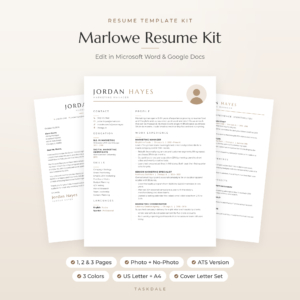
Marlowe Resume Template for Word & Google Docs
Price: $4.79 | Best for: testing all three lengths without spending much
Marlowe is a minimalist resume with photo, a cover letter and references. It has 1, 2 and 3 page CV versions and an ATS resume, in US Letter and A4.
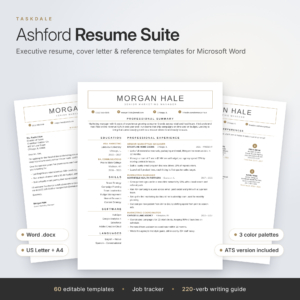
Ashford Resume Template Bundle
Price: $7.99 | Best for: senior professionals who may need a longer layout
Ashford is an executive and ATS-friendly resume bundle for Word and Google Docs. It includes a cover letter, a reference page, 1, 2 and 3 page CV versions and a job tracker.
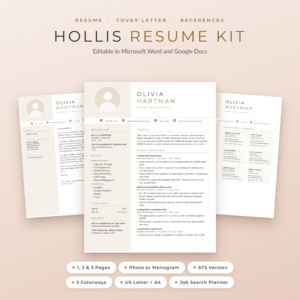
Hollis Resume Template for Word & Google Docs
Price: $8.99 | Best for: a photo CV with a planner for the search
Hollis is a resume with photo, a cover letter and references. It has 1, 2 and 3 page CV versions, an ATS resume and a job search planner, in US Letter and A4.
Comparison of the three templates
| Product | Format | Price | Best for | Link |
|---|---|---|---|---|
| Marlowe | Word and Google Docs, 1 to 3 pages, ATS version | $4.79 | Lowest cost way to test lengths | View |
| Ashford | Word and Google Docs, 1 to 3 pages, executive and ATS | $7.99 | Senior and executive roles | View |
| Hollis | Word and Google Docs, 1 to 3 pages, ATS version | $8.99 | Photo CV and job search planner | View |
How to cut a resume that runs too long
Most people do not struggle to add. They struggle to cut. If your draft is a page or two over, work through this list in order.
First, delete jobs older than fifteen years unless they matter directly. A line or two with the title and company is enough. Next, trim each older role to two bullets. Then look at every bullet and ask whether it shows a result. “Responsible for scheduling” shows nothing. “Cut scheduling gaps by a third” shows something.
Merge similar points. If you have four bullets that all say you trained people, turn them into one strong one. Remove the “References available on request” line, since everyone knows they are. Drop your street address, too. City and region are plenty.
After that, check your wording. Short words beat long ones. “Used” beats “made use of”, and “ran” beats “was responsible for running”. You can often save a whole line per bullet just by tightening the phrasing.
Finally, resist the pull to shrink the font. Keep it readable, around 10 to 12 points for body text, with decent margins. A cramped page is tiring to read, and tired readers move on.
How to stretch a resume that feels too short
Short is not bad. A clear one page resume beats a padded two page one. But if you feel like you have more to say, here is where to look before you pad.
Add numbers to what you already have. How many customers? How big was the budget? How much faster, cheaper or safer? Add projects, volunteer work or freelance gigs that show skills. Include training and certificates that match the job. Mention tools and systems you know well.
If, after all that, the page is still short, leave it short. White space is not a flaw. It makes the page easy to scan, and easy scanning wins.
A quick example
So when you ask how long should a resume be, picture that glance. Now take two applicants for the same office manager job. Dana has eight years of experience, but her resume runs three pages with every duty from every job listed. Priya has nine years and a tight two pages, each role showing three results.
The hiring manager reads Priya’s in under a minute and knows exactly what she can do. Dana’s takes longer, and the best results sit on page three. Both are qualified. Only one made it easy. That is what length really controls: how fast the reader finds proof.
One last check before you decide
Print your draft, or view it at full page size, and hold it at arm’s length. Can you still see where each section starts? Do the bold lines tell a story if you read only them? If yes, the length is working. If the page looks like a gray wall, cut something, whatever the page count says.
Frequently asked questions
How long should a resume be for a first job?
One page. Put education near the top, then any part time work, internships, projects, volunteering and skills. Keep it short and clear. Employers know you are starting out and mostly want to see effort, reliability and a willingness to learn.
Is a two page resume okay?
Yes, if you have enough relevant experience to fill it well. Most professionals with ten or more years of work land on two pages. Put your best material on page one and make sure page two is at least half full.
When is a three page resume acceptable?
For very senior roles, academic CVs, and jobs that call for a full list of projects or publications. Keep every line useful. If page three is mostly filler, cut it back to two. Check the norms for your field and country.
Does resume length matter to ATS software?
Software generally reads text, not page count, so length itself is rarely the issue. Clear structure and plain formatting matter more. Taskdale templates such as Marlowe and Ashford include an ATS version next to the styled layout.
Should I use a smaller font to fit my resume on one page?
No. Tiny text makes your resume harder to read. Cut content instead by removing older roles, merging bullets and tightening wording. Keep body text around 10 to 12 points with comfortable margins.
Your next step
So, how long should a resume be for you? Find out tonight. Write out your full work history in one messy document. Then pick the length that matches your experience and cut until every line earns its spot. If you want a head start, try Marlowe for $4.79 and test the 1, 2 and 3 page versions with your own words.