Color by number printable pages for preschool learning do something worksheets often fail at. They get a three- or four-year-old to practice numbers on purpose, for fifteen minutes, without anyone saying the word “lesson”. The child thinks they are making a ladybug. You know they just read the number 3 eleven times.
This guide is for preschool teachers, homeschool parents and grandparents who want to use these pages well. You will see which early skills each page builds, how to introduce them to a child who has never tried one, a simple weekly plan for home and for class, and how to tell when a child is ready for the next step.
Quick picks for preschool color by number
| Product | Best for | Price | Link |
|---|---|---|---|
| Hop to Ten Color by Number for Kids | Numbers 1 to 10, ages 3 to 6, with answer keys | $4.49 | View |
| Crayon Campus Preschool Learning Coloring Worksheets | Shapes, numbers 1 to 20, colors and science in one set | $4.99 | View |
| Starmane Meadow Unicorn Coloring Book for Kids | A themed reward set with dot-to-dots and mazes | $4.49 | View |
What preschoolers actually learn from color by number
A single page practices more than you might guess. Here is what a child is doing while they color a simple fish.
Number recognition
They look at a 4, hold it in their head, scan the key for another 4 and match them. That is reading a numeral, twice, with a purpose. On a page with 20 spaces, it happens 20 times.
Color words
Good keys pair each number with a crayon swatch and a word like Red or Light Blue. Over a few weeks, children start to recognize the shape of the word “blue” next to the blue blob. Early reading sneaks in.
Pencil control
Staying inside a shape trains the small muscles in the hand and the link between eye and hand. That is the same control children need later to form letters.
Following a rule
“Color the 2s brown” is a two-step instruction. Holding it in mind while working is a quiet but real skill, and one kindergarten teachers notice.
Finishing something
A preschooler who finishes a page and sees a whole picture appear feels proud. That small win builds the habit of sticking with a task.
How to introduce a child to their first page
The first page matters more than any other. Keep it short and very easy, with only two or three numbers.
- Show the finished picture first. “We are going to make this ladybug.” A goal makes the task feel worth doing.
- Put out only the crayons in the key. Three crayons, not a box of 24.
- Point together. Touch the 1 in the picture, then slide your finger to the 1 in the key. Say “one” out loud.
- Color one space together. Your hand guides theirs if needed.
- Let them hunt. “Can you find another 1?” This turns it into a game.
Expect wobbles. Expect a red space that should be black. Say “Look, you found all the ones!” and leave the mistakes alone. The goal on day one is a happy child who wants to do another.
Choosing pages that teach, not just fill time
Many free color by number pages are made to entertain, not teach. That is fine for a rainy afternoon, but for learning you want a few extra things.
- A clear order from easy to harder, so numbers 1 to 5 come before 6 to 10.
- Big spaces and bold lines, so the hand can succeed while the brain works on numbers.
- Color words next to swatches, for early reading.
- A finished picture to check against, so children can see if they matched correctly.
- A name line, so pages can go into a portfolio or home folder.
A book built around these points saves you from mixing pages from five sites with five different styles. For more on page design for little hands, see our guide to preschool coloring pages with big shapes.
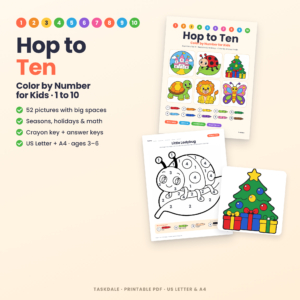
Hop to Ten Color by Number for Kids
Price: $4.49 | Best for: preschool and pre-K number practice
Fifty-two original pictures that use only the numbers 1 to 10, in five parts from easy to harder, ending with color by answer sums and take-away within 10. Every page has big spaces, a crayon key with plain color names and a name line, and full-color finished pictures act as answer keys. Two Number Practice pages add ten frames and tracing. US Letter and A4 PDFs include a one-teacher classroom licence. Start with Part 1.
Pair every page with something hands-on
Numbers on paper make more sense when they connect to things a child can touch. A two-minute warm-up before coloring makes the page land better.
- Count real objects first. If the page uses 1 to 5, line up five buttons, five blocks or five raisins and count them together.
- Match crayons to toys. Hold up the red crayon and find something red in the room. Then do blue. Color words stick faster when they are tied to a truck or a sock.
- Hop the numbers. Write 1 to 5 in chalk outside and let the child jump to each one you call. Then go inside and color. Busy bodies settle better after a burst of movement.
- Finger trace. Before coloring a 7 space, trace the 7 with a finger. It links the shape of the numeral to the hand.
None of this takes planning. A cup of buttons on the table is enough. The point is that the number 4 stops being a squiggle and becomes “four things”, which is the whole idea behind early math.
A five-day plan for home
Short daily sessions beat one long one on Saturday. Ten to fifteen minutes is the sweet spot for most three- and four-year-olds. Here is a simple week that a parent can run before lunch or after nap.
| Day | Page | Talk about |
|---|---|---|
| Monday | A 1 to 5 page with an animal | Say each number as you color it |
| Tuesday | A second 1 to 5 page | Count how many 3 spaces there are |
| Wednesday | A number practice page with a ten frame | Color the boxes for today’s number |
| Thursday | A seasonal page | Name the colors in the key together |
| Friday | Child’s choice | Check the finished picture and give a sticker |
After four weeks of this, many children can name 1 to 5 on sight and are ready for 6 to 10. Keep the finished pages in a folder. Looking back through it together at the end of the month is a lovely, proud moment.
Using color by number in a preschool classroom
Teachers have a different problem: 16 or 20 children at different levels, all at once. Color by number fits several parts of the day.
Morning work
Put a page on each table before children arrive. They settle in, find their name line and start coloring while you greet families at the door. It is calm, self-running and quiet.
Math centers
Set up one table with color by number pages, a cup of the key crayons and a finished-picture card for checking. Four children can work there for ten minutes while you run a small group nearby.
Early finishers and sub plans
Keep a folder of printed pages by the door. A substitute can hand them out with zero explanation, and an early finisher always has something worthwhile to do.
A wider set that mixes color by number with shapes, color words and counting gives you material for every center, not just math.
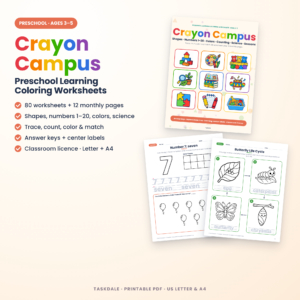
Crayon Campus Preschool Learning Coloring Worksheets
Price: $4.99 | Best for: teachers running preschool centers
Eighty worksheets in clear sections: Shapes, Numbers 1 to 20, Counting and Math, Colors, Matching and Science, plus 12 monthly pages. Each page has one simple job, a Name and Date line and a one-line instruction to read aloud. It includes a color by number hot air balloon, dot-to-dots, answer keys, a skills checklist, a certificate and learning-center labels, in US Letter and A4 with a one-teacher licence. Print the skills checklist first.
How to tell when a child is ready for the next step
Moving up too fast is the most common mistake. Moving up too slowly leads to boredom. Watch for these signs.
- Ready to move up: the child finds numbers quickly without pointing, matches colors correctly most of the time and finishes a page in one sitting.
- Not ready yet: the child guesses, colors spaces randomly, or asks you to find every number.
- Ready for math pages: the child can count objects to 10 and knows that 2 and 3 together make 5 with fingers.
A simple record helps. Write the date and “1 to 5 easy” or “6 to 10 tricky” on the back of each finished page. Patterns show up within a couple of weeks.
Adapting pages for threes, fours and fives
A three-year-old and a five-year-old can use the same book with a few tweaks.
For three-year-olds
Use only one or two numbers per session. Color the rest of the page yourself, or leave it. Chunky triangular crayons are easier to grip. Sit with them the whole time.
For four-year-olds
Full pages with 1 to 5, then 6 to 10. Let them work alone after the first few spaces. Ask them to tell you a story about the picture when it is done.
For five-year-olds
Mixed 1 to 10 pages and simple sums. Let them check their own work against the finished picture. That self-checking is a real step toward independent learning.
Themed sets as a reward
Learning pages work best with a little fun on the side. After a week of number practice, a themed page with a favorite subject feels like a treat, even though it still involves matching numbers and colors.
Unicorns, dinosaurs and space are favorites. A themed book with color by number, dot-to-dots and simple mazes keeps the same skills going in a new costume. For more theme ideas, see our post on coloring pages for kids that they will finish.

Starmane Meadow Unicorn Coloring Book for Kids
Price: $4.49 | Best for: Friday treats for unicorn fans
Seventy-eight pages of original unicorn art, starting with chunky Little Hooves pages for preschoolers with extra-thick outlines and a big hollow word to color. A games section adds four color by number pages, dot-to-dots that start at 1 to 15, three mazes and a word search, all with answer keys. It prints in US Letter or A4. Save a color by number unicorn for Friday as a reward page.
Sharing progress with families
Finished pages are a simple way to show parents what a child is learning. A Friday folder with three colored pages and a sticky note saying “Mia can find 1 to 5 on her own now” tells a family more than a report card line ever will.
For homeschool families, the same folder becomes a quiet record of the year. Date every page. By spring you will have a stack that runs from scribbly ladybugs with three numbers to tidy trains with ten, and the change is easy to see. Grandparents love getting one of these pages in the post, too, and children love choosing which one to send.
Printing and setup tips
- Print in black and white. Coloring pages do not need color ink. Print the answer keys in color once and keep them in sheet protectors.
- Print at actual size. Shrinking pages makes spaces smaller and harder for little hands.
- Batch print on Sunday. Five pages for the week, clipped together, means no scrambling on a busy morning.
- Try dry-erase sleeves. Slide a page into a clear protector and use dry-erase crayons for practice you can wipe and repeat.
- Keep a crayon cup per page set. Matching crayons in a labeled cup saves searching and arguments.
Common mistakes with preschool color by number
- Too many numbers at once. A page with 1 to 10 overwhelms most three-year-olds.
- Correcting every slip. It turns play into a test. Let wrong colors go.
- Long sessions. Stop at ten or fifteen minutes, while the child is still keen.
- No checking step. Without a finished picture, children cannot see what they got right.
- Using only free single pages. Random pages jump around in difficulty, which makes steady progress hard.
Frequently asked questions
At what age can preschoolers do color by number?
Many children can start around age 3 with pages that use only 1 to 3 or 1 to 5 and very big spaces.
Do color by number pages help with number recognition?
Yes. Children read and match the same numbers many times on one page, which is gentle repeated practice.
How long should a preschool color by number session be?
Ten to fifteen minutes is enough for most three- and four-year-olds. Stop while they are still enjoying it.
Can I use color by number pages in a pre-K math center?
Yes. Put out pages, a cup of the key crayons and a finished picture for checking. Children can work in small groups with little help.
What if my child colors with the wrong colors?
Let it go on early pages. Later, show them the finished picture and let them spot the difference themselves.
Should preschoolers use crayons or markers?
Chunky crayons are easier to control and do not bleed. Markers are fun, but save them for pages with very big spaces.
Your next step
This week, run the five-day plan above with one child and keep every finished page in a folder. On Friday, flip through it together and celebrate. When you want a set that climbs from 1 to 5 all the way to simple sums, start with Part 1 of Hop to Ten Color by Number for Kids.