The quickest way to choose the best coloring sheets for adults by skill level is to look at the smallest space on the page, not the picture. If your pencil tip fits comfortably inside every shape, the sheet matches your skill. If you find yourself squinting at cells the size of a rice grain on your first night, it does not, however beautiful the preview looked.
This guide gives you a simple way to place yourself on a skill scale, the clues to look for in a sheet or product listing, and a plan for moving up a level without the frustration that makes so many people give up. You will also find four printable sets from Taskdale that cover beginner to advanced, so you can start in the right place.
Quick picks: one set for each level
| Product | Best for | Price | Link |
|---|---|---|---|
| Snug Hours: Bold & Easy Cozy Coloring Book for Adults | True beginners and tired eyes | $5.99 | View |
| Easy Mandala Coloring Book | Confident beginners who like patterns | $3.49 | View |
| Hue & Harmony Color by Number for Adults | Moving from easy to advanced in one set | $4.99 | View |
| Gearhead Zoo Printable Coloring Book | Detail lovers ready for fiddly work | $3.99 | View |
The four skill levels at a glance
Coloring sheets do not come with official grades, so it helps to have your own scale. This one is based on things you can see on the page.
| Level | Smallest spaces | Areas per page | Lines | Time per page |
|---|---|---|---|---|
| Beginner | Bigger than a fingertip | About 20 to 60 | Thick and bold | 20 to 45 minutes |
| Confident beginner | About the width of a pencil | About 60 to 150 | Bold, some thinner details | 45 to 90 minutes |
| Intermediate | A few millimeters | About 150 to 300 | Medium, even | 1.5 to 3 hours |
| Advanced | Smaller than a pencil tip | 300 and up | Thin and fine | 3 hours to several evenings |
The numbers are rough, and that is fine. You are not measuring for a lab. You are looking for the band where a page feels absorbing rather than either boring or exhausting.
A two-minute self-test: where do you fit?
Answer these honestly. Count how many you say yes to.
- Have you finished at least five coloring pages in the last few months?
- Do you usually stay inside the lines without much effort?
- Do you blend two colors together, or shade one side of a shape darker?
- Do you own a pencil sharpener you use more than once per session?
- Have you ever felt bored halfway through an easy page?
- Do you enjoy sessions longer than an hour?
Zero to one yes: start at beginner. Two to three: confident beginner. Four to five: intermediate. Six: you are ready for advanced pages, or already there.
One more factor overrides the score: your eyes and hands. If you have tired eyes after work, or hands that shake a little, step down one level whatever your score says. Comfort beats challenge every time.
Beginner sheets: what to look for
A good beginner sheet feels generous. Big shapes, thick outlines, one clear subject and plenty of white space around it. You should be able to finish one in a single evening and feel pleased, not drained.
- Thick lines. They act like a fence and catch small wobbles.
- One subject per page. A cat in a chair, not a cat in a chair in a room full of shelves.
- Familiar themes. Cozy rooms, flowers and pets are easy to picture in color.
- No tiny background patterns. These are where beginners lose heart.
A beginner page is not a lesser page. Plenty of experienced colorists reach for bold sheets on busy weeks simply because they are restful.
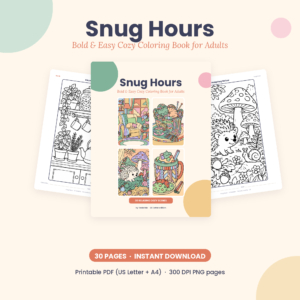
Snug Hours Cozy Coloring Book
Price: $5.99 | Best for: beginners and anyone with tired eyes
Snug Hours has 30 bold and easy cozy pages with thick outlines and large shapes, such as a sleeping cat in a reading nook, a rainy window seat and a garden tea party. You get US Letter and A4 PDFs, 300 DPI PNG pages, a color test page and six palette ideas. Use the color test page first to see how your pencils look on paper.
Confident beginner: patterns with room to breathe
Once bold pages start to feel quick, the next step is more areas without much smaller spaces. Mandalas are perfect for this. They have more shapes than a simple scene, but the shapes are still roomy, and the repeating design means you only make a few color choices before the pattern carries you.
At this level, start trying one new skill per page. Shade the inside edge of every petal a little darker. Or blend two colors where they meet. One skill at a time keeps it fun.
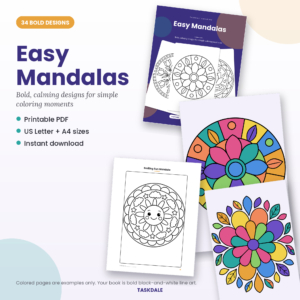
Easy Mandala Coloring Book
Price: $3.49 | Best for: confident beginners who like patterns
Easy Mandala has 34 bold mandalas with open patterns and thick outlines, including Petal Sun, Daisy Circle, Starburst and Butterfly Wings. Each design sits on its own page in US Letter and A4 PDFs, with a clickable contents page and picture gallery. Start with Petal Sun and try shading the inner edge of each petal.
Intermediate: where structure helps you grow
The jump from beginner to intermediate is where most people get stuck. Pages suddenly have hundreds of areas, and choosing colors for all of them can feel like a test. Structure helps a lot here. Color by number is a useful bridge, because it lets you handle more detail while someone else makes the color decisions. You learn how a well-planned palette looks, and you can borrow those ideas for free coloring later.

Hue and Harmony Color by Number
Price: $4.99 | Best for: colorists stepping up a level
Hue & Harmony has 30 color by number designs split into 10 Easy, 10 Medium and 10 Advanced, with a color key of named swatches on every page and a full-color Finished Gallery at the back. Easy pages use five to seven colors, Advanced pages use up to fourteen. It prints on US Letter or A4. Do one Easy page, then go straight to a Medium one.
A set with built-in levels is handy for testing yourself. If a Medium page feels comfortable, you are an intermediate colorist. If it feels like hard work, stay with Easy for another few weeks. No shame either way.
Advanced: detail you can sink into
Advanced sheets have fine lines, tiny areas and plenty of texture. You will need sharp pencils, good light and patience across more than one sitting. The reward is a page that pulls you in so completely that an hour disappears.
A good advanced sheet still has a clear structure underneath the detail. Look for larger shapes that hold the small ones, like a gear made of teeth or a fern made of leaflets. That structure lets you plan colors in families instead of cell by cell.
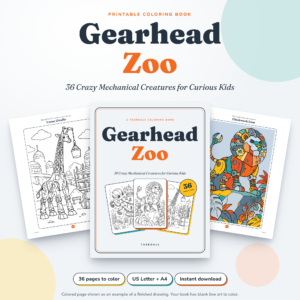
Gearhead Zoo Coloring Book
Price: $3.99 | Best for: detail lovers who enjoy fiddly work
Gearhead Zoo has 36 full-page robot animals built from gears, springs, pipes and panels, such as Clockwork Lion, Toaster Rhino and Airship Whale. There are plenty of small bolts and rivets to fill. The download includes US Letter and A4 PDFs, single PNG pages and a 9-page user guide. Try metallic gel pens on the gears of Clockwork Lion.
Reading a listing or preview for skill clues
You often have to judge a sheet before you print it. These clues help.
- Title words. Bold, easy, simple and big shapes point to beginner. Intricate, detailed and fine line point to advanced.
- Page count versus price. Detailed pages take much longer to draw, so a large book of very cheap pages is often simpler than it claims.
- Zoomed previews. If the listing shows only tiny thumbnails, look for a zoomed page. You want to see actual line thickness.
- Who it is for. Listings that mention seniors, beginners or low vision are almost always beginner-friendly. Mentions of hidden objects or many hours usually mean advanced.
- Finished examples. A sample colored by a skilled artist can make a simple page look advanced. Look at the line art, not the sample.
Our list of the best coloring books for adults notes the skill level for each pick, which saves some of this detective work.
Skill level is not only about detail
Two people with the same experience can need different sheets. Several things beyond skill change the right level for you.
Your tools
Chunky markers suit beginner sheets. Fine-tip pens and sharp pencils make advanced sheets possible. If you only own a basic set of thick markers, choose sheets with larger spaces until you add finer tools.
Paper or screen
On a tablet, you can zoom in, so an advanced page can feel like an intermediate one. If you color digitally, our guide to the best coloring book app for iPad covers apps that handle detailed pages well.
Time and energy
A nurse finishing a night shift and a retired teacher with a free afternoon might have the same skill, but they need different pages on the day. Keep sheets at two levels printed so you can match the page to your energy.
Three colorists, three choices
Here is how the scale might work for three different kinds of colorist.
A 58-year-old brand new to coloring
She scores one on the self-test and wears reading glasses. She starts with bold cozy pages, prints them on plain paper and uses a basic set of 24 pencils. After three weeks, she finishes a page in thirty minutes and starts to wonder what is next. Her next step is a bold mandala, not a detailed garden.
A 34-year-old who colored as a teenager
He scores four. He blends without thinking and gets bored on bold pages, but he has not colored in years and his pencils are old. He picks intermediate color by number pages for the first month to warm up, then buys a sharpener and moves on to free coloring of detailed scenes.
A 71-year-old lifelong crafter
She scores six, but her hands tire after an hour. She keeps advanced pages for Sunday afternoons and bold pages for weeknights. Two levels, both right, chosen by energy rather than ego.
Notice that none of them picks by skill alone. Each one matches the sheet to their eyes, hands, tools and time as well.
Printing at the right size for your level
Print size changes difficulty more than people realize. A page printed at 90 percent to fit odd margins is a little harder than the artist meant. A page enlarged from US Letter to 11 by 17 inches at a print shop is noticeably easier, because every space grows. If an advanced page tempts you but feels too tight, enlarge it rather than skip it. And always pick the PDF that matches your paper, US Letter or A4, so nothing gets squeezed.
Moving up a level without the frustration
Most people jump too far, hit a wall and quit. A gentle step plan works better.
- Finish three pages at your current level. Notice when they start to feel easy.
- Try one page a level up, on a weekend. Not on a tired weeknight.
- Color only the biggest shapes in the first session. Leave the fine work for later.
- Go back down for a page or two. Mixing levels keeps the hobby relaxing.
- Repeat until the higher level feels normal. For many people that takes a month or so.
The moment you finish your first page at a new level is worth noticing. It is a small, real bit of progress, and you made it on your own.
Common mistakes when choosing by skill
- Buying for the person you want to be. Pick for how you color now. The advanced book can wait.
- Judging by the colored sample. Check the black and white line art.
- Ignoring paper size. A detailed page shrunk to fit the wrong paper size becomes a page a level harder.
- Sticking with one level forever. Comfort is good. Boredom is not. Try a step up every few weeks.
Frequently asked questions
What coloring sheets are best for adult beginners?
Sheets with thick outlines, large shapes and one main subject. Cozy scenes, simple flowers and bold mandalas are good first choices.
How do I know if a coloring page is too hard for me?
If you feel tense, squint often, or want to stop after ten minutes, it is probably too detailed for now. Try a page one level down.
Is color by number good for building skill?
Yes. It lets you handle more detail without stressing over color choices, and you see how good palettes work.
Are mandalas beginner or advanced?
Both. Bold mandalas suit beginners, while mandalas with hundreds of tiny cells are firmly advanced. Check the size of the smallest shapes.
How long should I stay at one skill level?
Until pages feel easy and slightly dull. For most people that is three to six weeks of regular coloring, but there is no deadline.
Can seniors use advanced coloring sheets?
Many can and do. Eyesight and hand comfort matter more than age. Printing a page larger or coloring on a tablet can help. For more free and paid options, see our guide to coloring pages for adults.
Your next step
Take the six-question self-test above and note your level. Then print one sheet at that level and one a step up, and color the easier one first tonight. If you are between levels, download Hue & Harmony and use its Easy, Medium and Advanced pages to find your fit.