The 50 30 20 rule fits on a sticky note. Take your monthly take-home pay. Put about half towards the things you must pay, about 30% towards the things you enjoy, and 20% towards savings and paying off debt. That is the whole rule. Everything else is detail.
This explainer is for anyone who has heard of the 50 30 20 budget and wants it in plain words, without jargon or a finance degree. You will see exactly how to work out your three numbers, what belongs in each bucket (including the grey areas that trip people up), worked examples at three different incomes, how to set the split up on payday, and what to do when your needs alone eat 65% of your pay. At the end, there are a few tools that do the percentages for you.
Quick picks: tools that track the 50 30 20 split
| Product | Best for | Price | Link |
|---|---|---|---|
| Sagebloom 50/30/20 Budget Planner | A spreadsheet built around the rule | $14.99 | View |
| Ultimate Annual Budget Spreadsheet | A full-year budget with a 50/30/20 dashboard | $6.00 | View |
| Petalwise Budget Planner | Handwriting your budget on a tablet or paper | $3.20 | View |
The rule in one minute
Here are the three buckets, said as simply as possible:
- 50% Needs. Things you would still have to pay if you lost your job tomorrow. Rent, utilities, basic groceries, insurance, minimum loan payments, getting to work.
- 30% Wants. Things that make life nicer but are optional. Eating out, streaming, hobbies, holidays, new clothes beyond the basics, the upgrade to a bigger phone plan.
- 20% Savings and debt. Money for your future self. Emergency fund, retirement, a house deposit, and any debt payments above the minimum.
The percentages are guides, not laws. Think of them as lane markings on a road. Drifting a little is fine. Living in the wrong lane all month is the problem.
How to work out your three numbers
Use take-home pay, the amount that actually lands in your bank after tax and workplace deductions. Not your salary. This catches out more people than anything else.
- Find your monthly take-home. If you are paid every two weeks, multiply one paycheck by 26 and divide by 12. A $1,750 biweekly check gives $3,792 a month.
- Multiply by 0.5 for needs. $3,792 x 0.5 = $1,896.
- Multiply by 0.3 for wants. $3,792 x 0.3 = $1,138.
- Multiply by 0.2 for savings and debt. $3,792 x 0.2 = $758.
One small note. If money is taken from your pay for a workplace retirement plan before it reaches your account, many people count it as part of their 20%. That is reasonable. Just do not count it twice.
Worked examples at three incomes
Seeing the rule at different pay levels shows where it fits easily and where it pinches.
| Monthly take-home | Needs (50%) | Wants (30%) | Savings and debt (20%) |
|---|---|---|---|
| $2,600 | $1,300 | $780 | $520 |
| $4,000 | $2,000 | $1,200 | $800 |
| $6,500 | $3,250 | $1,950 | $1,300 |
At $2,600 a month
A recent graduate sharing an apartment. Rent share $780, utilities $90, phone $50, groceries $280, bus pass $60, student loan minimum $40. Total needs: $1,300 exactly. Tight, but it fits. In a city where a room costs $1,100, it would not.
At $4,000 a month
A single parent with one child. Rent $1,250, utilities $170, groceries $420, car insurance and fuel $260, phone $60. Needs come to $2,160, which is 54%. A little over. Trimming wants to 26% keeps savings at a full 20%.
At $6,500 a month
A couple with no kids. Mortgage $1,900, utilities $220, groceries $650, two cars $480. Needs: $3,250. Right on target, with $1,300 a month going to savings and an extra car loan payment. At this level, the 20% often grows to 25% or more without much pain.
Needs or wants? The grey areas
Most of the confusion with the 50 30 20 rule is not math. It is deciding which bucket things belong in. A good test: if you cut it to the cheapest version that still works, the cheap version is a need and the rest is a want.
| Item | Need part | Want part |
|---|---|---|
| Groceries | Basic food for the week | Fancy coffee beans, snacks, ready meals |
| Phone | A basic plan | Unlimited data, the latest handset |
| Car | Reliable transport to work | The bigger payment on a nicer model |
| Clothes | Work shoes, a winter coat | Style updates |
| Gym | Usually a want | Unless prescribed for health |
| Internet | Basic speed if you work from home | Top-tier speed for gaming |
You do not have to split every receipt in two. Just be honest at the plan stage. If your phone bill is $95 and a basic plan would be $35, count $35 as a need and $60 as a want. It is a small exercise that often shows exactly where the money slips.
Setting up the split on payday
The easiest way to stick to 50 30 20 is to stop relying on willpower. Let your bank do the sorting the moment your pay lands.
A simple setup uses three places for money:
- Bills account. Your main checking account. Needs money stays here, and rent, utilities and insurance come out by automatic payment.
- Spending account or card. Each payday, move your wants amount here. When it runs low, the wants are done until next payday. No spreadsheet needed to know where you stand.
- Savings account. Set an automatic transfer for your 20% on the day after payday, before you have a chance to spend it.
Take the $3,792 example. On payday, $1,138 of the monthly wants (or half that per biweekly check) moves to the spending account and $758 a month goes to savings. What remains covers needs. After two or three paydays, the system runs itself, and checking your spending account balance tells you everything you need to know about the wants bucket.
When your needs are more than 50%
For a lot of households, especially renters in expensive cities or anyone on a lower income, needs alone come to 60% or 70%. That does not mean the rule is useless. It means you adjust it.
- Shrink wants first. If needs take 60%, a 60/20/20 split still keeps savings healthy.
- Keep some savings, even if small. A 70/20/10 split is still a real plan. Ten percent of $2,600 is $260 a month, or $3,120 in a year.
- Look for one big lever. Rent, car and insurance usually dwarf everything else. A roommate, a cheaper car at the next change or a shopped-around insurance quote can move needs by 5% in one step.
- Revisit at every pay rise. Put at least half of any raise into savings, and the ratio improves without you feeling poorer.
Our longer piece on whether the 50/30/20 budget works on a real income looks at this in more depth, with cost-of-living examples.
Tracking the split in a spreadsheet
The rule is easy to set up and easy to forget. In month one you know your three numbers. By month three, nobody is checking whether wants are at 30% or creeping towards 41%. That is where a tracker helps. You tag each purchase as a need, want or saving, and the sheet shows your real split next to the target.
The first time you see your actual numbers, expect a surprise. Most people find wants running higher than they guessed, usually through small things: takeaway coffee, delivery fees, subscriptions.
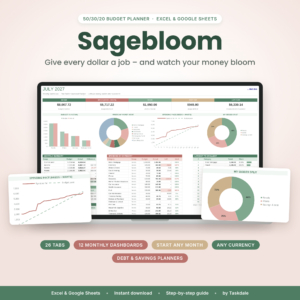
Sagebloom 50/30/20 Budget Planner
Price: $14.99 | Best for: anyone following the 50 30 20 rule
Sagebloom is a 50/30/20 budget spreadsheet for Excel and Google Sheets with 26 connected tabs, all fed from a single transactions list. A 50/30/20 dashboard shows your real split beside your goal with plain-English tips when a bucket drifts, and you can switch to 60/20/20 or 70/20/10 in Settings. It also has monthly dashboards, a bill calendar, debt payoff, sinking funds and net worth. Set your ratio and income first, then log a week of spending.
After a month, compare your actual split with the target. If wants hit 38%, you now know where the extra 8% went, and you can decide whether it was worth it.
Using the rule across a whole year
Monthly splits wobble. December wants might hit 45% with gifts and parties. A quiet February might land at 20%. That is fine as long as the year averages out. Looking at the full year stops one expensive month from making you feel like you have failed.
A yearly view also shows the bigger pattern. If savings hit 20% in nine months out of twelve, you are doing well. If they only hit it twice, the plan needs a nudge: maybe a smaller wants target or an automatic transfer on payday.
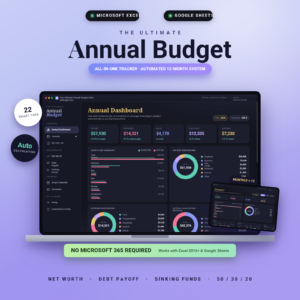
Ultimate Annual Budget Spreadsheet
Price: $6.00 | Best for: seeing the split across twelve months
This annual budget workbook has 22 tabs, including an annual dashboard, 12 monthly dashboards with expected versus actual, a 50/30/20 dashboard showing your needs, wants and savings split, net worth, sinking funds and a debt payoff calculator. It works in Excel 2016 or later, Google Sheets and LibreOffice, and you only type in the gold cells. Set up your categories once, tag each as need, want or saving, and the split builds itself.
A pen-and-paper version
You do not need a spreadsheet at all. The 50 30 20 rule is one of the easiest budgets to run on paper, because there are only three numbers to watch. Write them at the top of a monthly page. Below, list needs, then wants, then savings. Each week, add up what went into each bucket and write the running total beside the target.
A simple trick: draw three bars at the top of the page and color in each one as the month goes on. When the wants bar is three-quarters full by the 15th, you see it at a glance. There is something quietly satisfying about that.
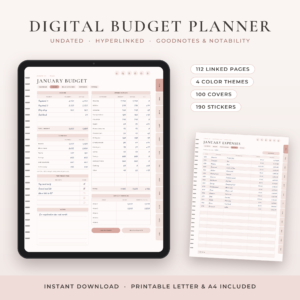
Petalwise Budget Planner
Price: $3.20 | Best for: tablet and paper budgeters
Petalwise is an undated digital budget planner with 112 hyperlinked pages for GoodNotes, Notability, Noteshelf and Xodo, plus a printable edition in US Letter and A4. Each month has calendar, budget, bills and savings, expenses and review pages, with color-in progress grids for savings and debt. Write your three 50 30 20 targets at the top of each month’s budget page and fill in the grids as you go.
Mistakes people make with 50 30 20
The rule is simple, which is exactly why small slips go unnoticed for months. These are the common ones.
Calling wants needs
The premium cable package becomes a need because “we always watch it”. Be strict at the planning stage, even if you keep paying for it. Calling it a want is not a judgment. It is just honest bookkeeping.
Leaving irregular costs out
Car registration, a yearly software renewal, holiday gifts. If they are not in the plan, they land as a surprise and blow up one month’s split. Divide them by twelve and put them in the right bucket each month.
Spending the 20% last
If savings get whatever is left at the end of the month, they usually get nothing. Move the 20% first, on payday, and live on the rest.
Giving up after one bad month
A month at 58/35/7 is not a failure. It is information. Look at what pushed it, and aim for a better split next month.
50 30 20 or zero-based: which suits you?
The two methods are often compared. They are not rivals so much as two levels of detail.
- 50 30 20 works in three big buckets. It is quick to set up, quick to check and forgiving. It suits people who want a sense of balance without tracking twenty categories.
- Zero-based gives every single dollar a named job, down to the $12 for a birthday card. It suits people who want tight control, or who are paying off debt fast.
Plenty of people start with 50 30 20, then move to a more detailed plan once the habit sticks. Others do the reverse after a year of detailed tracking and want something lighter. If you want to compare, our guide to the zero-based budget explains the detailed approach in full.
Frequently asked questions
Is the 50 30 20 rule based on gross or net income?
Net income, the take-home amount after tax and deductions. Using gross pay makes every bucket look bigger than the money you can actually spend.
Does debt go in needs or savings?
Minimum payments are needs, because you have to make them. Anything you pay above the minimum counts towards the 20% savings and debt bucket.
Is rent a need or a want in the 50 30 20 rule?
Rent is a need. If you chose a place well above what you need, some people count the extra as a want, but most simply put all of it in needs.
What if I cannot save 20%?
Save what you can and adjust the split, for example 60/30/10 or 70/20/10. Even 5% builds a buffer, and you can raise it as income grows or costs fall.
Is 50 30 20 good for beginners?
Yes. It is one of the simplest budgets to start with because you only watch three numbers. Many people use it as a first step before trying a more detailed method.
Your next step
Find your monthly take-home pay and multiply it by 0.5, 0.3 and 0.2. Write those three numbers somewhere you will see them every day. Then, to see how your real spending compares, set up the Sagebloom 50/30/20 Budget Planner and log one week of purchases.