A master budget is one plan that ties your whole year together: what you expect to sell, what it will cost to make or deliver, what you spend to keep the doors open, when cash actually moves, and what is left for you. Big companies build them across dozens of spreadsheets. A small business can do the same job in one workbook, in an afternoon, and it is one of the most useful afternoons an owner can spend.
This guide is for owners of small shops, studios, makers, service businesses and solo operators who want a clear plan for next year without hiring a finance team. It walks through each piece of a master budget template for small businesses in the order you should build it, with a full worked example from a two-person product business. You will also see how to plan your own pay, how to review the budget each month, and the mistakes that trip up most first attempts.
Quick picks: budget templates for owners
| Product | Best for | Price | Link |
|---|---|---|---|
| Orchid Business Hub | Business budget, P&L, goals and dashboard in one workbook | $6.99 | View |
| Budget Planner Spreadsheet for Excel and Google Sheets | Owners with uneven pay planning their personal side | $2.00 | View |
| Ultimate Annual Budget Spreadsheet | A 12-month personal budget alongside the business | $6.00 | View |
| Budget Planner Spreadsheet for Google Sheets | Owners who pay themselves on a set schedule | $26.00 | View |
What a master budget is, in small business terms
In accounting textbooks, a master budget is a stack of smaller budgets that feed each other: sales, production, materials, labor, overheads, cash, a budgeted income statement and a budgeted balance sheet. That is a lot of paperwork for a florist or a two-person web studio.
The small business version keeps the idea and drops the bulk. You still plan each piece. You just do it on a handful of tabs, with simple monthly columns, and you skip anything that does not change a decision. For most small firms, five pieces cover it.
- Sales budget. What you expect to bring in, month by month.
- Direct costs. Materials, stock, packaging, shipping, contractor time: costs that rise and fall with sales.
- Operating expenses. Rent, software, insurance, marketing, wages: costs you carry whatever sales do.
- Cash budget. When money actually lands and leaves, which is rarely the same month you earn or owe it.
- Budgeted profit and owner pay. What is left, what you set aside for tax, and what you can safely pay yourself.
Build them in that order. Each one depends on the one before it. A cash plan made before you know your sales pattern is just a guess with a spreadsheet around it.
Step one: build the sales budget first
Everything else hangs off sales, so spend the most care here. If you have a year of history, start with last year’s sales by month. If you are new, build from the ground up: how many customers or orders you can realistically handle each month, multiplied by your average price.
Units times price, by month
A dog groomer doing 14 grooms a day, five days a week, at an average of $70 is looking at roughly $21,000 a month at full capacity. Nobody runs at full capacity every month, so knock it back to a realistic level, maybe 75 to 80 percent, then adjust for the slow and busy seasons you already know about.
Seasons matter more than growth
Owners love to add a growth percentage, and that is fine. But for most small businesses, the shape of the year matters far more than a 10 percent bump. A garden center lives on spring. A gift shop lives on November and December. A tax preparer lives on February to April. Get the shape right first. Then add modest growth if you have a specific reason to expect it, such as a new product line or a second location.
Write down your assumptions
Next to each month, jot why you chose that number. “Last year plus 5 percent.” “Two weddings booked already.” “Market season starts.” When actual sales come in different, these notes tell you whether the plan was wrong or the month was strange. That saves a lot of second-guessing in June.
Step two: direct costs and operating expenses
Now split your costs into the two groups that behave differently.
Direct costs move with sales
These are the costs of making or delivering what you sell. For a product business: materials, packaging, shipping, card processing fees. For a service business: subcontractor hours, travel to jobs, supplies used per job. Express them as a share of sales where you can. If a candle costs $4.50 in wax, jar, wick and label and sells for $15, materials run 30 percent of sales. Then your direct cost budget simply follows your sales budget, month by month.
Operating expenses stay put
These are the costs of being open. Rent, utilities, insurance, software, phone, accounting fees, marketing, any regular wages. List each with its monthly amount. Watch for the yearly ones: insurance paid annually, a trade show fee, a domain renewal. Put them in the month they hit, not spread evenly, because the cash budget in step three needs to see them land.
A workbook that links income, expenses and budget to a monthly profit and loss means you only type each number once, and the totals stay honest.
Orchid Business Hub
Price: $6.99 | Best for: small business owners and freelancers
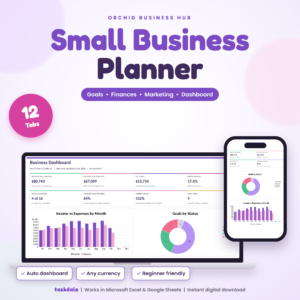
Orchid Business Hub is a 12-tab small business planner for Excel and Google Sheets. Income and expenses feed a monthly profit and loss, which feeds the budget check and a dashboard showing revenue, expenses, net profit and margin, with goals, tasks and marketing campaigns alongside. It arrives blank, so start by entering your expense categories and monthly budget amounts from this step.
Step three: the cash budget, where timing bites
Profit and cash are not the same thing, and the gap between them sinks more small businesses than bad products do. You can be profitable on paper and still unable to pay rent on the 1st.
The cash budget asks one question for every month: how much money will be in the bank at the end? Start with the opening balance. Add cash you will actually collect that month. Subtract cash you will actually pay out. The result becomes next month’s opening balance.
What shifts the timing
- Customers who pay later. If clients pay invoices in 30 days, March’s sales arrive in April. Clear, prompt invoices help, and our guide to choosing an invoice template in Word, Excel or PDF covers the basics.
- Stock bought ahead. Seasonal businesses buy inventory months before they sell it.
- Yearly bills. Insurance, licenses and annual software land in one month.
- Equipment purchases. A new oven or laptop is cash out now, even though it is used for years.
- Tax payments. Quarterly estimated payments leave in set months.
Find your lowest month. That is the number to watch. If the cash budget shows the bank dipping below about one month of operating expenses at any point, plan for it now: build a reserve, ask a supplier for later terms, or move a purchase.
Worked example: a two-person candle business
Here is a full year for a small candle maker that sells online and at weekend markets. Two owners, one part-time helper in the holiday rush.
| Line | Q1 | Q2 | Q3 | Q4 | Year |
|---|---|---|---|---|---|
| Sales | $18,000 | $22,000 | $20,000 | $40,000 | $100,000 |
| Materials (30%) | $5,400 | $6,600 | $6,000 | $12,000 | $30,000 |
| Packaging and shipping (10%) | $1,800 | $2,200 | $2,000 | $4,000 | $10,000 |
| Studio rent | $2,700 | $2,700 | $2,700 | $2,700 | $10,800 |
| Marketing | $1,500 | $1,500 | $1,500 | $1,500 | $6,000 |
| Software, website, insurance | $1,650 | $450 | $450 | $450 | $3,000 |
| Market stall fees | $0 | $1,000 | $1,000 | $1,000 | $3,000 |
| Part-time helper | $0 | $0 | $0 | $6,000 | $6,000 |
| Profit before owner pay | $4,950 | $7,550 | $6,350 | $12,350 | $31,200 |
On paper, every quarter is profitable. But look at the cash. In September they buy $9,000 of wax, jars and boxes ahead of the holiday rush, while September sales are only about $7,000. Add a $2,400 wax melter they plan to buy that month, and the bank balance drops sharply right before their best season. Without the cash budget, that dip would have arrived as a nasty surprise. With it, they kept $8,000 in reserve from the spring and sailed through.
Of the $31,200 profit, less the $2,400 melter, they plan $1,800 a month in owner pay, or $21,600 for the year. The remaining $7,200 goes to a tax reserve and buffer. Their accountant confirmed the tax set-aside rate for their situation. That step matters, because rates vary a lot by location and business structure.
Paying yourself from the master budget
The last line of a small business master budget is the one owners skip most: what you take home. Many owners pay themselves whatever is left in the account each month. That makes personal life feel like a rollercoaster and hides whether the business really supports you.
A steadier approach is to set a fixed monthly owner pay from the budgeted profit, after tax set-aside and a reserve. In good months, extra profit builds the reserve. In slow months, the reserve covers your pay. Your household gets a predictable income, just like a salary.
Then budget your personal side around that number, kept completely separate from the business. A personal budget that handles uneven or irregular pay periods helps if your draw dates move around.
Budget Planner Spreadsheet for Excel and Google Sheets
Price: $2.00 | Best for: freelancers and owners with uneven income
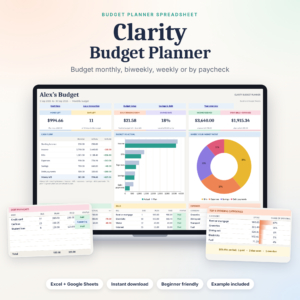
This budget planner works in Excel and Google Sheets for monthly, weekly, biweekly or payday-to-payday budgets: change one date and you move to the next period. You log everything on one Transactions sheet, and the dashboard shows money left, days left, bills due and a daily spending room figure, with savings goals and snowball or avalanche debt payoff. Set your owner pay as the income line, then plan household bills around it.
If you prefer the whole year laid out at once on the personal side, the Ultimate Annual Budget Spreadsheet in the quick picks table gives 12 monthly dashboards and a sinking funds tracker for the irregular costs that come with self-employment.
Reviewing the budget each month, and the common mistakes
A master budget earns its keep in the monthly review. Block 45 minutes in the first week of each month and compare budget with actual for every line. Ask three questions: Where did we land? Why? What changes for next month? Write the answers down, briefly.
Expect differences. A budget is a forecast, not a promise. The goal is to spot trends early, such as materials creeping from 30 to 34 percent of sales, while there is still time to raise prices or switch suppliers. For the bigger annual planning session, our guide to planning with an annual budget template covers how to roll this year’s actuals into next year’s plan.
Mistakes that weaken a small business budget
- Starting with costs instead of sales. Costs follow sales. Build sales first.
- Spreading yearly bills evenly in the cash plan. The insurance does not arrive in twelve pieces. Put it in its real month.
- Treating profit as cash. Check the cash budget for your lowest month.
- Forgetting owner pay. If the budget only works when you earn nothing, it does not work.
- Making it once and filing it. A budget that is never compared with actuals is just a wish list.
- Mixing personal and business money. Separate accounts make every number clearer.
Frequently asked questions
What is included in a master budget for a small business?
A sales budget, direct costs, operating expenses, a cash budget and a budgeted profit with owner pay and tax set-aside. Larger firms add production and balance sheet budgets.
Can I build a master budget in Excel or Google Sheets?
Yes. One workbook with a tab for each piece and monthly columns is plenty for most small businesses. Link the tabs so sales flow into costs and profit automatically.
How often should a small business update its budget?
Compare budget with actual every month. Rebuild the full master budget once a year, or sooner after a big change like a new location or a major client loss.
What is the difference between a cash budget and a profit budget?
A profit budget shows what you earn and owe in each month. A cash budget shows when money actually lands in and leaves the bank. The two often differ because of payment terms and stock bought ahead.
How much should I pay myself from my small business?
Start from budgeted profit, subtract a tax set-aside and a reserve, and pay a steady amount from what is left. Agree the tax rate with an accountant for your location and structure.
Your next step
Open a blank sheet and write your sales for each month of last year, or your best honest guess if you are new. Next to each month, write one sentence on why. That sales line is the backbone of everything else. When you are ready to tie it to costs, profit and a dashboard, set it up in the Orchid Business Hub and do your first monthly review next month.