Kids who love dinosaurs hit a point where cartoon dinos stop being enough. They want the T. rex to look like the one in the museum. They want to know how long it was, what it ate and whether it really had feathers. Realistic dinosaur coloring book pages with dinosaur facts meet them right there: accurate drawings to color, with true information beside each one.
This guide is for parents, teachers and older dinosaur fans, from about age 7 to adult. You will learn what “realistic” really means in dinosaur art, how to color a dinosaur so it looks like a living animal, how to spot shaky facts, and how to turn a detailed page into a small science lesson. Two printable sets on Taskdale fit the bill, and you will see where each one helps.
Quick picks for realistic pages with real facts
| Product | Best for | Price | Link |
|---|---|---|---|
| Roar to Z Dinosaur Coloring Book A to Z with Names and Facts | Checked facts plus detailed prehistoric landscapes | $4.49 | View |
| Gallop Gallery Horse Breeds Coloring Book for Kids and Adults | Animal fans who want realistic portraits and facts | $4.99 | View |
What “realistic” means for a dinosaur page
Nobody has seen a living dinosaur, so realistic does not mean “photo-perfect”. It means drawn the way scientists currently think the animal looked, based on its bones and on close relatives. That picture has changed a lot in the last few decades, and older books often show dinosaurs that look outdated now.
A few things to look for in a realistic page:
- T. rex standing level. Older art shows it upright like a kangaroo with its tail on the ground. Today it is drawn with the body roughly horizontal and the tail held out behind for balance.
- Feathers on raptors. Velociraptor is now shown with feathers, because fossils of close relatives show them and Velociraptor arm bones have small bumps where feathers attached.
- Correct size for Velociraptor. It was roughly the size of a large turkey, not the human-height monster from films.
- Tails off the ground. Most dinosaurs held their tails up. A dragging tail is a sign of very old reference art.
- Believable plants. Ferns, cycads, conifers and, later in the Cretaceous, early flowering plants. No wide grassy meadows of the kind we see today.
Older children love these “spot the mistake” details. Show them a vintage dinosaur picture next to a modern page and ask them to find three differences. It is a small lesson in how science changes when new evidence turns up, and kids find it oddly thrilling that the experts changed their minds.
Facts kids can trust
A page with facts is only useful if the facts hold up. Children repeat dinosaur facts with total confidence, at school, at dinner, to strangers on the bus. A wrong one travels far.
Here is a small table of safe, rounded facts for some of the most popular dinosaurs. Sizes vary between sources, so “about” is the honest word.
| Dinosaur | Lived | Where | Size, roughly |
|---|---|---|---|
| Tyrannosaurus rex | Late Cretaceous, about 68 to 66 million years ago | Western North America | About 12 m long |
| Triceratops | Late Cretaceous, about 68 to 66 million years ago | Western North America | About 8 to 9 m long |
| Stegosaurus | Late Jurassic, about 155 to 150 million years ago | Western North America | About 9 m long |
| Velociraptor | Late Cretaceous, about 75 to 71 million years ago | Mongolia and China | About 2 m long, mostly tail |
| Brachiosaurus | Late Jurassic, about 154 to 153 million years ago | Western North America | Over 20 m long |
One fact that always lands: Stegosaurus lived further back in time from T. rex than T. rex lives from us. Tens of millions of years separate them. Children find that hard to believe, then repeat it to everyone.
How to check a fact
When a page claims something surprising, look it up on a natural history museum website. Museum pages are written by people who work with the fossils. If a fact appears only on one random site, treat it as a maybe.
A dinosaur book built around checked facts
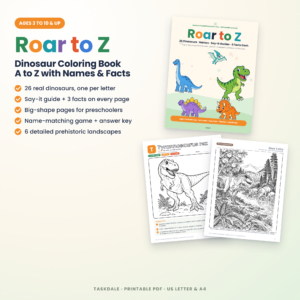
The most useful realistic pages come with the facts on the same sheet, so a child reads and colors in one go. Roar to Z does this for 26 dinosaurs and prehistoric reptiles, with three facts each covering when and where it lived, how big it was and one fun fact. The ages and sizes are rounded and checked against museum and scientific sources.
For realistic coloring specifically, the six detailed prehistoric landscapes are the pages to look at. They include a Late Cretaceous river valley with T. rex and Triceratops, a Jurassic floodplain with Brachiosaurus and Stegosaurus, a Cretaceous sea with Mosasaurus and ammonites, pterosaur cliffs and a Maiasaura nesting colony. Each has a short, accurate caption.
Roar to Z Dinosaur Coloring Book
Price: $4.49 | Best for: Fact lovers aged 7 to adult
A 58-page printable PDF in US Letter and A4. Older kids and adults get 6 detailed prehistoric landscapes with captions, 26 A to Z dinosaur pages with three facts each, a timeline, a size chart that compares lengths with a school bus and a child, and 26 cut-out fact cards. Start with the Late Cretaceous river valley, then read the timeline so the scene sits in its right place in time.
Honest note: there are six detailed landscapes, not sixty. The A to Z pages are clear, friendly illustrations rather than museum paintings. For a fact-hungry eight-year-old, that mix is about right.
How to color a dinosaur so it looks real
A realistic drawing can still end up looking like a toy if the colors are flat. A few tricks borrowed from wildlife art make a big difference.
Countershading
Many animals are darker on the back and lighter on the belly. It helps them blend in. Color the top of the dinosaur in a darker shade and fade to a paler one underneath. Instantly it looks rounder and more alive.
Borrow patterns from living animals
Big plant eaters can take the muted grays and browns of elephants and rhinos. Smaller hunters can borrow stripes from tigers or spots from leopards. Feathered dinosaurs can look like birds: a hawk’s barred feathers, a pheasant’s speckles.
Match the setting
A dinosaur in a forest scene can take greens and browns. One on open floodplain can be sandy. Ask: where would this animal hide?
Add light
Pick one side as the sunny side. Leave small white highlights on the eye, the top of the back and the tips of horns on that side. Darken the opposite side a little. Two minutes of work, a big jump in realism.
Remember, nobody knows for sure
For most dinosaurs, skin color is unknown. Scientists have made careful guesses for a few small feathered ones from microscopic pigment structures. So realistic coloring means believable, not proven. A bright blue crest might be wrong. It might also be right.
Coloring a prehistoric landscape, step by step
A full scene with several animals, plants and water can feel daunting. Working in layers, from back to front, keeps it calm.
- Sky first. A pale wash of blue or a warm early-evening yellow. Keep it light so the animals stand out.
- Distant hills or cliffs. Use cooler, grayer colors. Things far away look paler and bluer, which gives the page depth.
- Water. Darker near the banks, lighter in the middle. Leave a few white streaks for ripples.
- Plants. At least three different greens. Ferns in yellow-green, conifers in deep blue-green, cycads somewhere between.
- Animals last. Now the stars of the scene go on top of a finished world. Use your strongest colors here.
A teen or adult working this way usually needs two or three sittings of about 40 minutes each. Pace yourself. Stopping halfway through the plants is fine; the scene waits.
Reading a size chart without getting lost
Numbers like “12 meters” mean little to most children. Comparing a dinosaur to things they already know makes the size click. A school bus is roughly 12 meters long, about the length of a big T. rex. A Velociraptor would stand roughly at the height of a child’s hip. Brachiosaurus was about as long as two school buses parked end to end.
Ask your child to find something at home that is the same size as a small dinosaur. A cat-sized Fruitadens next to the family cat, if you have one, is a great comparison that sticks for years.
Turning a detailed page into a science lesson
A single landscape page can carry a whole lesson for a class of 9-year-olds or a homeschool afternoon. Here is a 45-minute plan.
- Five minutes: read the caption. When is this scene set? Where on the timeline?
- Ten minutes: label the scene. Name every animal and plant you can. Use the fact cards to check.
- Twenty minutes: color with a purpose. Each child picks a camouflage strategy for one animal and explains it.
- Ten minutes: compare. Line the pages up. Whose T. rex would be easiest to spot? Whose would vanish into the ferns?
Then add a quick size activity. Use the size chart, then pace out the length of a T. rex in the playground or the garden. Twelve meters is longer than most children expect, and the gasp when the last pace lands is worth hearing.
Realistic pages for other animal fans
Children who love real facts about dinosaurs often love real facts about living animals too. The habit is the same: an accurate picture, true information, and the satisfaction of coloring it properly. Horses are a common second passion, especially for kids who ride or want to.
Gallop Gallery Horse Breeds Coloring Book
Price: $4.99 | Best for: Animal fans who like real facts
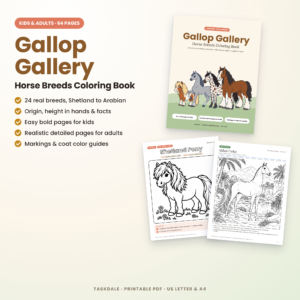
24 real horse breeds, each drawn twice: an easy page with bold outlines and a realistic, detailed portrait for teens and adults. Every breed lists its origin and height in hands, with 2 facts on the kids’ page and 3 deeper facts on the adult page, plus guides to face markings, leg markings and coat colors. Printable PDF in US Letter and A4. Try the coat color guide first, then color one realistic portrait as a true bay or palomino.
For more animal pages across safari, farm, ocean and woodland themes, our guide to animal coloring pages compares several printable sets.
Tools for detailed coloring
- Colored pencils are the best choice for realistic work. They layer, blend and shade far better than markers.
- A white pencil or a white gel pen adds highlights to eyes and scales after coloring.
- A blending stump or a cotton bud softens pencil strokes into smooth skin tones.
- Heavier paper, around 120 gsm, takes several layers of pencil without going shiny or tearing.
- A sharpener with a container. Sharp points make fine detail possible. Blunt ones turn scales into smudges.
Who realistic pages suit, and who they do not
Realistic dinosaur pages suit children from about 7 who read well and ask lots of “why” questions, teenagers who like drawing, and adults who enjoy detailed coloring with a bit of learning mixed in. Grandparents and grandchildren often meet in the middle here, coloring the same scene side by side.
They are a poor fit for most children under 5. Small spaces and fine detail frustrate young hands quickly, and the facts go over their heads. Start little ones on big, friendly shapes and save the realistic scenes for later. If you need free pages to tide a younger sibling over, our roundup of free coloring book PDFs has simpler options.
Mistakes that make realistic pages less useful
- Trusting old art. Upright T. rex and scaly Velociraptor are clues the reference is decades old.
- Mixing time periods without saying so. T. rex and Stegosaurus in one scene is fun, but tell kids they never met.
- Calling every prehistoric reptile a dinosaur. Pterosaurs flew and mosasaurs swam. They were relatives, not dinosaurs.
- Precise numbers presented as certain. “Exactly 12.3 meters” sounds clever and is not how science works. Use “about”.
- Rushing the coloring. Realistic pages reward slow layers. Split one page over two or three sessions.
Frequently asked questions
Did T. rex really have feathers?
Some relatives of T. rex had feathers, but skin impressions from T. rex itself show scaly skin in the places that were preserved. Many artists now draw it mostly scaly.
What is the most accurate way to draw Velociraptor?
Turkey-to-wolf sized, covered in feathers, with wing-like feathered arms and a long stiff tail. Fossil evidence supports feathers.
Are dinosaur facts in coloring books accurate?
Some are, some are not. Look for books that round sizes and dates and say their facts were checked against museum sources.
What age is right for realistic dinosaur coloring pages?
Around 7 and up, including teens and adults. Younger children usually enjoy simpler big-shape pages more.
Did T. rex and Stegosaurus live at the same time?
No. Stegosaurus lived in the Late Jurassic, tens of millions of years before T. rex appeared in the Late Cretaceous.
How do scientists know what color dinosaurs were?
For a few small feathered dinosaurs, they have studied fossilized pigment structures. For most species, color is still unknown.
Your next step
Print one detailed prehistoric scene this weekend, read its caption together, and use the countershading trick on the biggest dinosaur in it. Pace out its length outside afterward. The six landscapes and 78 facts in the Roar to Z Dinosaur Coloring Book give you enough for a month of weekends.