Color by number pictures teach number recognition through a simple loop: see a numeral, hold it in mind, find the same numeral in the key, color. Then do it again. A page with 25 spaces runs that loop 25 times, and the child is having too much fun watching a dragon appear to notice they are practicing.
This guide is for parents, teachers and tutors who want to understand why these pictures work and how to get more out of them. You will see the small skills hiding inside number recognition, which numerals trip children up and why, how to choose pictures that teach well, and a handful of games that turn one page into a week of practice.
Quick picks for number recognition practice
| Product | Best for | Price | Link |
|---|---|---|---|
| Hop to Ten Color by Number for Kids | Learning 1 to 10 in a steady order, ages 3 to 6 | $4.49 | View |
| Crayon Campus Preschool Learning Coloring Worksheets | One page per number from 1 to 20 with ten frames | $4.99 | View |
| Starmane Meadow Unicorn Coloring Book for Kids | Dot-to-dots to 70 and themed color by number | $4.49 | View |
What “number recognition” really means
Recognizing a number sounds like one skill. It is really several small ones stacked together, and a color by number picture practices each of them.
- Seeing the shape. Telling a 3 from an 8 means noticing that the 8 is closed and the 3 is open on the left.
- Naming it. Linking the shape to the spoken word “three”.
- Holding it in mind. Remembering “three” while the eyes travel down to the key.
- Finding a match. Scanning a row of numerals and stopping at the right one.
- Linking it to amount. Knowing that 3 means three things. Pictures can practice this too, if some spaces show dots instead of numerals.
When a child struggles, it helps to know which piece is wobbly. A child who can say “three” when asked but cannot find the 3 in the key needs matching practice, not naming practice.
Why pictures work better than flashcards for many kids
Flashcards drill one skill: naming. They are quick, and some children enjoy them. Many do not. After four cards the eyes wander and the guessing starts.
A color by number picture spreads the same practice across a reason to care. The child wants to see the picture. Each numeral is a step toward that. They will read the number 4 fifteen times on one page without complaint, which is more than most will tolerate from a flashcard stack.
The picture also gives instant feedback. If a child colors a 6 space with the 9 crayon, the dragon’s wing comes out pink instead of green. They often spot it themselves when they compare with the finished picture, and finding your own mistake is a powerful kind of learning.
The order that builds recognition fastest
Children learn numerals faster when they meet a few at a time and in a steady order. A page that throws 1 to 10 at a child who only knows 1 to 3 turns into a guessing game.
- Start with 1 to 5. Five numerals, lots of repetition. Stay here until the child finds each one without hesitation.
- Add 6 to 10 on their own. Pages that use only the bigger numbers give them focused practice before mixing.
- Mix 1 to 10. Now the child must tell all ten apart in one picture. This is the real test.
- Bring in amounts. Ten frames and dot groups link each numeral to a quantity.
A book that follows this order means you do not have to sort free pages by number range yourself. The pictures do the sequencing.
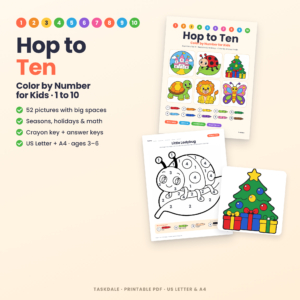
Hop to Ten Color by Number for Kids
Price: $4.49 | Best for: children learning numerals 1 to 10
Fifty-two original pictures that use only the numbers 1 to 10. Part 1 uses 1 to 5, Part 2 uses 6 to 10, and Part 3 mixes all ten, followed by seasonal pages and color by answer sums. Every page has big friendly numbers, a crayon key with color names and a name line, and two Number Practice pages add tracing and ten frames. Full-color answer keys, US Letter and A4 PDFs. Begin with Part 1 and the ladybug.
The numerals that cause the most trouble
Some numerals are easy to confuse, and color by number pictures are a great place to sort them out. Watch for these pairs.
6 and 9
The same shape, upside down. Children often mix them up well into first grade. Point out where the circle sits: at the bottom for 6, at the top for 9. A little rhyme helps some kids: “6 sits down, 9 stands tall.”
2 and 5
Both have a flat line and a curve, just flipped. Trace each with a finger before coloring and say the direction: “2 curves round then goes flat. 5 goes flat, then down, then curves.”
1 and 7
In some fonts a 1 has a little flag that looks like a 7. Good pictures use a simple 1 with no hook. If a page uses a fancy font, circle the 1s in pencil before your child starts.
Reversed numerals
A backwards 3 or 7 in a child’s writing is very common for young children and usually fades with practice. Coloring pages help because the child sees the correct shape again and again without having to produce it.
A small trick: when a child confuses two numerals, pick a page that uses one but not the other. Then a page that uses the other. Then one with both. Three pages, one week, and the pair is usually sorted.
What to look for in a picture that teaches
Not every color by number picture is good for learning numbers. Some are made for fun first and learning second. These features make a picture a better teacher.
- Large, upright numerals. No tiny numbers squeezed sideways into corners.
- A plain, rounded font. Fancy fonts make 1, 4 and 7 harder to tell apart.
- Each numeral used several times. Repetition is the whole point.
- A key with color swatches and words. Children who cannot read yet can still match.
- Unnumbered spaces left white. Fewer distractions, clearer focus.
- A finished picture for checking. Children learn more when they can see their own mistakes.
For more on page design for small hands, our guide to preschool coloring pages with big shapes covers line weight and space size.
Five games that stretch one picture into a week
You do not need a new page every day. One good picture can carry several sessions with a few small twists.
- Number of the day. Monday, color only the 3s. Tuesday, only the 5s. The picture fills in slowly across the week.
- Treasure hunt. Before coloring, the child circles every 7 on the page in pencil and counts how many they found.
- Say it, color it. The child must say each number out loud before coloring its space. Great for children who recognize but do not name.
- Reverse key. You point to a colored space and the child tells you what number was underneath.
- Grown-up mistake. You color one space wrong on purpose. The child plays detective and finds it. They love catching you.
Each game shifts which skill is doing the work. That variety keeps things fresh without needing more paper.
Linking numerals to amounts
Recognizing the shape of 8 is one thing. Knowing that 8 means eight apples is the next step, and it is where real number sense starts.
Pictures that pair numerals with ten frames, dot groups or small sets of objects bridge that gap. A child colors the big 6, colors six boxes in a ten frame, then counts and colors six little ducks. Three ways of seeing six on one page.
A set with one dedicated page per number, from 1 all the way to 20, gives you a full run of these. You can work through one number a day for four weeks, which turns into a gentle, steady routine.
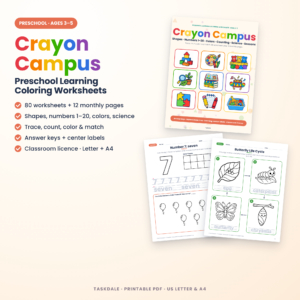
Crayon Campus Preschool Learning Coloring Worksheets
Price: $4.99 | Best for: number of the day routines
Eighty preschool worksheets, including 20 Numbers pages: one for every number from 1 to 20, where children color the big number, fill a ten frame, trace the numeral and number word, then count and color a group of pictures. Other sections cover shapes, counting and math, colors, matching and science, plus 12 monthly pages. US Letter and A4 PDFs with answer keys and a skills checklist. Do one Numbers page a day.
Bigger numbers through dot-to-dots
Once a child knows 1 to 10 well, dot-to-dots carry the same recognition skill into the teens and beyond. Joining 1 to 30 means spotting 14, then 15, then 16, scattered around a page. Children start to see the pattern: the second digit counts up just like 1 to 9 did.
A themed picture at the end makes the effort worth it. Color the finished shape, and you have combined counting order, numeral recognition and pencil control in one quiet page.

Starmane Meadow Unicorn Coloring Book for Kids
Price: $4.49 | Best for: kids ready for bigger numbers
Seventy-eight pages of original unicorn art with a games section that includes six dot-to-dots growing from 1 to 15 up to 1 to 70, four color by number pages, three mazes and a word search, with finished pictures and answer keys. Coloring pages range from chunky preschool unicorns to detailed fantasy scenes. Prints in US Letter or A4. Start with the 1 to 15 star, then work up.
Helping a child who is struggling
Some children take longer, and that is normal. A few changes make pictures easier to use.
- Cut the numbers. Use pages with only two or three numerals for a while. Success matters more than speed.
- Color the key yourself first. Bright swatches next to each numeral make matching easier.
- Use touch. Let the child trace each numeral with a finger before coloring, or make numerals from play dough.
- Keep sessions short. Five minutes of success beats fifteen minutes of frustration.
- Celebrate the small wins. Finding every 2 on a page is worth a high five.
If a child still finds numerals very hard after months of gentle practice, mention it to their teacher. They can look at it with fresh eyes.
Pictures for children learning English
Numerals look the same in most languages, which makes color by number pictures a gentle bridge for children who are new to English. A child from a Spanish-speaking home may already know that 4 means four. What they need is the English word.
Use the picture as a word game. Say “four” each time they color a 4 space, and let them say it in their home language too. Then point to the color word in the key, “blue”, and say it together. After a week, many children are saying both the number and the color in English without being asked.
This works in the other direction as well. An English-speaking child can learn to count to ten in a grandparent’s language with the same page. Grandparents tend to love that, and it turns coloring time into family time.
Tracking progress without tests
A simple chart on the fridge is enough. Write 1 to 10 across the top. Each time the child finds a numeral on a page quickly and without help, they color its box. When every box is colored three times, that set is mastered.
Children love seeing the chart fill up. Parents love seeing exactly which numerals still need work. And nobody has to sit a test. For older kids moving into simple sums, our guide to color by number pages for preschool math practice picks up where this one leaves off.
Common mistakes to avoid
- Too many numerals too soon. Ten numerals on a first page is overwhelming.
- Fancy fonts. They make similar numerals harder to separate.
- Doing it for them. Point and guide, but let the child find the match.
- Skipping the naming. Saying each number out loud doubles the practice.
- Only pictures, never objects. Count real things too, so numerals connect to amounts.
Frequently asked questions
How do color by number pictures help with number recognition?
Children read a numeral, find the same numeral in the key and color, again and again on one page. That repeated matching builds quick, confident recognition.
What age should kids start color by number pictures?
Many children can start around age 3 with pictures that use only 1 to 3 or 1 to 5 and very large spaces.
Why does my child mix up 6 and 9?
They are the same shape turned around, so the mix-up is very common in young children. Point out where the circle sits, and practice with pages that use one before pages that use both.
How many numbers should a beginner’s color by number picture use?
Two to five numerals for beginners. Move to 1 to 10 once the child finds each numeral without help.
Are color by number pictures better than flashcards?
For many children, yes, because the picture gives a reason to keep going and practices matching as well as naming. Some children enjoy both.
How can I tell if my child has mastered a number?
If they find it quickly, name it without prompting and do it correctly on three different pages, it is usually secure.
Your next step
Pick one picture that uses only 1 to 5, play “number of the day” with it across this week, and start a simple 1 to 10 chart on the fridge. When the first five boxes are colored three times, move on to Part 2 of Hop to Ten Color by Number for Kids.