Dinosaur coloring is not only for children. Plenty of adults grew up with a plastic Stegosaurus on the windowsill and never quite let go. Dinosaur coloring pages for adults swap the cartoon grins for river valleys, fern forests and herds moving across a floodplain, and they give a grown-up something to sink into for an evening or three.
This guide is for adult colorers who want prehistoric scenes with depth and detail. You will get pencil techniques for skies, water, foliage and scaly skin, a way to plan a big scene so it does not overwhelm you, honest notes on where detailed dinosaur landscapes come from, and a few calmer adult books for nights when your brain wants something simpler.
Quick picks for adult dinosaur and relaxed coloring
| Product | Best for | Price | Link |
|---|---|---|---|
| Roar to Z Dinosaur Coloring Book A to Z with Names and Facts | Six detailed prehistoric landscapes with captions | $4.49 | View |
| Bold Florals Flower Coloring Book | Practicing plant textures on big, easy shapes | $3.49 | View |
| Kettle & Quilt Cozy Coloring Book | Gentle nights between big projects | $6.99 | View |
What makes a dinosaur page feel grown-up
It is not the dinosaur. A T. rex is a T. rex. What makes an adult page is everything around it.
- A full scene. Foreground, middle ground and background. A river bending away, hills behind, plants up close.
- Several animals at different sizes. A big plant eater in the middle, smaller animals near the water, flying reptiles over cliffs.
- Varied textures. Bark, ferns, water, rock, skin. Each one is a small coloring puzzle.
- A sense of time and place. A caption that says Late Cretaceous or Jurassic floodplain turns a picture into a window.
The good news is that a scene like this rewards slow work. There is no rush. A single landscape can carry you through a week of evenings, and the moment you step back and see a whole prehistoric valley you colored yourself is quietly satisfying.
Where detailed dinosaur landscapes come from
Most dinosaur coloring is aimed at children, so detailed adult landscapes are thinner on the ground than florals or mandalas. Free single pages do turn up on artists’ sites and museum activity pages, but they are scattered and in mixed styles. Adult coloring books that focus entirely on dinosaurs exist too, though many lean toward fantasy dragons more than real prehistoric animals.
One honest option sits inside a family book. Roar to Z is mainly a children’s A to Z dinosaur book, but it includes six detailed prehistoric landscapes meant for older kids, teens and adults: a Late Cretaceous river valley with T. rex and Triceratops, a Jurassic floodplain with Brachiosaurus and Stegosaurus, a Triassic forest edge, a Cretaceous sea with Mosasaurus and ammonites, pterosaur cliffs and a Maiasaura nesting colony. Each has a short, accurate caption.
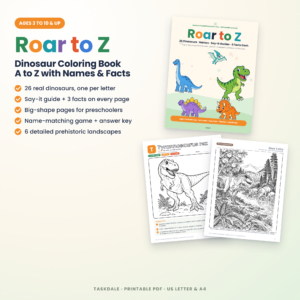
Roar to Z Dinosaur Coloring Book
Price: $4.49 | Best for: Adults who color with kids
A printable PDF in US Letter and A4. For adults, the six detailed prehistoric landscapes are the draw, each with a caption, plus a timeline and size chart for context. The rest of the book is for children, which makes it a good shared buy if there is a young dinosaur fan in the family. Print the Jurassic floodplain on heavier paper and keep a second copy for a grandchild.
If you want sixty adult dinosaur scenes, this is not that. If you want six good ones plus a book to share with a young relative, it fits nicely.
Planning a big scene before you color
A detailed landscape can stall you on page one. Too many choices. Ten minutes of planning saves an hour of hesitation.
- Pick a time of day. Morning light is cool and pale. Midday is bright and flat. Late afternoon is warm and golden. This one decision sets every color that follows.
- Choose five main colors. One sky, two greens, one earth tone, one accent for the animals. Extra shades can come later, but five keeps the scene unified.
- Decide where the light comes from. Mark a tiny sun in the corner of your test sheet. Every shadow falls away from it.
- Test your palette. Color a small swatch of each on a scrap of the same paper. Pencils look different on paper than in the tin.
- Work back to front. Background first, then the middle, then the foreground and animals.
Techniques for skies, water, plants and skin
A sky that glows
Start with your lightest color near the horizon, such as a pale yellow or peach. Layer a light blue from the top down, pressing very gently, and let the two meet in the middle. Go over the blend with a white or colorless blender pencil. The result is a soft gradient rather than stripes.
Water that looks wet
Water takes its color from the sky and the banks. Use the sky color in the middle and darker greens and browns near the edges. Leave thin horizontal white gaps for light on ripples. Under animals standing in water, add a slightly darker, wobbly version of their color for a reflection.
Ferns and foliage
Never color a fern in one flat green. Lay down a mid green, then add a darker green on the side away from the light and a yellow-green on the tips. Three greens on one frond makes it look alive. Vary the greens across the scene, too: blue-greens for conifers, yellow-greens for young ferns.
Scaly skin
For large dinosaurs, color the whole body in a base tone first. Then darken along the back, under the belly and where legs meet the body. Finally, tap tiny dots or short curved strokes of a darker shade over the base to suggest scales. You do not need to draw every scale. The eye fills in the rest.
Rocks and cliffs
Use a warm gray as a base, then add flecks of brown and blue-gray. Darken the cracks and the undersides of ledges. A tiny touch of moss green in shady corners makes rock look damp and old.
Three palettes for a prehistoric world
If choosing colors is the part that freezes you, borrow one of these and adjust as you go.
Humid river morning
Sky in pale peach fading to soft blue. Water in gray-blue with olive edges. Ferns in yellow-green, conifers in deep blue-green. Dinosaurs in warm browns and muted reds. Mist in the background is just the paper left almost white.
Dry floodplain at noon
Sky in clear mid blue. Ground in sandy ochre and pale terracotta. Plants in dusty sage. Long-necked giants in gray and slate, smaller dinosaurs with bold stripes. Short, sharp shadows directly beneath each animal.
Golden evening by the cliffs
Sky in orange, rose and violet. Cliffs in warm gray picking up orange on the sunlit side. Flying reptiles as dark silhouettes against the glow. Water reflecting the sky colors in streaks.
Pick one, write the five main colors on a sticky note, and stick it to the edge of your page. It sounds fussy. It stops you second-guessing every layer.
Creating depth with lighter backgrounds
The single biggest trick for landscapes: things far away look paler, bluer and less detailed. Painters call it atmospheric perspective. You can use it with pencils.
- Color distant hills and trees with lighter pressure and cooler colors.
- Use your strongest, warmest colors only in the foreground.
- Keep the sharpest contrast, darkest darks next to brightest lights, close to the viewer.
- Let small background animals be soft silhouettes rather than detailed figures.
Do this and a flat line drawing suddenly has miles of space in it. It is the moment most adult colorers say “oh” out loud.
Practicing plant textures on simpler pages
Foliage is where most landscape pages go wrong. Too flat, too uniform, too much of one green. Before you tackle a full fern forest, it helps to practice shading leaves and petals on bigger, simpler shapes where mistakes are cheap.
A bold flower page works well for this. Big petals and leaves let you test light-to-dark shading, color layering and blending without squinting. Fifteen minutes on a single tulip teaches you more about the greens you will use for a cycad than an hour of worry.
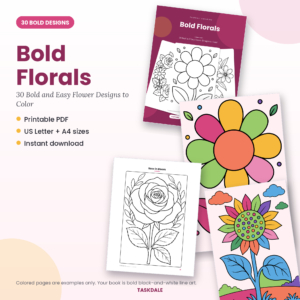
Bold Florals Flower Coloring Book
Price: $3.49 | Best for: Adults practicing shading on big shapes
30 bold and easy flower designs with thick outlines and large petals, as a printable PDF in US Letter and A4. Pages include a rose in bloom, sunflower, tulip pair, peony and a wildflower meadow. Use a single-bloom page as a practice sheet for three-green leaf shading before you start the foliage in a prehistoric scene.
Tools that suit detailed dinosaur scenes
| Tool | Why it helps |
|---|---|
| Soft-core colored pencils | Layer and blend smoothly for skies and skin |
| Harder-core pencils | Keep a sharp point for fern edges and small details |
| Colorless blender pencil | Smooths layers into a single even tone |
| White gel pen | Adds highlights to eyes, water and wet rock at the end |
| Fine black liner | Re-strengthens outlines you have colored over |
| Paper around 120 to 160 gsm | Takes many layers without going shiny or pilling |
For more on choosing adult books with the right level of detail, our ranking of the best coloring books for adults compares bold, medium and intricate styles.
A week with one landscape
Here is how one Late Cretaceous river valley might come together over five evenings of about 40 minutes each.
- Evening 1: plan the palette, color the sky gradient.
- Evening 2: distant hills and far trees, light pressure and cool tones.
- Evening 3: the river, with reflections and white ripple gaps.
- Evening 4: foreground ferns and cycads with three greens each.
- Evening 5: the T. rex and Triceratops, shading, scales and final white highlights.
Five short sessions, no marathon. By Friday you have a finished scene and a week of calm evenings behind you. Many people find that the slow pace is the real point, and our guide to mindfulness coloring pages for adults has simple prompts that pair well with a long project like this.
Nights when you want something gentler
Not every evening suits a fern forest. After a long day, fine detail can feel like more work. On those nights, a bold, cozy page you can finish in one sitting is the better choice, and it keeps the habit going without draining you.
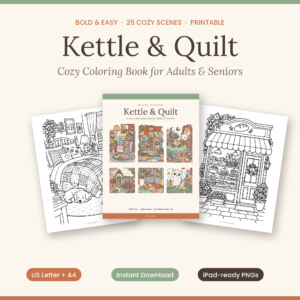
Kettle and Quilt Cozy Coloring Book
Price: $6.99 | Best for: Tired evenings and easy wins
25 original cozy scenes with thick, clean outlines and big open spaces: sleepy cats in armchairs, a corner bakery, seaside cottages and a fireside fox. Print at home in US Letter or A4, and the listing notes it suits tablet colorists too. Keep two or three pages printed beside your landscape, and reach for one when your eyes are tired.
Coloring prehistoric scenes with grandchildren
A detailed dinosaur landscape is one of the few pages a grandparent and a grandchild can both enjoy at once. Split the scene. The adult takes the sky and the water, the child takes the dinosaurs. Or print two copies and color side by side, then compare. Children are often thrilled that a grown-up chose to color dinosaurs too, and you will hear a lot of facts you did not ask for. Enjoy them.
Displaying a finished landscape
A finished scene deserves better than a drawer. A standard 8 by 10 or A4 frame from any homeware shop fits a Letter or A4 page with a small mat. Spray fixative, used outdoors, stops pencil from smudging under glass. Or scan the page and print a copy as a card for the dinosaur fan in your life.
Mistakes that flatten a landscape
- One green for everything. Use at least three, and vary them by distance.
- Pressing hard from the start. Heavy first layers leave no room to blend. Start light.
- Bright colors in the background. They pull distant things forward and kill the depth.
- Coloring the animals first. Then the background never matches. Work back to front.
- Trying to finish in one sitting. Detail rewards patience. Tired coloring shows.
Frequently asked questions
Are there dinosaur coloring books made for adults?
Yes, though fewer than for flowers or mandalas. Some family books, like Roar to Z, also include detailed landscapes aimed at teens and adults.
What pencils are best for detailed landscapes?
Soft-core colored pencils for layering, plus a few harder pencils that hold a sharp point for fine detail.
How do I make a coloring page look like it has depth?
Color distant parts lighter, cooler and less detailed, and save strong colors and contrast for the foreground.
How long does a detailed landscape page take?
Often three to six hours in total. Splitting it into 40-minute sessions over a week keeps it relaxing.
What paper should I use for adult coloring pages?
Smooth paper around 120 to 160 gsm handles several pencil layers without pilling.
Can adults and kids color the same dinosaur scene?
Yes. Split the jobs, or print two copies and color side by side. It is a lovely shared project.
Your next step
Choose one prehistoric scene, pick a time of day and five colors, and color only the sky tonight. Tomorrow, add the hills. The six landscapes in the Roar to Z Dinosaur Coloring Book are a good place to start, and they come with a whole children’s book to share.