A printable coloring book of animals can do far more at home than fill a quiet hour. With a little planning, the same pages teach habitats, counting, early reading, map skills and even a bit of creative writing. The child just thinks they are coloring a giraffe.
This guide is for homeschool families, parents doing after-school learning and grandparents who look after kids a few days a week. You will get a ready-made four-week animal unit, simple lesson plans that take about thirty-five minutes, ideas for every school subject, ways to adjust for ages three to eleven, and four printable animal books from Taskdale that fit the plan.
Quick picks: animal books for home learning
| Product | Best for | Price | Link |
|---|---|---|---|
| Little Explorers Preschool Coloring Book | Ages 2 to 5, animals plus early learning pages | $3.49 | View |
| Safari Animals Coloring Book | Habitats and geography lessons | $3.49 | View |
| Deep Sea Fun Fair Printable Coloring Book | Storytelling and creative writing | $3.99 | View |
| Botanical Animals Coloring Book | Older kids, nature study and detail | $3.49 | View |
Why animal coloring works so well for learning
Children care about animals. That interest is the hardest thing to create in any lesson, and animals bring it for free. A child who yawns at a worksheet about the word big will happily tell you the elephant is the biggest animal on the page and ask why.
Coloring also slows children down. While their hands are busy, they listen better, and they will often answer questions they would dodge at the table without a crayon. Many parents find that the best conversations of the day happen halfway through coloring a hippo.
And a printable book is reusable. Print the lion page once for coloring, again for labeling, and a third time for cutting out and gluing onto a habitat map. One download can carry a whole month of lessons.
A simple thirty-five-minute lesson shape
Every lesson in the unit below follows the same pattern. Repeating it means less planning for you and a comfortable routine for your child.
- Talk (10 minutes). Show the animal page. Ask three questions: Where does it live? What does it eat? What is special about it? Read a few facts from a library book or encyclopedia if you have one.
- Color (15 minutes). Your child colors the page. Keep talking gently. This is when the facts sink in.
- Do (10 minutes). One small follow-up activity: label it, count something, write a sentence, or place it on a map.
Finish by putting the page in a binder labeled My Animal Book. By the end of a month, your child has a book they made themselves, and they will show it to every visitor. That pride is half the learning.
A four-week animal unit you can start Monday
Here is a ready plan. Each week covers one group of animals, with four lessons and one free day.
| Week | Theme | Big question | Main skills |
|---|---|---|---|
| Week 1 | Farm and garden animals | Which animals live near people? | Naming, sounds, counting legs |
| Week 2 | Safari and grassland | How do animals survive in hot places? | Habitats, map skills, size order |
| Week 3 | Ocean animals | How do animals live underwater? | Sorting fish and mammals, storytelling |
| Week 4 | Woodland and night animals | Which animals come out at night? | Day and night sorting, nature journal |
On the free day each week, let your child choose any page from the week to color again in silly colors. A pink lion after four days of careful facts is a well-earned treat.
Week 1 for the youngest: farm friends and first words
Preschoolers learn best from familiar animals with big, simple shapes. Week 1 sticks to animals they may have seen in real life or picture books: a puppy, a duck, a bunny, a cow. Each lesson ends with a tiny skill: say the animal’s name, make its sound, count its legs.
Little Explorers Preschool Coloring Book
Price: $3.49 | Best for: preschoolers ages 2 to 5 at home
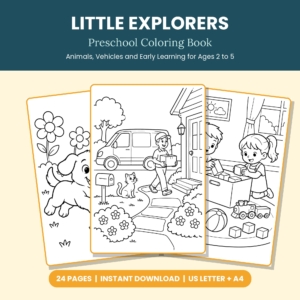
Little Explorers has 24 simple pages with thick outlines, split into Friendly Animals, Busy Vehicles and Early Learning. The animal pages include a garden puppy, a bunny picnic, an elephant at the pond and a duck family parade, while the learning pages cover counting, shapes, feelings and animal homes. You get US Letter and A4 PDFs plus 300 DPI PNGs. Pair the Animal Homes page with the Week 1 big question.
For three-year-olds, keep the talk part to five minutes and the do part to one task, like pointing to the duck’s beak. Short and happy beats long and thorough at this age.
Week 2: safari animals and simple geography
Safari animals open the door to a much bigger world. Lions, elephants, zebras and giraffes live a long way from most homes, which makes them a natural reason to look at a map or globe. Put a sticker on the grasslands of Africa, then color the animals that live there.
Week 2 activity ideas
- Size line. Cut out colored animals and line them up from smallest to biggest. Meerkat first, elephant last.
- Waterhole map. Draw a blue circle on a big sheet. Glue colored animals around it and talk about why they all need water.
- Pattern hunt. Compare the zebra’s stripes, the giraffe’s patches and the cheetah’s spots. Which would hide best in long grass?
Safari Animals Coloring Book
Price: $3.49 | Best for: kids learning about habitats
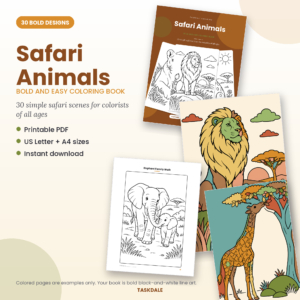
Safari Animals has 30 bold, easy scenes of grassland animals, such as Lion at Sunrise, Elephant Family Walk, Giraffe and Acacia, Zebra by the Waterhole, Hippo in the River and Playful Meerkat. Simple backgrounds show grass, rivers, trees and sky. It comes as US Letter and A4 PDFs, one design per page. Print Zebra by the Waterhole for the waterhole map activity.
Week 3: ocean animals and story time
Week 3 goes underwater, and it is a good week to bring in creative writing and storytelling. Ocean animals are already a little magical to children. Add a fantasy twist and they will invent stories without being asked.
Try this: after coloring, ask your child to give the main animal a name, a job and a problem. An octopus called Inky who runs a ferris wheel and has lost her ticket box is a story waiting to be told. Older children can write three sentences. Younger ones can tell it while you write it down at the bottom of the page.
Deep Sea Fun Fair Coloring Book
Price: $3.99 | Best for: kids who love stories and silly scenes
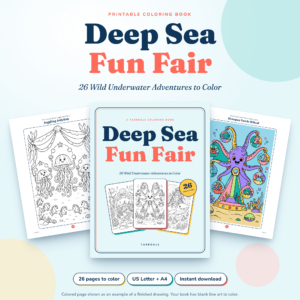
Deep Sea Fun Fair has 26 full-page scenes of an underwater carnival, including an octopus ferris wheel, juggling jellyfish and a hermit crab roller coaster. Each page has a title and caption to spark ideas. The download includes US Letter and A4 PDFs, single PNG pages and an illustrated user guide. Use Octopus Ferris Wheel for the name, job and problem story prompt.
Mix in a real science task too. Sort the sea creatures into fish and mammals. Dolphins and whales breathe air, which surprises most children and makes a great fact to share at dinner.
Week 4: woodland, night animals and nature journals
The last week suits older children well. Woodland and night animals like foxes, owls, hedgehogs and deer come with interesting habits: who sleeps in the day, who hunts at night, who curls into a ball. It is also a good week to start a nature journal, where children color an animal carefully and write two facts beside it.
Botanical Animals Coloring Book
Price: $3.49 | Best for: older kids who like detailed pages
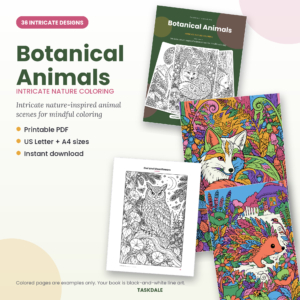
Botanical Animals blends creatures and plants across 36 detailed scenes, such as Fern Fox, Owl and Moonflowers, Hedgehog Garden and Stag in Wildflowers. The finer lines suit children around nine and up who want a challenge. It comes as US Letter and A4 PDFs. Use Owl and Moonflowers to talk about animals that come out at night.
For a younger sibling in the same lesson, print a simpler owl from a preschool set. Both children study the same animal at their own level, and nobody feels left out.
One lesson, start to finish
Here is how a single Week 2 lesson might run for a six-year-old on a Tuesday morning.
9:00, talk. You show the giraffe page and ask where giraffes live. Your child guesses the jungle. You find the grasslands of Africa on a map together and put a small sticker there. You read three facts: giraffes are the tallest land animals, they eat leaves from high branches, and their tongues are dark, which may help protect them from sunburn. That last one gets a big laugh.
9:10, color. Your child colors the giraffe while you color the acacia tree on your own copy. They ask why the tree is flat on top. You do not know, so you write the question on a sticky note to look up later. That is a real lesson in itself.
9:25, do. Your child labels the neck, legs and tongue, then writes one sentence: “The giraffe eats leaves.” The page goes in the binder.
9:35, done. Thirty-five minutes, one map sticker, three facts, one sentence and a question to chase tomorrow. Small, steady and genuinely satisfying for both of you.
Ideas for every school subject
An animal page can touch nearly every subject. Pick one idea per lesson for the do part.
Science
Sort animals into mammals, birds, fish, reptiles and insects. Talk about what each animal eats. Match animals to habitats.
Reading and writing
Label body parts: ear, tail, wing, fin. Make an animal alphabet, one colored page for each letter. Write one sentence per page, starting with “The fox can…”
Math
Count legs, spots or stripes. Add the legs of two animals together. Make a bar chart of the family’s favorite animals with colored squares.
Geography
Place colored animals on a world map. Talk about hot and cold places, forests and oceans.
Art
Try warm and cool colors, or color one animal in real colors and a second copy in made-up ones. Ask which one they like better and why.
Adjusting for different ages
| Age | Coloring page | Talk | Do |
|---|---|---|---|
| 3 to 4 | Big shapes, one animal | Name and sound | Point to body parts, count to five |
| 5 to 6 | Animal in a simple scene | Where it lives, what it eats | Label two parts, sort by habitat |
| 7 to 8 | Busier scenes | Three facts from a book | Write two sentences, make a chart |
| 9 to 11 | Detailed scenes | Research one question | Nature journal entry with facts |
Mixed-age families can run one lesson for everyone. Same animal, different page and different task. It saves you time and keeps siblings working side by side.
Keeping it fun, not school-at-the-kitchen-table
Home learning works best when it does not feel like school. A few simple habits help.
- Let them pick the colors. Facts are for the talk part. Color time is theirs.
- Stop before they are bored. If a five-year-old is fading at twenty minutes, finish there.
- Join in. Color your own copy. Children copy what adults do.
- Celebrate the binder. Every Friday, flip through My Animal Book together and pick a favorite page of the week.
- Take it outside. On sunny days, color on a blanket in the garden and look for real birds and bugs between pages.
For more printable sets to keep screen-free days easy, see our list of printable coloring books for kids. If your child is mad about birds, our guide to bird coloring pages makes a great bonus week.
Printing tips for a month of lessons
- Print one week at a time. Five pages on Sunday night is easy. Twenty at once is a chore.
- Print key pages twice. One to color, one to cut out for maps and size lines.
- Use card for cut-outs. It survives gluing and moving around.
- Print in black only. Grayscale saves colored ink for the bar charts.
- Keep a hole punch handy. Pages go straight into the binder.
Frequently asked questions
Is coloring really educational?
On its own it builds hand control and focus. Paired with a short talk and a small task, animal coloring pages become a gentle lesson in science, reading, math and geography.
What age is an animal coloring book good for?
Any age from about two upward. Choose bold, simple pages for preschoolers and detailed scenes for children around nine and older.
How long should a home coloring lesson take?
About thirty-five minutes for school-age children and fifteen to twenty for preschoolers. Stop early if attention fades.
Can I use a printable coloring book for homeschool?
Yes. Most printable books allow personal and family use, so you can print pages as often as your own children need. Check the product page for classroom use.
What if I do not know the answer to my child’s animal question?
Write it down and look it up together the next day. Showing how to find an answer is one of the most useful lessons a child can get.
How do I keep my child interested for a whole unit?
Change the animal group each week, let them choose colors freely, and build a binder they can show off at the end.
Your next step
This Sunday, print five farm or garden animal pages, set up a binder labeled My Animal Book, and run the first thirty-five-minute lesson on Monday. If you have a preschooler, download Little Explorers and start with the Animal Homes page.