Ask a dinosaur kid for their favorite and you will get a name, not a shrug. Stegosaurus. Spinosaurus. “Pachycephalosaurus, because it head-butts.” That is why free dinosaur coloring pages sorted by popular dinosaur species are so handy: you can go straight to the animal your child loves, check the page gets it right, and print.
This guide sorts the most popular species into five groups: the meat eaters, the horned and armored, the long-necks, the duck-bills, and the famous “not actually dinosaurs”. For each one you get the features a good page must show, one fact to read aloud, and a coloring idea. You will also see where free pages come from and when a full printable set saves time.
Quick picks for species-by-species coloring
| Product | Best for | Price | Link |
|---|---|---|---|
| Roar to Z Dinosaur Coloring Book A to Z with Names and Facts | 26 species with names, facts and say-it guides | $4.49 | View |
| Swish & Shade Digital Coloring Pages for Kids | Mess-free tablet coloring on trips | $4.99 | View |
| Easy Mandala Coloring Book | A calm page for the adult at the table | $3.49 | View |
Where free species pages come from
Free dinosaur pages turn up on big coloring sites, teacher resource sites and some museum and library activity pages. The big sites have the widest range of species but also the most ads and the most anatomy mistakes. Museum sheets are usually accurate but limited to a few animals. If your child wants a less famous species, such as Pachycephalosaurus or Maiasaura, expect to dig.
Before printing any free page, compare it with the “must show” notes below. A page that gets the key features wrong teaches the wrong thing, and dinosaur kids notice. For more on judging free pages across all themes, see our guide to coloring pages for kids.
The meat eaters
Tyrannosaurus rex
Must show: huge head, tiny two-fingered arms, thick tail held out behind, body roughly level rather than upright.
Fact to read: T. rex lived at the very end of the age of dinosaurs in what is now western North America and grew to about 12 meters long.
Coloring idea: dark back fading to a pale belly, the way many big hunters are colored today.
Velociraptor
Must show: feathers, a long stiff tail, a big curved claw on each foot. It should look bird-like.
Fact to read: Velociraptor was about the size of a large turkey and lived in what is now Mongolia and China.
Coloring idea: borrow the colors of a hawk or a pheasant, with barred or speckled feathers.
Spinosaurus
Must show: a tall sail along the back, a long narrow snout like a crocodile’s, short legs.
Fact to read: Spinosaurus lived in North Africa and is one of the longest meat-eating dinosaurs known. It spent a lot of time in and around water, catching fish.
Coloring idea: bold stripes or a bright pattern on the sail, like a display flag.
Allosaurus
Must show: a big head with small bony bumps above the eyes, three-fingered arms longer than a T. rex’s.
Fact to read: Allosaurus lived in the Late Jurassic, long before T. rex, and was about 8 to 9 meters long.
Coloring idea: sandy browns with dark blotches for a dry floodplain.
The horned and armored
Triceratops
Must show: three horns, two long above the eyes and one short on the nose, a big bony frill and a beak.
Fact to read: the name means “three-horned face”, and Triceratops lived at the same time and place as T. rex.
Coloring idea: a plain body with a bright, patterned frill.
Stegosaurus
Must show: two rows of tall plates along the back, four spikes on the end of the tail, a small head.
Fact to read: Stegosaurus lived in the Late Jurassic and had been gone for tens of millions of years before T. rex appeared.
Coloring idea: plates in a rainbow from neck to tail.
Ankylosaurus
Must show: a low, wide body covered in bony armor, and a heavy club at the end of the tail.
Fact to read: Ankylosaurus lived at the end of the Cretaceous in North America, alongside T. rex.
Coloring idea: lots of small armor sections, perfect for a patient child with sharp pencils.
Pachycephalosaurus
Must show: a thick, domed skull ringed with small knobs and spikes.
Fact to read: its name means “thick-headed lizard”. Scientists still debate how it used that dome.
Coloring idea: a bright dome with a darker ring of knobs.
The long-necks
Brachiosaurus
Must show: very long neck held high, front legs longer than back legs, a short tail compared with other long-necks.
Fact to read: Brachiosaurus means “arm lizard”, because of those long front legs.
Coloring idea: elephant grays and browns, with a tall tree beside it to show off the neck.
Diplodocus
Must show: a very long neck held more forward, and an even longer, whip-like tail.
Fact to read: Diplodocus lived in the Late Jurassic and could reach about 25 meters long, much of it tail.
Coloring idea: stripes running down the length of the tail.
The duck-bills
Parasaurolophus
Must show: a long, curved, hollow crest sweeping back from the head, and a duck-like bill.
Fact to read: scientists think the hollow crest may have helped it make loud, low sounds.
Coloring idea: a brightly colored crest, as if for showing off to others in the herd.
Maiasaura
Must show: a flat duck-like bill and, on the best pages, a nest with eggs or babies.
Fact to read: the name means “good mother lizard”. Fossil nesting sites with eggs and young were found in Montana.
Coloring idea: soft greens and browns for the parent, pale speckled eggs in the nest.
Famous, but not dinosaurs
Every dinosaur collection has a few gatecrashers. Kids love learning which ones, so it is worth getting right.
- Pteranodon. A flying reptile, a pterosaur, with a wingspan of around 6 meters in the largest. A close relative of dinosaurs, but not one.
- Mosasaurus. A giant sea reptile, more closely related to modern lizards and snakes than to dinosaurs.
- Plesiosaurs. Long-necked sea reptiles with flippers. Also not dinosaurs.
A good coloring book labels these clearly. If a free page calls Pteranodon a “flying dinosaur”, fix it with a pen before handing it over.
All the popular species in one printable book
Finding a free, accurate page for every species above takes a while. Some you will find in minutes. Maiasaura and Pachycephalosaurus might take an evening of scrolling. A single book that covers many species in one style, with names and facts already checked, is quicker.
Roar to Z covers 26 species from A to Z, including Ankylosaurus, Brachiosaurus, Diplodocus, Maiasaura, Parasaurolophus, Stegosaurus, Tyrannosaurus rex and Velociraptor. Its big-shape preschool section adds T. rex, Triceratops, Stegosaurus, Brachiosaurus, Spinosaurus, Ankylosaurus and Pteranodon, and the A to Z section clearly labels Quetzalcoatlus as a flying reptile rather than a dinosaur.
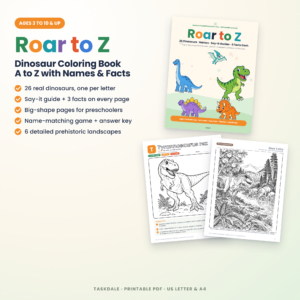
Roar to Z Dinosaur Coloring Book
Price: $4.49 | Best for: Kids with a favorite species
A printable PDF in US Letter and A4 with 26 A to Z species pages, each with the name in outline letters, a say-it guide, the name meaning and three checked facts, plus 8 big-shape preschool pages, a matching game, a timeline, a size chart and 26 fact cards. Use the clickable ABC chart to jump straight to your child’s favorite species and print that page first.
A color starter for each group
Children often freeze at the crayon box. Giving each group a loose “house palette” helps them start, and they can break the rules once they are going.
- Meat eaters: browns, olive greens and dark reds, with paler bellies.
- Horned and armored: earthy grays and tans, with one bright color for frills, plates or clubs.
- Long-necks: elephant grays, soft blues and stripes down the tail.
- Duck-bills: leafy greens and browns, with a bold crest.
- Not dinosaurs: sea blues for swimmers, sunset colors for flyers.
Nobody knows the real colors of most of these animals, so every palette is a fair guess. Tell your child that, and watch the pressure lift.
A species-of-the-week plan
Following the groups above makes an easy plan for a month or more.
| Week | Group | Activity |
|---|---|---|
| 1 | Meat eaters | Compare arm sizes: T. rex, Allosaurus, Velociraptor |
| 2 | Horned and armored | Count horns, plates and spikes on each page |
| 3 | Long-necks | Measure a Diplodocus with string in the garden |
| 4 | Duck-bills | Make crest sounds by humming through a paper tube |
| 5 | Not dinosaurs | Sort colored pages into “dinosaur” and “not dinosaur” piles |
Week five is often the favorite. Children feel very clever knowing that Pteranodon is not a dinosaur, and they will tell everyone. That is the point.
Sorting your printed pages at home
A pile of colored dinosaurs gets messy fast. Sorting them by group keeps the collection useful and turns tidying into another learning game.
- Five folders or binder sections, one per group, labeled with a simple drawing.
- A contents page at the front where the child writes each species as it is added.
- A “favorites” sleeve for the three pages they are proudest of.
- A “not dinosaurs” section at the back, which kids find very funny.
Dinosaur coloring on the go
Paper and crayons are not always practical. Long drives, flights and restaurant waits call for something tidier. Digital coloring on a tablet gives the same calm focus without crayons rolling under the seat, and it works offline once downloaded.

Swish and Shade Digital Coloring Pages for Kids
Price: $4.99 | Best for: Families who travel with a tablet
60 mess-free digital coloring pages as transparent PNG line art plus a hyperlinked PDF for GoodNotes, Notability and Xodo, in four sets: toddler, kids, detailed and a phone-shaped travel set. It works offline after download. Load it onto the tablet the night before a trip, alongside a few dinosaur pages saved as images, so there is variety on the road.
Prefer screens with a game element? Our roundup of online coloring games lists free picks for kids and adults.
Turn species pages into trading cards
Once a few species are colored, cut each dinosaur out with a little border and glue it to a piece of card about the size of a playing card. On the back, write three things: the name, the group (meat eater, horned, long-neck, duck-bill or not a dinosaur) and one fact. Add a made-up “power score” out of ten for fun.
Now you have a deck. Kids can sort it by group, quiz each other on facts, or play a simple top-trumps style game where the bigger score wins. A deck of 15 homemade cards can keep two siblings busy on a long car journey, and swapping cards with a friend at school is pure joy for a seven-year-old.
A grown-up page for the same table
Children settle faster when the adult beside them is coloring too. You do not have to pick a dinosaur. A bold, open mandala lets you relax while still being present, and it shows a child that coloring is something grown-ups enjoy, not just a way to keep kids quiet.
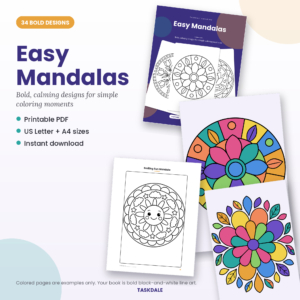
Easy Mandala Coloring Book
Price: $3.49 | Best for: Parents coloring beside their kids
34 bold mandalas with thick outlines and open spaces, as a printable PDF in US Letter and A4. Designs include a Petal Sun, Starburst and Butterfly Wings mandala, and the listing notes it suits parents and kids coloring together. Print one for yourself each time you print a dinosaur, and finish it in the same sitting.
Common mistakes on free species pages
- Stegosaurus with spikes everywhere. It had plates on the back and spikes only on the tail.
- Velociraptor without feathers. Modern evidence supports feathers.
- Triceratops with two horns. Count them. Three.
- T. rex standing upright like a person. Outdated. The body was roughly level.
- Every reptile called a dinosaur. Pteranodon and Mosasaurus were not.
Frequently asked questions
What are the most popular dinosaurs for kids?
T. rex, Triceratops, Stegosaurus, Velociraptor, Brachiosaurus and Spinosaurus are common favorites, with Ankylosaurus and Parasaurolophus close behind.
Is Pteranodon a dinosaur?
No. Pteranodon was a pterosaur, a flying reptile closely related to dinosaurs but not one.
How can I tell if a free dinosaur page is accurate?
Check the key features: three horns on Triceratops, back plates on Stegosaurus, feathers on Velociraptor and a level body on T. rex.
Where can I find coloring pages of less famous dinosaurs?
Museum activity pages and A to Z dinosaur books are your best bet, since big free sites focus on the famous few.
Which dinosaur had the longest tail?
Diplodocus is famous for its very long, whip-like tail, which made up a large part of its length.
Did T. rex and Stegosaurus ever meet?
No. Stegosaurus lived in the Late Jurassic and was long gone before T. rex appeared near the end of the Cretaceous.
Which dinosaur pages are best for a beginner?
Start with T. rex, Triceratops or Brachiosaurus. Their shapes are bold and easy to recognize, and there are few small parts to color.
Your next step
Ask your child to name their top three species, then check each free page against the “must show” notes before printing. Start a binder with five sections tonight. When the free search for Maiasaura gets tiring, the Roar to Z Dinosaur Coloring Book has it, and 25 more, ready to print.