Ask most people what their monthly expenses are and they will name rent, the car payment and maybe the phone bill. Then the real number turns out to be several hundred dollars higher. The difference hides in variable spending, quarterly bills, yearly renewals and the small purchases that never feel like “expenses” at all.
This guide is for anyone who wants an honest list of what their household costs to run each month. That number matters for everything: building a budget, sizing an emergency fund, deciding whether you can afford a new car, or simply understanding why money feels tight. You will get a five-step method for listing every expense, a full checklist you can work through, a worked example for a family of four, a way to turn yearly costs into monthly figures, and a light routine to keep tracking them.
Quick picks: tools for listing and tracking expenses
| Product | Best for | Price | Link |
|---|---|---|---|
| Hearthfolio Family Budget Planner | Monthly, quarterly and yearly bills in one file | $22.00 | View |
| Printable Grocery List Template Bundle | Tracking the grocery line shop by shop | $2.00 | View |
| Hollyfold Christmas Gift Tracker | Keeping holiday spending inside a budget | $1.99 | View |
The four kinds of monthly expenses
Not every expense behaves the same way. Sorting them into four kinds makes the list easier to build and far more accurate.
- Fixed. The same amount every month. Rent, a car loan, most subscriptions. Easy to list.
- Variable. Every month, but the amount changes. Groceries, fuel, electricity, eating out. You need an average.
- Periodic. Predictable, but not monthly. A quarterly water bill, twice-yearly car insurance, an annual membership. These need converting to a monthly figure.
- Occasional. Real costs that come up a few times a year at unpredictable moments. Car repairs, a new pair of glasses, a vet visit. You plan a monthly amount for these too.
Most people list the fixed ones and guess at a couple of variable ones. The periodic and occasional costs get forgotten, and they are usually the reason “we should have money left over” turns into “where did it go?”
How to list your monthly expenses in five steps
Step 1: Gather three months of statements
Checking account, savings account, every credit card. Three months gives you enough to see patterns without drowning in detail. Download them or print them, whichever you prefer to work with.
Step 2: Write down every outgoing payment
Every single one, with the amount and a short name. Yes, the $3.99 app charge. Yes, the $2.50 parking meter. You will group them in a moment. For now, just list.
Step 3: Group them into categories
Housing, utilities, food, transport, insurance, kids, health, personal, subscriptions, debt, giving, fun. Use whatever names make sense to you. Twelve to fifteen categories is usually enough.
Step 4: Average the variable ones
Add up three months of groceries and divide by three. Same for fuel, electricity, eating out. If one month had an unusual spike, like a holiday, note it but still include it. Unusual months happen more often than we expect.
Step 5: Convert periodic and occasional costs to monthly
Look back over the last year, not just three months, for anything that comes less than monthly. Add up the yearly total for each and divide by twelve. A $480 car registration becomes $40 a month. Car repairs that cost $900 last year become $75 a month.
When you are done, add every category together. That total is your true monthly cost of living. It is often a bit of a shock. It is also the most useful number in your financial life.
A monthly expenses checklist
Use this list to catch anything you missed. Not every line will apply to you.
Housing
- Rent or mortgage
- Property tax (if not included in the mortgage)
- Home or renters insurance
- HOA or building fees
- Repairs and maintenance
Utilities
- Electricity and gas
- Water, sewer and trash
- Internet
- Phones
Food
- Groceries
- Household supplies bought with groceries
- School and work lunches
- Eating out, takeaways, coffee
Transport
- Car payment or lease
- Car insurance
- Fuel or charging
- Registration, inspection, tolls, parking
- Servicing, tires, repairs
- Transit passes, rideshares
Family and personal
- Childcare and school costs
- Kids’ activities and allowances
- Pet food, vet, grooming
- Haircuts, toiletries, clothes
- Medical, dental, prescriptions
Money and future
- Loan and card payments
- Savings transfers
- Retirement contributions outside your paycheck
- Life insurance
Everything else
- Streaming, music, apps, cloud storage
- Gym and memberships
- Gifts: birthdays, holidays, weddings
- Charitable giving
- Hobbies and entertainment
- Travel
A worked example: the Lopez family
The Lopez family is two adults and two kids aged 6 and 10. They thought their monthly expenses were about $4,800. Here is what the five-step list actually showed.
| Category | Type | Monthly |
|---|---|---|
| Mortgage including tax and insurance | Fixed | $1,960 |
| Utilities, internet and phones | Variable | $420 |
| Groceries and household | Variable | $1,080 |
| Eating out | Variable | $260 |
| Car loan, insurance and fuel | Fixed and variable | $690 |
| Kids: activities, school, clothes | Variable | $310 |
| Subscriptions and memberships | Fixed | $95 |
| Car registration and servicing | Periodic | $85 |
| Home repairs | Occasional | $100 |
| Medical and dental | Occasional | $70 |
| Gifts and holidays | Periodic | $125 |
| Personal and pets | Variable | $180 |
| Total | $5,375 |
The real figure was $575 higher than their guess. Almost all of the gap came from four lines: groceries (they had guessed $800), car registration and servicing, home repairs and gifts. None of those were new. They just had never been written down as monthly costs.
The relief, oddly, came from seeing the bigger number. For two years they had felt like they were failing at money. It turned out the plan had simply been $575 too small every month.
How the list changes with your situation
The checklist above is broad on purpose. Your own list will lean heavily on a few sections depending on where you are in life.
- Renting alone. Housing and utilities often make up half the list, since rent, internet and power do not shrink for one person. Watch eating out, which tends to grow when nobody else is cooking.
- New parents. Childcare can become the second-biggest line overnight, followed by diapers, formula and a sudden jump in household supplies. Add a line for baby clothes that are outgrown every few months.
- Homeowners. Repairs and maintenance deserve a real monthly figure, not a hopeful one. Many owners set aside a small percentage of the home’s value each year, split into monthly amounts.
- Pet owners. Food is predictable. Vet bills are not. A monthly pet fund of even $30 softens the blow of a $400 visit.
If your list looks very different from your friends’ lists, that is normal. The point is that it matches your life, not anyone else’s.
Tracking expenses month to month
A one-time list is useful. A list you update every month is far more useful, because expenses change. Prices creep up, kids start new activities, a subscription sneaks in. Tracking means comparing each month’s actual spending with your list and adjusting the list when reality shifts.
A spreadsheet that already knows which bills come monthly, quarterly or yearly saves the most effort, because the periodic costs land on the right months without you remembering them.
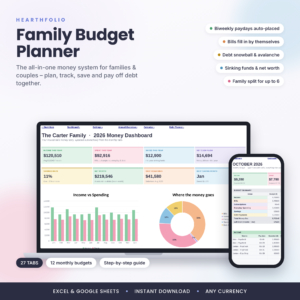
Hearthfolio Family Budget Planner
Price: $22.00 | Best for: families with many kinds of bills
Hearthfolio is a family budget spreadsheet for Excel and Google Sheets. Monthly, quarterly, twice-a-year and yearly bills and subscriptions fill in on the right months, sorted by due date, and paychecks land on their real dates. It includes a bill calendar, account tracking, debt payoff and sinking funds, works in any currency, and locks calculated cells so they are hard to break. Enter every bill from your list with its frequency, then log variable spending weekly.
For more habits that keep a household’s spending on track once the list exists, see our family budget planner habits.
Groceries: the expense that moves the most
In most households, groceries is the largest expense that can change quickly. Mortgage and insurance are fixed for a year. Food can swing by $200 a month depending on planning, waste and how many “just a few things” trips happen.
Tracking groceries shop by shop, rather than in one monthly total, gives you control while the month is still running. Write each shop’s total next to the date, keep a running total, and compare it with a quarter of the monthly budget at the end of each week. A written list, checked against what is already in the cupboard, is the simplest way to keep each shop on target.
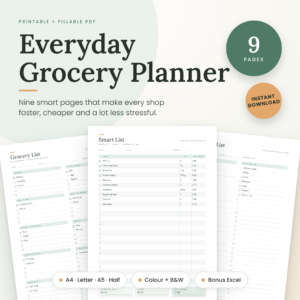
Printable Grocery List Template Bundle
Price: $2.00 | Best for: households tracking every grocery shop
This printable grocery planner has nine pages, fillable or printable, in A4, US Letter, A5 and Half Letter, each in a color and an ink-saver version. It includes a smart list with quantity, price and budget boxes, an aisle-by-aisle category list, a meal plan with shopping list, kitchen and household staples checklists, a price comparison sheet and a monthly budget tracker that logs each shop as planned against actual. Print the monthly tracker first and log every shop on it.
Seasonal expenses: the holidays
Some monthly expenses are really yearly ones in disguise, and holiday spending is the biggest of them. Gifts, food, travel, decorations, cards, a party or two. For many families it is one of the largest single costs of the year, and it all lands in November and December.
The fix is the same as for any periodic expense. Work out last year’s holiday total, divide by twelve, and set that aside every month. Then track December’s spending against it, person by person for gifts, so it does not quietly double. If you are not sure what a sensible amount per person looks like, our guide to how much to spend on Christmas gifts walks through a per-person budget.
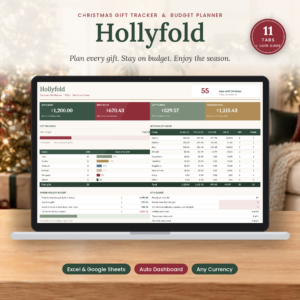
Hollyfold Christmas Gift Tracker
Price: $1.99 | Best for: families with a long gift list
Hollyfold is a Christmas gift tracker spreadsheet for Excel and Google Sheets. You add the people on your list, plan gifts and type what you paid, and the dashboard shows what you have spent, what is left and how close you are to being ready. It keeps a budget for each person, flags duplicate or repeat gifts, builds a shopping list and adds up wider holiday costs such as food, travel and decorations. Set a budget per person before you buy anything.
Spotting expenses you can trim
Once the full list is in front of you, cutting becomes much easier, because you can see the size of each line. A few places almost always have room:
- Subscriptions. List them all, cancel any you have not used in a month. Many families find $30 to $60 here.
- Insurance. Get a fresh quote at every renewal. Loyalty is rarely rewarded.
- Phones and internet. Plans change often. A ten-minute call can drop a bill by $20 a month.
- Eating out. Not cutting it to zero, just deciding on a number and planning around it.
- Groceries. Meal planning and a written list usually trim this more than any coupon.
Do not try to cut everything at once. Pick the two biggest opportunities, change them this month, and see what difference it makes. Small, visible wins keep you going.
A short monthly routine
- Total last month’s actual spending by category.
- Compare it with your expense list. Mark anything more than $25 off.
- Update the list if a cost has genuinely changed, like a price rise or a new activity.
- Check next month’s periodic costs. Is anything quarterly or yearly due? Is the money set aside?
- Write next month’s plan from the updated list.
Twenty minutes once a month. After three months, your expense list will be accurate to within a few dollars, and that accuracy is what makes every other money decision easier.
Frequently asked questions
What are typical monthly expenses for a household?
Housing, utilities, groceries, transport, insurance, phones and internet, childcare or school costs, debt payments, subscriptions, personal costs, and a share of yearly costs like gifts and car registration.
How do I calculate my monthly expenses?
List every payment from three months of statements, group them into categories, average the variable ones, and convert periodic and occasional costs to a monthly amount by dividing the yearly total by twelve.
How do I include yearly bills in monthly expenses?
Add up the yearly total for each bill and divide by twelve. Set that amount aside every month so the money is ready when the bill arrives.
Why are my monthly expenses higher than I thought?
Usually because periodic and occasional costs, like car repairs, gifts and annual renewals, were left out, and variable costs like groceries were guessed rather than averaged.
What is the difference between fixed and variable expenses?
Fixed expenses stay the same each month, like rent or a loan payment. Variable expenses change, like groceries, fuel and electricity, so you plan them from an average.
How often should I review my monthly expenses?
Compare actual spending with your list once a month, and do a full review of every line, including subscriptions and insurance, once a year.
Your next step
This week, download three months of statements and work through the five steps, using the checklist above to catch anything you missed. When your list is done, enter it into the Hearthfolio Family Budget Planner so every monthly, quarterly and yearly cost lands on the right month.