The water cycle is easier to remember when a child has colored it. Evaporation, condensation, precipitation and collection are four long words for a six-year-old. Four colors on a page are not.
This guide is for parents, grandparents and homeschool families who want to teach the water cycle at the kitchen table. You will get a simple color key, page ideas you can draw yourself for free, four printable books from Taskdale that fit the topic, small experiments to pair with them and a five-day plan you can start on Monday.
Quick picks for a water cycle week
| Product | Best for | Price | Link |
|---|---|---|---|
| Cloud Casters Printable Coloring Book | Clouds, rain and storms with a funny twist | $3.99 | View |
| Friendship Fun Coloring Book | Puddles, snow and everyday weather scenes | $2.99 | View |
| Indoor Activities Coloring Book Adventure | Rainy-day science and window garden pages | $2.99 | View |
| Ancient Forests: A Coloring Book of Timeless Wilds | Older kids and teens tracing water through a forest | $2.99 | View |
The water cycle in four colors
Give each stage of the cycle its own color and keep it the same all week. That one rule does most of the teaching for you. By Thursday, a child sees an orange arrow and says “that’s the sun pulling water up” without being asked.
Here is a key that works well with a basic box of crayons:
- Evaporation: orange. The sun warms the sea, a lake or a puddle, and water rises as vapor you cannot see. Orange arrows going up.
- Condensation: gray. The vapor cools high up and turns into tiny drops that make clouds. Gray clouds, getting darker as they fill.
- Precipitation: blue. The drops get heavy and fall as rain, snow or hail. Blue lines and dots coming down.
- Collection: green. Water gathers in rivers, lakes, the sea and under the ground, then the whole loop starts again. Green for the land it soaks into, or a second blue if your child prefers.
Write the key on a sticky note and put it on the fridge. A 7-year-old who has colored the same four colors five days in a row will remember the order long after the worksheet is gone. That is the small win you are after.
Free page ideas you can draw in five minutes
You do not need to buy anything to start. A sheet of printer paper, a pencil and a marker will give you the classic water cycle picture, and drawing it together is part of the lesson.
The big loop page
Draw a wavy sea along the bottom, a hill on one side, a sun in the top corner and two fat clouds. Add four arrows in a circle: up from the sea, across to the clouds, down as rain on the hill, and back along a river to the sea. Your child colors each arrow from the key. Ten minutes, start to finish.
The puddle diary page
Fold a sheet into three. In the first box, draw a puddle after rain. In the second, the same puddle at lunch, smaller. In the third, a dry patch with an orange arrow rising. This page teaches evaporation through something a child has stepped in that very morning.
The one-drop story page
Draw a single raindrop with a face. Older children write where the drop goes next: into a stream, up a tree root, into a cup of tea. It is silly, and it works. A drop called Pip who ends up in the bath is easier to remember than a textbook diagram.
Free printable diagrams are easy to find through a search, and many are fine. They tend to be the same flat picture, though, and children color them once and move on. For more ideas built around sea and river themes, our guide to water coloring book pages has plenty to try.
Clouds and storms that make kids laugh
Clouds are the hardest part of the cycle to picture. A child can see a puddle and feel rain, but vapor turning into a cloud happens far away and out of sight. A funny weather page brings it closer.
Ask questions while they color. Why is this cloud so dark? What is it holding? What happens when it gets too full? A child who answers “it’s going to rain because it’s heavy” has just explained precipitation in their own words.
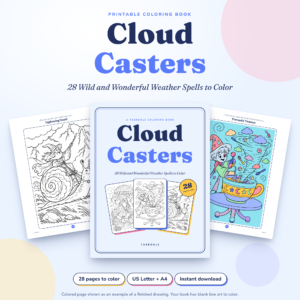
Cloud Casters Printable Coloring Book
Price: $3.99 | Best for: kids who love silly weather scenes
Cloud Casters has 28 full-page drawings of weather wizards at work: a tornado stirred in a teacup, a jellyfish umbrella that turns raindrops into music, a snail racing lightning. It comes as US Letter and A4 PDFs plus single-page PNG files, so you can reprint one favorite. Start with a rain page and ask your child to add the blue arrows from your color key.
Here is a simple add-on. After a weather page is colored, have your child draw a small orange arrow somewhere on it showing where that rain came from. A sea in the corner, a lake, a kettle. It turns a fun picture into a lesson without any fuss.
Puddles, umbrellas and snowy walks
Precipitation is the stage kids know best, because they get wet in it. Pages showing ordinary weather days connect the science to their own lives. A child who colors two friends splashing in a puddle will start pointing at real puddles on the way to school.
Snow is worth its own page. Many children do not know snow is part of the same cycle as rain. Show them: same blue color, just frozen. When it melts in spring, it runs into streams and the loop carries on.
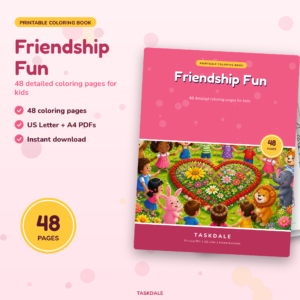
Friendship Fun Coloring Book
Price: $2.99 | Best for: ages 4 to 9 who like people scenes
Friendship Fun has 48 scenes of friends doing things together, each with a short, kind line at the top. Pages such as Umbrella Puddle Splash and Snowy Mitten Walk fit a water week perfectly. It downloads as US Letter and A4 PDFs for printing at home. Print the puddle page first and color it on a rainy morning.
After the puddle page, take a walk. Find a real puddle, mark its edge with a stick or a bit of chalk, and check it again after lunch. It shrinks. Your child just watched evaporation happen, and the coloring page from breakfast is the proof that they predicted it.
Kitchen experiments to pair with each page
Coloring explains the cycle. A small experiment shows it working. Put the two together and the idea sticks. Each of these takes under 15 minutes and uses things you already have.
The cloud in a jar
Pour a little hot water (adult job) into a glass jar. Put a plate of ice cubes on top. Within a minute or two, mist gathers under the plate and drops start to form. That is condensation. Your child colors a gray cloud on their page right after watching it.
The window bag
Put a few spoonfuls of water with a drop of blue food coloring into a zip bag. Draw the sun, a cloud and a sea on the bag with a marker, seal it and tape it to a sunny window. Over a day or two, drops form at the top and run down the sides. It is the whole cycle in a sandwich bag, and kids love checking it.
The melting snow cup
On a cold day, fill a cup with snow or crushed ice and mark the level. Check an hour later. Less in the cup, all of it water. Snow and rain are the same thing in different coats.
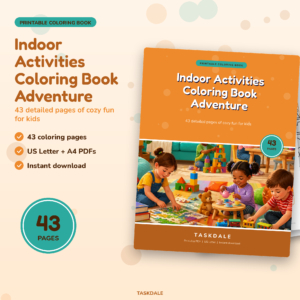
Indoor Activities Coloring Book Adventure
Price: $2.99 | Best for: rainy days stuck inside at home
Indoor Activities has 43 detailed scenes of things kids really do at home, including Science Fun, Window Garden, Cooking Help and Reading Nook. Print the Science Fun page to color while the jar experiment sits on the counter. It comes as separate US Letter and A4 PDFs with sharp, dark lines that are easy on ink.
Wet days are the best time for all of this. You cannot go outside, but the rain on the glass is the lesson.
Following water through a forest with older kids
Children from about 10 can handle the parts of the cycle that the simple picture skips. Water soaks into soil. Tree roots drink it up. Leaves let it go again as vapor, which is called transpiration. Springs bubble up from water stored underground.
A detailed forest scene is perfect for this. Ask an older child to color the stream blue, the roots and soil green, and then add tiny orange arrows rising from the leaves. They are tracing water through a whole landscape, and the page takes an hour, not five minutes. Teens and adults enjoy this one too.
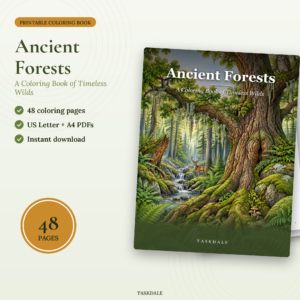
Ancient Forests Coloring Book
Price: $2.99 | Best for: teens and patient older kids
Ancient Forests has 48 full-page scenes of layered trees, roots and wildlife, including Deer at the Woodland Spring, Fern Cathedral and The Snowbound Old Grove. The detail suits older children, teens and adults rather than preschoolers. Pick a page with a stream or spring and use it to trace water from the ground, up the trees and back to the sky.
One more idea for this age: have them label the page with the four stage names in small, neat handwriting. Labels plus color make a great revision sheet before a science test.
A five-day water cycle plan
Here is a gentle week that fits around school runs and dinner. Each day takes 20 to 30 minutes.
- Monday: the big loop. Draw the free loop page together and stick the four-color key on the fridge.
- Tuesday: evaporation. Make the puddle diary page. Mark a real puddle or a wet saucer on the windowsill and check it twice.
- Wednesday: condensation. Do the cloud in a jar, then color a cloud or storm page.
- Thursday: precipitation. Color a rain or snow scene. Tape the window bag up for the weekend.
- Friday: collection and the whole loop. Color a river, lake or forest page, then ask your child to explain the cycle to someone else using all four colors.
Friday’s step matters most. When a child teaches Grandma the water cycle with a colored page in hand, you know it has landed. Expect a little pride. Let them enjoy it.
Want more pages that link coloring to science topics? Our guide to coloring worksheets for science covers plants, animals and weather with the same color-and-talk approach.
Mistakes that make the lesson slip away
Changing colors every day. If rain is blue on Monday and purple on Wednesday, the key stops working. Keep the four colors fixed for the whole week.
Starting with the words. “Precipitation” means nothing to a five-year-old. Start with rain. Add the long word on day three, once the picture is already in their head.
Too much detail too early. A preschooler handed a busy forest page will give up after one tree. Start young children on big, simple shapes, and save the detailed scenes for ages 9 and up.
Skipping the real world. A page with no puddle, jar or window to go with it is just a nice picture. Pair every page with one thing your child can see or touch.
Correcting the art. A pink cloud is still a cloud. Fix the science gently, never the coloring.
Printing and supply tips
Print at 100% or “Actual size” so the lines stay crisp. Plain printer paper is fine for crayons and pencils. If your child loves markers, use a heavier sheet and slip scrap paper under the page so ink does not bleed onto the table.
Blue is the color you will use most, so check you have a good one before Monday. A pale blue for sky, a darker one for rain and a sea, and a gray for clouds will cover most pages. A white crayon is handy too: press it hard before coloring the sky and it leaves raindrops showing through.
Keep the finished pages in order in a folder or a clear sleeve. Five colored pages, Monday to Friday, make a little water cycle book your child made themselves. For more sea and river themes, see our ocean coloring pages for kids and adults.
Frequently asked questions
What colors should I use for a water cycle coloring page?
Use one color per stage and keep it fixed: orange for evaporation, gray for condensation, blue for precipitation and green for collection. The same four colors every day help children remember the order.
What age can kids learn the water cycle?
Children as young as 4 can follow the simple loop of sun, cloud, rain and river. From about 7 they can learn the stage names, and from 10 they can add transpiration and groundwater.
Are there free water cycle coloring pages?
Yes. Free diagrams are easy to find online, and you can draw the big loop page yourself in five minutes. Free pages are great for one lesson. A printed book adds variety so the topic stays fun for a whole week.
How do I explain evaporation to a 5-year-old?
Show them. Leave a wet saucer on a sunny windowsill and check it after lunch. Tell them the sun lifted the water up into the air where we cannot see it, then color an orange arrow going up.
Can I color these pages on a tablet instead?
Yes. Printable PDFs can be imported into an annotation app such as GoodNotes or Notability. Paper still works better for the experiments, because a child can hold the page next to the jar.
Your next step
Tonight, write the four-color key on a sticky note and draw the big loop page. Tomorrow morning, print a rain scene from Cloud Casters, put the blue crayon on top and let your child start the week with a storm.