The best food plan for your goals and budget is the one built around two numbers you already know: what you want your food to do for you, and how much you can spend on it each week. Get those two straight and the rest is just filling in boxes.
Most people pick a plan backwards. They copy a diet from a video, buy a cart full of salmon and quinoa, and run out of money by Thursday. Or they pick the cheapest meals possible and wonder why they feel flat by 3 pm. Neither one lasts.
This guide is for anyone who wants a plan that fits real life: a parent feeding four on a tight wage, a student trying to eat more protein, someone cutting back after a big grocery month. You will set your numbers, match meals to your goal, see a worked week, and choose a planner format you will actually open again next Sunday.
Quick picks: planners that hold a food plan together
| Product | Best for | Price | Link |
|---|---|---|---|
| Pantry to Plate Meal Planner | Planning meals against a weekly food budget | $14.99 | View |
| Small Bites, Big Wins GLP-1 Meal Plan | Small appetites and protein-first meals | $6.99 | View |
| Fresh Week Meal Planner Printable Bundle | Pen-and-paper planners who like a fridge list | $2.99 | View |
| Daybloom Life Planner Spreadsheet | Food, bills and savings in one file | $2.00 | View |
Start with two numbers, not a diet
Write your goal in one plain line. Not “eat better.” Something you could check at the end of a month. “Spend under $500 on groceries in March.” “Get protein into every breakfast.” “Cook at home five nights a week instead of two.” A goal you can check is a goal you can plan for.
Then find your weekly food number. Open your bank app and add up what went to groceries, takeout and coffee runs over the last four weeks. Divide by four. That is your real starting point, and for a lot of people it is a shock. A family that thinks it spends $150 a week often finds it is closer to $210 once the Friday pizza and the school-morning drive-through are counted.
Pick a target a little below that real figure. If you spent $210, try $180, not $120. Cutting a third of the budget in one go is how plans break in week two. A $30 cut you can keep beats a $90 cut you abandon.
Write both numbers where you will see them
Top of the meal plan page, top of the spreadsheet, on a sticky note inside the cupboard door. When you are standing in the store deciding between the store-brand oats and the fancy granola, that number does the deciding for you.
Match the meals to what you want
Different goals need different plates. The budget is the fence; the goal decides what grows inside it. Here is how the most common goals shape a week.
Goal: spend less
Build the week around three or four cheap base foods you like: rice, oats, eggs, dried or canned beans, potatoes, frozen vegetables, a whole chicken. Plan two dinners that make leftovers on purpose. Cook a big pot of chili on Monday and it becomes Tuesday lunch and Thursday’s baked potato topping. Our guide to meal planning on a budget has eight more habits that shave the bill without making dinner sad.
Goal: lose weight
Plan the plate before the recipe. Half vegetables, a palm or two of protein, a fist of starch. Write snacks into the plan so they are chosen at 9 am, not grabbed at 4 pm. A simple food log for the first two weeks shows where the extra eating hides; for many people it is the hour after dinner.
Goal: more protein or more energy
Look at breakfast and lunch first. Dinner usually has protein already. A breakfast of toast and jam can become eggs on toast, or Greek yogurt with oats, for very little extra money. Canned tuna, eggs, cottage cheese, lentils and chicken thighs give the most protein per dollar in most stores.
Goal: smaller appetite, same nutrition
If you feel full fast, maybe because you are on a GLP-1 medication, the plan changes shape. Smaller plates, protein first, and four or five little meals instead of three big ones. Every bite has to earn its place, so ready-made ideas save a lot of guessing.

Small Bites, Big Wins GLP-1 Meal Plan
Price: $6.99 | Best for: people eating less who need protein
A 49-page printable in US Letter and A4 with 150 high-protein meal ideas, approximate protein and fiber on every recipe, a 206-item food list and a ready-made 4-week meal plan. It also has 13 tracker pages for water, protein, habits and progress. Start with the food list: circle what you already like, then build week one from those.
Goal: feed a family without three menus
Plan one base meal with build-your-own toppings. Taco night, rice bowls, baked potatoes, pasta with sauce on the side. The adult on a protein goal adds extra chicken; the picky seven-year-old has plain rice and cheese. Same pot, same shop, fewer fights.
A worked week: $120 for two adults
Numbers make this real, so here is one sample week. Two adults, both working, goal: eat more protein and stop the weekday takeout. Budget: $120.
| Day | Dinner | Next-day lunch |
|---|---|---|
| Monday | Sheet-pan chicken thighs, potatoes, green beans | Leftover chicken in wraps |
| Tuesday | Turkey chili (double batch) | Chili with rice |
| Wednesday | Egg fried rice with frozen peas | Tuna salad sandwiches |
| Thursday | Chili-topped baked potatoes | Lentil soup from the freezer |
| Friday | Homemade flatbread pizzas | Leftover pizza |
| Saturday | Pasta with meat sauce | Pasta bake |
| Sunday | Roast chicken with carrots | Chicken and rice bowls |
Breakfast is the same most days: oats with yogurt, or eggs and toast. Boring? A little. It also takes one line on the grocery list and costs a few dollars for the week. The rough split looks like this: about $45 on protein, $25 on starches and bread, $25 on fruit and vegetables, $15 on dairy and eggs, and $10 for oil, spices and a treat.
The trick sitting inside this week is overlap. Chili appears twice. Chicken appears three times. Rice turns up on Wednesday, Thursday and Sunday. Every ingredient bought gets used at least twice, which is where the money is really saved.
Spreadsheet, printable or all-in-one: pick your format
The plan only works if you open it again. So choose the format that suits how you already live, not how you wish you lived.
A spreadsheet that does the maths
Good for anyone who likes to see the total before leaving the house. You type the meals, the sheet adds up ingredients and tells you the bill. If your goal is money first, this is usually the strongest pick.
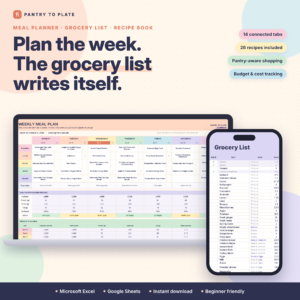
Pantry to Plate Meal Planner
Price: $14.99 | Best for: budget-first planners and batch cooks
An Excel and Google Sheets workbook with 14 tabs. You plan 7 days by 5 meal slots, and it builds the grocery list, subtracts what is already in your pantry, rounds to whole packs and prices the list against your weekly budget. It also totals calories, protein, carbs and fat per person per day. Set your budget on day one and plan one week before you shop.
A printable on the fridge
Good for households where more than one person needs to see the plan. A page on the fridge gets read by the teenager who would never open a spreadsheet. You can also write next to it: “we’re out of milk,” in shaky six-year-old handwriting.
One file for food and money together
Good if the food bill is part of a bigger money goal, like paying off a card. Seeing grocery spending next to rent and debt payments makes the choice at the store feel less abstract. If that sounds like you, our pick of the best budget spreadsheets for Excel and Google Sheets compares the options.
Mistakes that sink a food plan by week three
- Planning seven new recipes. New recipes take longer, need new spices and fail more often. Plan two new ones a week at most. The rest should be meals you could cook half asleep.
- Forgetting the busy night. If Wednesday is soccer practice until 7, do not plan a 45-minute stir fry. Plan leftovers, a freezer meal or eggs on toast, and call it a win.
- Shopping without checking the cupboard. Two minutes of looking saves buying the fourth jar of cumin.
- No plan for leftovers. Half a pot of soup with no job will sit there until Saturday and go in the trash. Give it a day on the plan.
- Treating one bad week as failure. You ordered pizza twice. Fine. Look at the budget line, adjust, plan again on Sunday.
If you want to see where the plan goes off track, a short food log helps. Our article on what a food journal template should include shows a simple layout that takes about a minute a meal.
A 20-minute weekly routine that keeps it running
Pick the same slot each week. Sunday after lunch works for a lot of people; Thursday evening suits anyone who shops on Friday. Then run through the same five steps.
- Look back (3 minutes). What did you spend last week? What got thrown out? What did everyone actually enjoy?
- Check the calendar (2 minutes). Late shifts, school events, a birthday dinner out. Mark the nights you will not cook.
- Shop the kitchen first (5 minutes). Open the fridge and freezer. Anything that needs using this week goes into the first two dinners.
- Fill the plan (7 minutes). Dinners first, then lunches made from dinners, then breakfasts and snacks.
- Write the list (3 minutes). Group by store section and add up a rough total. Over budget? Swap one meal for a cheaper one now, not at the till.
After four or five weeks you will have a little bank of plans that worked. Reuse them. Week one of March can be week one of February with two swaps. That is when planning stops feeling like homework.
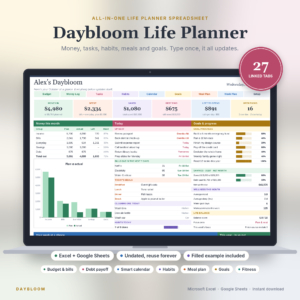
Daybloom Life Planner Spreadsheet
Price: $2.00 | Best for: tracking food alongside bills and savings
An undated Excel and Google Sheets planner with 27 linked tabs covering budget, bills, debt, habits, goals, a calendar and a meal planner. Choose Tuesday’s dinner and its ingredients go on your grocery list, while your spending flows through to the budget and dashboard. It comes with a filled example file, so open that first to see how the tabs connect.
Who a written food plan is not for
A full weekly plan is not for everyone, and that is okay. If you live alone, love cooking on a whim and your food spending is already where you want it, a written plan may just feel like admin. A short list of five go-to dinners and a stocked freezer might do the job.
It is also a poor fit for anyone following a medical diet set by a doctor or dietitian who has given them a specific plan. Use their plan. A planner can still help you shop for it, but it should not replace it.
And if planning food has started to feel stressful rather than helpful, step back to three planned dinners a week. Three is still better than none, and it leaves room to breathe.
Frequently asked questions
How much should I spend on food per week?
Start with what you spent over the last four weeks, divided by four, then aim about 10 to 15 percent lower. A target based on your real spending is far easier to hit than a number from someone else’s budget.
What is the cheapest healthy food plan?
One built on oats, eggs, beans, lentils, rice, potatoes, frozen vegetables, seasonal fruit and a few cheap cuts like chicken thighs. Plan leftovers on purpose and repeat breakfasts. Repetition is cheap.
Can I lose weight and save money with the same meal plan?
Yes. Fewer takeout meals and less snacking usually lowers both the bill and the portion sizes. Plan vegetables to fill half the plate, and keep protein steady with eggs, canned fish and legumes.
Is a meal planning app better than a template?
It depends on you. Apps often come with subscriptions and ads, while a spreadsheet or printable is a one-time download you keep. If you like to see costs before you shop, a spreadsheet that totals the list is hard to beat.
How long does meal planning take each week?
About 20 minutes once you have a routine. The first two weeks take longer, maybe 40 minutes, because you are building your list of go-to meals. After that you mostly reuse and swap.
Your next step
Tonight, find your real weekly food number from last month’s bank statement and write your goal in one line underneath it. Then plan just the next five dinners around both. If you want the sheet to price the list and check your pantry for you, start with the Pantry to Plate Meal Planner.