The first month of a new business is a strange mix. You feel brave and terrified on the same morning. There are a hundred jobs and no boss telling you which one comes first. So you either do everything at once, or you spend three weeks choosing fonts.
This guide to starting a business gives you a plan for the first 30 days, broken into four short weeks. Each week has one main job, a handful of tasks, and a clear finish line. It suits solo founders and side hustlers starting a service, a product business or an online shop, with a small budget and limited hours.
By day 30 you will have a clear offer, a price, your paperwork underway, a separate bank account, a simple way to track money and clients, and with any luck your first paying customer. That is a proper start.
Quick picks for your first month in business
| Product | Best for | Price | Link |
|---|---|---|---|
| Business HQ Undated Small Business Planner | Planning every part of the business on a tablet or paper | $3.95 | View |
| Keystone Business Hub | Clients, invoices and bookkeeping for service businesses | $6.99 | View |
| All-in-One Product Business Template | Makers who track stock, recipes and sales | $10.20 | View |
Before day one: decide what finished looks like
Thirty days will not build a finished business. Nobody’s first month does that. What it can do is turn an idea into something that exists, with a name, a price, a bank account and a first sale. Write that down as your finish line so you know when month one is done.
Then be honest about your hours. Someone with a full-time job might have six hours a week. Someone who just left a job might have forty. Neither is wrong, but the plan below shrinks or stretches to fit. A side hustler can take each “week” as two weeks and still be in great shape by the end of month two.
Last thing before you start: pick one notebook, planner or file for the whole month. Not five apps. One home for every decision. You will thank yourself on day 22 when you need the supplier’s name you wrote down on day 4.
Days 1 to 7: decide the offer and write it down
Week one is all about clarity. You are answering four questions on paper, in plain words.
- What exactly am I selling? Not “design services”. Something like “logo and brand kit for new cafes, delivered in 10 days”.
- Who is it for? One type of buyer. You can widen it later.
- What will I charge? A real number, based on your costs, your time and what similar sellers charge.
- Where will buyers find me? One or two places: a local Facebook group, a market, Etsy, word of mouth, LinkedIn.
Then write a one-page plan. It does not need to impress a bank. It needs to fit on one sheet and remind you what you decided. Our guide on how to write a business plan has a longer version for when you need one.
Spend the last day of the week on the name. Keep it short, easy to spell and free to use as a web address and social handle. Do not lose a week to it. A clear name you can say on the phone is enough.
A planner with prompts on every page helps here, because a blank page is the hardest thing to start with.
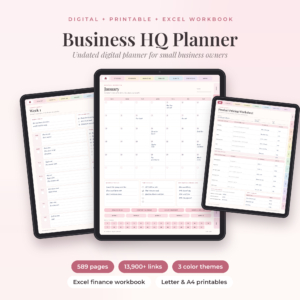
Business HQ Undated Small Business Planner
Price: $3.95 | Best for: new owners who like prompts
An undated, hyperlinked digital business planner for GoodNotes and similar apps, with printable US Letter and A4 versions and an Excel finance and pricing workbook. Every box has a short question under its title, and a Start Here page gives three paths for services, digital products and physical products. Begin with the strategy and pricing pages in week one, then use the daily pages for the rest of the month.
Days 8 to 14: make it official and separate the money
Week two is the paperwork week. It is not exciting. It is also the week that lets you sleep later, because the boring stuff is handled.
Choose a structure
Many small businesses start as a sole proprietorship because it is simple. Others form an LLC for the separation it offers. The right choice depends on your state, your risk and your tax picture. If you are unsure, a one-hour chat with an accountant is money well spent.
Register and check permits
Look up your state’s business registration page and your city or county website. Note what you need: a business name registration, a sales tax permit if you sell goods, a local business license, or a home business permit. Write each one down with its fee and how long it takes.
Open a separate bank account
This is the single most useful thing you will do in week two. Every business dollar in, every business dollar out, through one account. Tax time becomes far less painful, and you can see at a glance whether the business is paying its way.
Sort basic insurance
If you visit clients’ homes, handle food, give advice or hold stock, ask about liability cover. Get two quotes and read the exclusions. It takes an hour and might save the whole business one day.
Days 15 to 21: set up a simple back office
Week three is about systems. Small ones. You want a place to log money, a place to track clients and a way to send an invoice. That is the whole back office for a brand-new business.
- Money log: date, what, amount, category, in or out. Update it twice a week.
- Client list: name, contact, what they want, next step, date.
- Invoice template: your business name, the client’s details, an invoice number, what you did, the amount, and when it is due.
- Receipt folder: a physical envelope or a phone folder. Photograph every receipt the same day.
Keep it boring and keep it up to date. A plain spreadsheet you check on Tuesday and Friday is worth more than clever software you open once a month. A friend who started a cleaning round kept her first year’s books in one simple sheet. Her accountant said it was the tidiest set he had seen from a new client. She was quietly thrilled.
If you sell services, a linked workbook stops you typing the same client into three places.
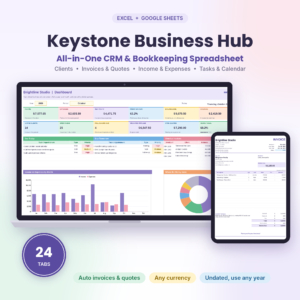
Keystone Business Hub
Price: $6.99 | Best for: new service businesses and freelancers
A 24-tab Excel and Google Sheets workbook that links a client CRM, quotes, invoices, income and expense logs, tasks and a month calendar. Record a payment and the invoice marks itself paid while the client balance and reports update. It also has a quarterly tax set-aside planner. In week three, enter your services and prices first, then add your first five contacts as leads.
Days 22 to 30: find your first customers
The last week is about money coming in. Everything so far has been preparation. Now you tell people.
Start with people who already know you
Write a list of 30 people: friends, former colleagues, neighbors, people from your gym or church. You are not asking them to buy. You are telling them what you now do and asking if they know anyone who needs it. Referrals from warm contacts are how most small businesses get their first five customers.
Show up where your buyers are
Post in one local group with a clear, friendly offer. Book one market stall. Message ten local businesses that fit your buyer. One channel done properly beats five done badly.
Make a launch offer
A small reason to act now helps. A founding client rate for the first five bookings. A free add-on for orders this month. Keep it simple and set an end date.
Ask every first customer for feedback
Two questions: what made you say yes, and what nearly stopped you? Their answers will shape your next month more than any plan.
If you sell physical products
Product businesses have one extra job in month one: knowing what each item really costs. Materials, packaging, fees and your time add up quickly, and many makers find out in month three that their bestseller barely breaks even.
Take a soap maker selling bars at $9. Oils, lye, fragrance, wrap and label might come to $2.80 a bar. Market fees, card fees and a share of her equipment add another $1.20. If each batch of 12 bars takes 90 minutes including cutting and wrapping, and she wants $20 an hour, that is $2.50 a bar for her time. Her true cost is $6.50, leaving $2.50 of profit per bar. Fine, but not the $6 she assumed.
Track stock from day one, too. Count what you have, log what you buy and log what you sell. It sounds tedious and takes five minutes a day.

All-in-One Product Business Template
Price: $10.20 | Best for: makers selling physical products
A single Excel file with 24 tabs for people who buy materials, make products and sell them. Purchases bring materials in, Production uses your recipes to turn them into finished goods, and Sales deduct stock and show true profit on every line. It includes low stock alerts, a printable invoice and receivables sorted by age. Use the Start Here tab, then set up your recipes before logging any sales.
A 20-minute daily routine for month one
A routine stops the month from swallowing you. Try this every working day, ideally at the same time.
- 5 minutes: check messages from buyers and reply to anything urgent.
- 5 minutes: log any money in or out and snap receipts.
- 10 minutes: pick the one task from this week’s plan that moves you closest to the finish line, and start it.
That last ten minutes is the important part. It is often the start of a longer session, because starting is the hard bit. Once you are in, you keep going.
What to skip in the first 30 days
Some jobs feel productive but can wait. Saying no to them frees hours for the work that brings in money.
- A custom website. A simple page, a social profile or a marketplace shop is enough to start.
- Expensive branding. A clean name and a simple logo will do for now.
- Business cards by the thousand. Order 50 if you must. Your details may change.
- Paid ads. Wait until you know what your buyers respond to.
- Every social platform. Pick one. Do it well.
- Big stock orders. Buy small and reorder what sells.
Our guide to setting up a home business without wasting money covers more of the spending traps.
Your day 30 review
On day 30, sit down for an hour with a coffee and answer five questions in writing.
- What did I set out to finish, and did I finish it?
- How much money came in and went out?
- Who were my first customers, and how did they find me?
- What took longer than expected?
- What is the one goal for month two?
Then take a moment. You started a business. A month ago it was an idea in your head. Now it has a name, a bank account and customers. That deserves more than a shrug.
Frequently asked questions
What should I do first when starting a business?
Decide exactly what you are selling, to whom, and at what price. Everything else, from the name to the bank account, is easier once those three are clear.
How long does it take to start a small business?
The basics can be in place within a month for a simple service or online shop. Registrations and permits in some areas take longer, so start them early.
Do I need a business plan to start?
You need a plan, but not a long one. A single page with your offer, buyer, price, costs and first goals is enough to start. Lenders and investors will ask for more.
Should I open a business bank account right away?
Yes, as soon as your business is set up enough to open one. Keeping business money separate makes bookkeeping and tax far simpler.
Can I start a business while working full time?
Many people do. Stretch the 30-day plan to 60 days and protect a few fixed hours each week for the business.
How do I get my first customer?
Tell the people you already know what you now offer and ask for referrals. Most first customers come from warm contacts, not ads.
Your next step
Today, write your four week-one answers on a single page: what you sell, who it is for, the price, and where buyers will find you. If you want prompts for every part of the business in one place, the Business HQ Undated Small Business Planner walks you through it page by page.