Running a small business has a thousand moving parts, but three of them carry most of the weight. You need a plan, so you know where you are going. You need a price that leaves you money after the costs. And you need people to hear about you. Get those three right and most other problems shrink.
This guide covers small business basics for owners in their first year or two, and for anyone who has been running on instinct and wants a bit more order. You will see how to write a one-page plan, how to work out your true costs and set a price, how to pick promotion channels you can keep up, and how to track what is working. There are worked examples throughout.
No business degree needed. If you can fill in a form and add up a column, you can do all of it.
Quick picks for planning, pricing and tracking
| Product | Best for | Price | Link |
|---|---|---|---|
| Business HQ Undated Small Business Planner | Planning, pricing worksheets and marketing pages | $3.95 | View |
| Small Business Command Center Spreadsheet Bundle | Seeing sales by channel and key numbers | $9.99 | View |
| Small Business Bookkeeping Spreadsheet Bundle Plan | Simple books, invoices and tax set-aside | $3.00 | View |
The three basics, and why the order matters
Plan, price, promote. The order is not random. Each one depends on the step before it.
If you promote before you have a plan, you end up shouting at everyone and reaching no one. If you promote before your price is right, every new customer can make you poorer. Picture a mobile car detailer who gets a flood of bookings from a Facebook post, then realizes after the first month that fuel and products ate most of the money. Busy and broke is a miserable place to be.
So start with the plan. Then fix the price. Then turn up the volume. You can loop back as you learn, and you will, but that first pass in order saves a lot of pain.
Plan: write your business on one page
A one-page plan is not a document for a bank. It is a note to yourself that answers the questions you will face every week. Keep it short enough to stick on the wall above your desk.
- What I sell: one or two sentences, specific. “Weekday dog walks for busy households, 30 or 60 minutes, small groups of three dogs max.”
- Who it is for: the main buyer. “Working couples within two miles of the park, with medium or small dogs.”
- Why me: what makes you the easy choice. “Same walker every day, photo update after every walk.”
- How they find me: your one or two main channels.
- What it costs to run: your monthly costs, roughly.
- What I want this year: one money goal and one other goal.
Maya, a dog walker, wrote hers in 40 minutes on a Sunday. She said the hardest part was the “why me” line, because she had never thought about it. Once she wrote “photo update after every walk” she realized it was the thing clients mentioned most. It went straight into her promotion.
Plan: choose three numbers to watch
A plan needs a scoreboard. You do not need twenty metrics. Three numbers, checked monthly, tell you most of what you need to know.
- Revenue: total money in from sales.
- Profit: what is left after all costs, including the small ones.
- Customers: how many paid you this month, and how many were new.
Write a target for each next to your one-page plan. Maya chose $3,200 revenue, $2,200 profit and 18 regular clients by June. Each month she writes the real numbers next to the targets. Seeing the gap shrink month by month is a real boost on the cold, rainy walking days.
A planner with prompts for each of these pieces makes the first draft much easier than a blank notebook.
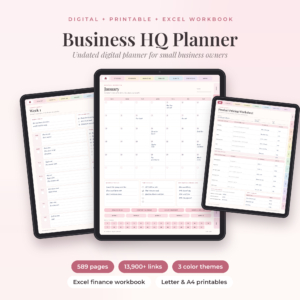
Business HQ Undated Small Business Planner
Price: $3.95 | Best for: owners who want plan and price in one
An undated hyperlinked digital business planner for GoodNotes and similar apps, with printable US Letter and A4 versions and an Excel finance and pricing workbook. It has sections for strategy, products, pricing, marketing, money and clients, and every box carries a short question so you know what to write. There is a step-by-step pricing worksheet with a filled-in example. Start with the strategy pages, then work through the pricing worksheet for your main product or service.
Price: work out what it really costs you
Most small business owners underprice. Not because they are bad at math, but because the small costs hide. A price that ignores them looks fine on a busy week and falls apart at year end.
For a service
Start with what you want to earn per hour, then add your costs. Say a house cleaner wants $25 an hour for her time. Each three-hour clean also uses about $6 of supplies and $8 of fuel, and her monthly costs (insurance, phone, booking app, equipment wear) come to $300, spread over about 60 cleans a month, so $5 a clean. Her cost for one three-hour clean is $75 time plus $6 plus $8 plus $5, so $94. Pricing at $90 would mean working for less than she planned. Pricing at $110 leaves room for quiet weeks and tax.
For a product
Add materials, packaging, selling fees, a share of overhead and your time per item. A candle with $3.10 of wax, wick, jar and fragrance, $0.60 of packaging, $1.20 of fees and $1.50 of labor costs $6.40 to make and sell. If you want a healthy margin, it probably needs to sell for $14 to $16, not the $9 that “feels” right.
Write these cost breakdowns down once. Update them when supplier prices change. It is one of the most useful pages in any business.
Price: three ways to set the number
Once you know your cost, you have a floor. Now you choose where above the floor to sit. There are three common ways to decide.
- Cost-plus: take your cost and add a markup. Simple and safe, but it ignores what buyers would happily pay.
- Market-based: look at five similar sellers and place yourself among them. Good for checking you are not wildly off.
- Value-based: price on what the result is worth to the buyer. A wedding cake is not priced like a loaf of bread, even if the flour costs are close.
Most owners blend all three. Use cost to set the floor, the market to sanity-check, and value to decide whether you can sit at the top of the range. If your service saves a busy family four hours a week, that time is worth a lot to them.
When to raise prices
Signs it is time: you are booked solid, nobody ever says your price is too high, or your costs have gone up. Give existing customers notice, explain briefly, and raise in sensible steps. Most will stay. The few who leave often free up space for better-fitting clients.
Promote: pick one or two channels and do them well
Promotion is where small owners burn out fastest, because there are endless options. Instagram, TikTok, Facebook groups, flyers, Google, local events, email, partnerships. Doing all of them badly is worse than doing two well.
To choose, ask where your buyers already spend time and what they trust. A few examples:
- Local home services: a Google business profile, local Facebook groups and word of mouth.
- Makers and gift sellers: markets, Instagram and an email list of past buyers.
- Consultants and bookkeepers: LinkedIn, referrals from accountants or lawyers, and a short monthly email.
- Online shops: Pinterest, a marketplace like Etsy, and email.
Pick two. Commit for three months. Then look at where customers actually came from and adjust.
Promote: a weekly routine you can keep
Consistency beats bursts. Three posts a week for six months will do more than thirty posts in one excited week followed by silence. Here is a plain routine for about two hours a week.
- Monday, 30 minutes: plan the week’s posts or emails. Three ideas: a tip, a behind-the-scenes moment, a customer result.
- Tuesday and Thursday, 20 minutes each: post and reply to comments.
- Wednesday, 20 minutes: ask one happy customer for a review or referral.
- Friday, 30 minutes: note what got responses and where new inquiries came from.
A simple content calendar keeps this from becoming a daily scramble. Our guide to the social media content calendar template shows a layout you can copy.
Do not forget the oldest channel: asking. A short message to past customers saying “I have two openings next month” often fills them faster than any post.
Track what is actually bringing in sales
Promotion only gets smarter if you know where sales come from. Ask every new customer, “How did you hear about us?” and write the answer down. Tag every sale with a channel: market, Instagram, referral, website.
After three months, patterns appear. Maybe Instagram gets lots of likes but only two sales, while referrals bring in eleven. That tells you where the next three months of effort should go. Many owners are surprised by what they find. The channel that feels busiest is often not the one paying the bills.
A workbook that tags sales by channel and shows key numbers on a dashboard does this sorting for you.

Small Business Command Center
Price: $9.99 | Best for: owners who want numbers at a glance
An Excel and Google Sheets bundle where you log sales on one tab and costs on another, and it builds an executive dashboard with KPI cards and live charts. The sales tracker tags every order by channel and flags unpaid ones, and there is a cash flow forecast, a tax estimator, a KPI scorecard and a scenario planner for worst, expected and best cases. Log last month’s sales with channels first, then check which source led.
Keep simple books from the first sale
Books sound like a fourth basic, but they are really the foundation under the other three. Your plan needs real numbers. Your price needs real costs. Your promotion needs to know which sales came from where. All of it lives in your books.
Keep it simple: one log for money in, one for money out, each with a date, amount and category. Add an invoice list so you know who owes you. Set aside a share of every payment for tax in a separate account. Update twice a week and it never gets scary. Our roundup of the best bookkeeping spreadsheets for small business compares a few options.
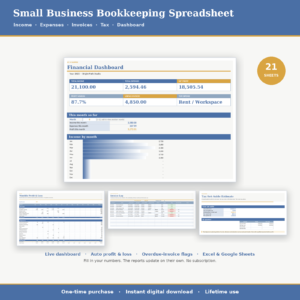
Small Business Bookkeeping Spreadsheet Bundle Plan
Price: $3.00 | Best for: owners avoiding monthly software fees
A bookkeeping spreadsheet built on three simple sheets: money in, money out and transfers. Your entries feed a running register, monthly profit and loss, category breakdowns, an invoice tracker that shows days overdue, a tax estimate sheet and a dashboard. It opens with a sample business filled in so you can see how it works. Clear the example rows, then enter this month’s income and costs.
Common mistakes with each basic
Planning mistakes
Writing a 30-page plan and never reading it again. Setting ten goals. Leaving out your own wage. A short plan you check monthly beats a long one in a drawer.
Pricing mistakes
Copying the cheapest competitor. Forgetting fees and travel. Never raising prices, even as costs climb. Giving discounts to everyone who asks.
Promotion mistakes
Trying every platform at once. Posting only sales pitches. Stopping after three weeks because nothing happened yet. Not asking happy customers for reviews.
Frequently asked questions
What are the basics of running a small business?
A clear plan, prices that cover your true costs with profit left over, a steady way to reach customers, and simple books so you can see how it is all going.
How do I price my products as a beginner?
Add up materials, packaging, fees, a share of overheads and your time per item. That is your floor. Then compare with similar sellers and price where your quality and service sit.
What is the cheapest way to promote a small business?
Word of mouth, a free business profile on search and maps, local groups and asking past customers for referrals. They cost time, not money.
How often should I review my business plan?
Check your three key numbers monthly and update the whole page every quarter.
Do I need bookkeeping software for a small business?
Not always. Many small businesses do well with a good spreadsheet, as long as it is updated regularly and keeps income, expenses and invoices in one place.
Your next step
This week, write your one-page plan and work out the true cost of your main product or service. Only then decide on your two promotion channels. If you want prompts and a pricing worksheet to guide you, start with the Business HQ Undated Small Business Planner.